Showing posts with label usb. Show all posts

Friday, July 3, 2026

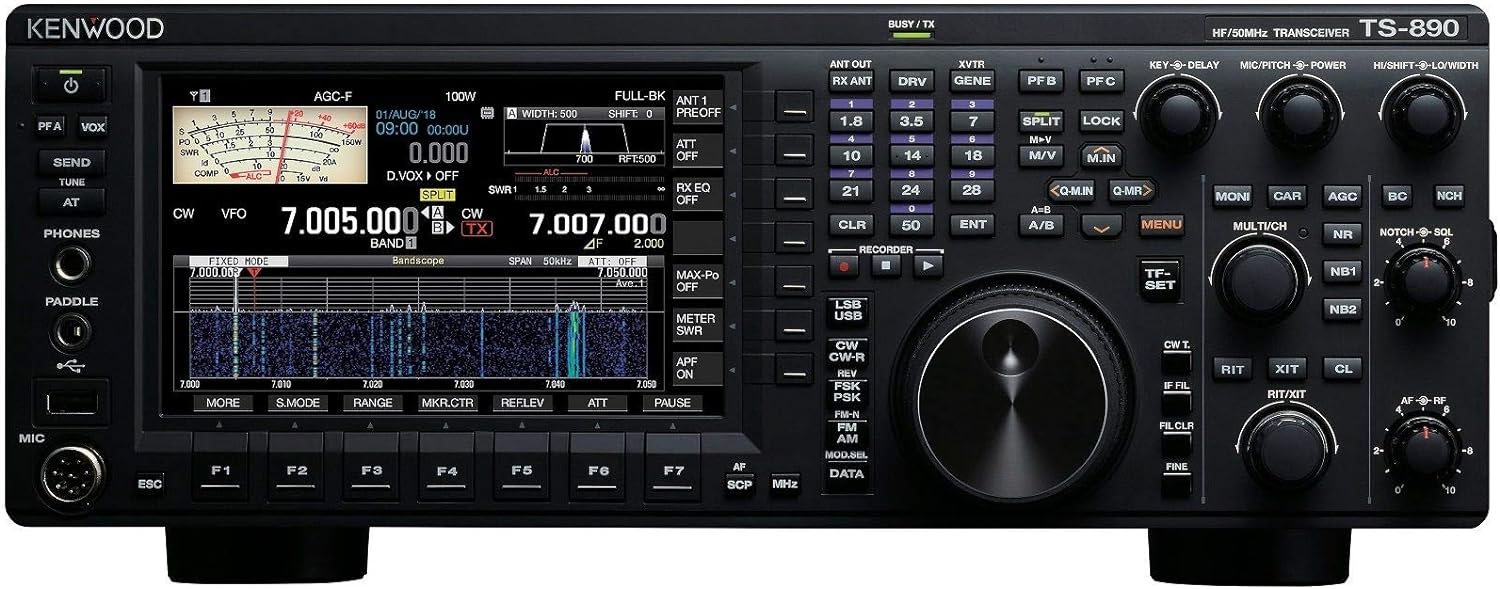
Kenwood TS-890S 100W HF/50MHz Transceiver with Advanced DSP Review


The Kenwood TS-890S is widely regarded as one of the finest HF transceivers ever produced by Kenwood. Designed for serious amateur radio operators who demand exceptional receiver performance, outstanding transmit audio, and intuitive operation, the TS-890S represents a premium-class transceiver that competes directly with other flagship radios from Yaesu, Icom, FlexRadio, and Elecraft.

Rather than trying to include every possible feature, Kenwood focused on what matters most to HF enthusiasts: building one of the cleanest, quietest, and most enjoyable receivers available. The result is a radio that excels during long operating sessions, crowded contest weekends, DX pileups, and everyday ragchewing.

Whether you enjoy DX chasing, contesting, digital modes, CW, or casual HF operation, the TS-890S has been engineered to deliver outstanding performance.


First Impressions

The first thing you'll notice about the TS-890S is its substantial build quality. This is not a lightweight portable transceiver. Weighing nearly 35 pounds, it feels like professional communications equipment rather than consumer electronics.

The front panel is thoughtfully arranged with numerous dedicated controls, minimizing the need to dive into menus. Every knob has a solid feel, and the overall layout makes it easy to operate without constantly looking through software menus.

The large 7-inch color display provides excellent visibility while displaying:

  • Band scope
  • Waterfall display
  • Audio spectrum
  • Filter settings
  • Operating frequency
  • Signal strength
  • Meter functions
  • Operating mode
  • DSP status

The display remains easy to read from several feet away.


Frequency Coverage

The TS-890S covers:

  • 160 meters
  • 80 meters
  • 60 meters
  • 40 meters
  • 30 meters
  • 20 meters
  • 17 meters
  • 15 meters
  • 12 meters
  • 10 meters
  • 6 meters

Receive coverage extends well beyond the amateur bands, allowing monitoring from longwave through HF and into 50 MHz continuous coverage. It supports SSB, CW, AM, FM, FSK, and PSK modes.


Receiver Performance

The receiver is unquestionably the highlight of this radio.

Kenwood designed the TS-890S around receiver performance first rather than simply adding SDR technology.

Some of its most important design features include:

These components work together to produce one of the cleanest receivers available.


Outstanding Dynamic Range

Dynamic range determines how well a receiver handles strong nearby signals without becoming overloaded.

During contests or DX pileups, dozens of powerful stations may be transmitting only a few kilohertz apart.

Many radios begin producing distortion or intermodulation under these conditions.

The TS-890S remains remarkably clean.

Weak stations remain readable even when surrounded by powerful nearby signals.

This makes a tremendous difference during:

  • CW contests
  • SSB contests
  • DXpeditions
  • Multi-operator events
  • Crowded evening bands

Roofing Filters

One of the defining features of the TS-890S is its roofing filter system.

Built-in roofing filters include:

  • 500 Hz
  • 2.7 kHz
  • 6 kHz
  • 15 kHz

An optional 270 Hz crystal filter is available for dedicated CW operators. These filters help reject strong adjacent signals before DSP processing, improving receiver performance in demanding conditions.


DSP Performance

Kenwood's Advanced DSP system performs nearly every stage of receive and transmit processing.

DSP features include:

  • Noise reduction
  • Auto notch filter
  • Manual notch
  • Beat cancellation
  • Variable IF filters
  • Adjustable bandwidth
  • Noise blanker
  • Digital AGC
  • Audio equalization

The receiver has a smooth, natural sound that many operators find less fatiguing during extended listening sessions.


Transmitter Performance

The transmitter delivers a full 100 watts on HF and 6 meters.

Transmit audio is exceptionally clean.

Microphone equalization allows extensive customization of audio characteristics.

Whether operating:

the TS-890S consistently produces high-quality transmitted audio.


Built-In Automatic Antenna Tuner

The integrated antenna tuner operates quickly and handles moderate impedance mismatches with ease.

Advantages include:

For resonant antennas, tuning is nearly instantaneous.


Band Scope and Waterfall

The large spectrum scope is one of the best features of the radio.

The high-speed FFT band scope allows operators to:

The waterfall display is crisp, smooth, and responsive, making weak signals easier to identify.


Ergonomics

Kenwood has long been praised for producing radios that are comfortable to operate.

The TS-890S continues that tradition.

Nearly every commonly used function has its own physical control.

Large tuning knob.

Smooth encoder.

Dedicated buttons.

Excellent spacing.

Minimal menu dependence.

This results in a radio that feels intuitive after only a short period of use.


Digital Mode Support

Modern digital operators will appreciate:

  • USB audio interface
  • USB CAT control
  • DATA mode
  • LAN interface
  • Easy integration with logging software

The TS-890S works well with popular digital applications without requiring an external sound card.


CW Performance

CW operators are among the biggest fans of this radio.

Features include:

  • Adjustable sidetone
  • Full break-in operation
  • Semi break-in
  • Digital filters
  • Narrow bandwidth
  • Excellent AGC
  • Optional 270 Hz roofing filter

Weak CW signals remain surprisingly readable.


Contest Performance

Contest operators demand three things:

The TS-890S excels in all three.

Even during extremely crowded contests, the receiver maintains clarity.

The fast spectrum scope allows rapid search-and-pounce operation.

Split operation is also very well implemented.


DX Performance

DXers will appreciate:

The radio is clearly designed with DX enthusiasts in mind.


Build Quality

Build quality is exceptional.

Everything feels premium.

The knobs are solid.

The switches have positive feedback.

The display is bright.

Cooling is effective.

Overall construction inspires confidence that the radio is built for years of operation.


Advantages

  • Outstanding receiver performance
  • Excellent dynamic range
  • Premium construction
  • Superb transmit audio
  • Large color display
  • Excellent waterfall
  • Outstanding ergonomics
  • Fast antenna tuner
  • Excellent CW performance
  • Strong contest capabilities
  • Outstanding DX performance
  • USB digital mode support
  • Smooth tuning
  • Excellent filtering

Disadvantages

No radio is perfect.

Potential drawbacks include:

  • Premium price
  • Heavy weight
  • Single receiver (operators wanting true dual independent receivers may prefer other flagship models)
  • Large desk footprint
  • Optional accessories increase overall cost

Some operators also feel that the noise reduction system is not quite as aggressive as those found in certain competing flagship radios, although the overall receiver audio quality remains outstanding.


Who Should Buy the TS-890S?

The Kenwood TS-890S is ideal for:

It may be more than a casual operator needs, but for those who spend significant time on the HF bands, its receiver performance and operating experience can justify the investment.


Final Verdict

The Kenwood TS-890S stands among the best premium HF transceivers available. Its exceptional receiver design, advanced DSP, intuitive front panel, beautiful display, and robust construction make it a pleasure to operate. Rather than relying solely on flashy features, Kenwood concentrated on the fundamentals that matter most on the air: hearing weak stations clearly, handling crowded bands gracefully, and providing an interface that keeps the operator focused on making contacts.

For amateur radio operators seeking a top-tier 100-watt HF/50 MHz transceiver with outstanding receive performance and a refined operating experience, the TS-890S remains an excellent choice that continues to earn high praise years after its introduction.

See The Kenwood TS-890S On Amazon!

Friday, February 20, 2026

Retevis Ailunce HS4 10 Meter Radio – In-Depth Review


The Retevis Ailunce HS4 10 Meter Radio is a feature-packed amateur transceiver designed for serious ham radio operators who want robust performance on the 10 meter band. It combines high power output, multiple operating modes, advanced signal-processing features, and protective functions into a solid base-station and mobile platform. In this in-depth review, we’ll explore every facet of this radio — from build quality and features to performance, usability, and who it’s best suited for.


Overview and Purpose

The Ailunce HS4 is a high-power 10 meter amateur radio transceiver engineered for CW, SSB, AM, FM, and PA mode operation. Its versatile mode support makes it suitable for a wide range of communication styles — from contesting and long-distance DXing in SSB and CW to casual contacts on FM and AM. With power ratings up to 100 watts and smart features like noise reduction and SWR protection, the HS4 aims to bridge the gap between entry-level rigs and more expensive base stations.


Build Quality and Design

Right out of the box, the HS4 feels solid and well constructed. The chassis is rugged metal, giving it durability for both base station use and in-vehicle mounting. The front panel is straightforward, with a clear display, tactile buttons, and an intuitive knob layout. The display provides frequency readout, mode indicators, signal strength, and other operational parameters at a glance.

The ergonomics avoid unnecessary complexity. Larger knobs for volume and tuning, coupled with well-spaced buttons, make adjustments easy even in the heat of operation. The menu system is logical, and while there’s a learning curve for beginners, active operators will appreciate the thoughtful control placement.


Operating Modes and Flexibility

One of the strongest points of the HS4 is its broad mode support:

  • CW (Continuous Wave): Excellent for Morse code operators with good stability and responsiveness.

  • SSB (Single Side Band): Clear voice reproduction and good AGC response help make SSB operation enjoyable and effective.

  • AM and FM: While less common on 10 meters, these modes are supported and perform reliably for local contacts or repeater work.

  • PA Mode: Allows the transceiver to function as a linear amplifier driver or interface for other station components.

The inclusion of CW, SSB, AM, and FM in a single radio adds considerable versatility that appeals to those who operate in multiple styles or enjoy experimenting.


Power Output and RF Performance

With up to 100 watts of high-power output, the HS4 is capable of delivering solid signal strength for both casual and serious contacts. This power level is respectable in the 10 meter class and enables effective communication over long distances when band conditions permit.

Receiver sensitivity and selectivity are strong, with noise reduction technology helping to improve intelligibility in crowded or noisy band conditions. Operators will appreciate how the radio handles weak signals with commendable clarity and minimizes background static.

The automatic SWR protection provides a layer of safety, reducing the risk of damage from high reflected power when antenna matching isn’t perfect. This feature is especially helpful for operators who frequently change antennas or operate portable setups.


Advanced Features

The HS4 isn’t just about raw power. It also includes a suite of features designed to improve the experience:

  • Noise Reduction (NR): Helps cut down on static and background noise to make signals easier to hear.

  • ASQ (Automatic Squelch): Ensures that only signals above a certain strength are heard, reducing irritation from weak noise.

  • SWR Protection: Monitors the standing wave ratio and helps protect the transmitter from mismatches.

  • Memory Channels: Easy access to saved frequencies and settings.

  • RIT/XIT (Receiver/Transmitter Incremental Tuning): Enables fine tuning without changing the primary dial frequency — especially useful for SSB and CW work.

These features elevate the HS4 above simple rigs and make it a capable tool for operators who want smart functionality without complexity.


User Experience

For seasoned hams, the learning curve is modest. The radio’s logic and documentation are solid enough that you quickly get comfortable navigating modes, adjusting filters, setting noise reduction levels, and storing memories. For novices, there’s more to learn, but the rewards are worth the effort: a flexible rig with capabilities many base stations lack at a similar price point.

The display is easy to read in various lighting conditions, and the tactile controls give confidence during operation. Audio quality from the internal speaker is adequate for most uses, though many operators will want an external speaker for the richest sound, particularly in SSB.


Pros and Cons

Pros:

Cons:

  • Learning curve for beginner operators

  • Menu system could be more streamlined

  • Internal speaker adequate, but not exceptional


Who Is This Radio For?

The Retevis Ailunce HS4 is ideal for:

It’s less suited for complete beginners without any guidance, simply because the menuboard and settings require familiarity. However, motivated newcomers who are willing to learn will find the radio rewarding.


Conclusion

The Retevis Ailunce HS4 10 Meter Radio delivers a compelling mix of power, features, and usability. From its durable construction to its broad mode support and smart listening aids like noise reduction and ASQ, it punches well above its price. While not perfect, the HS4 represents excellent value for operators who want a capable 10 meter base station or mobile rig without spending top-tier dollars. For ham radio enthusiasts interested in solid performance and flexible operation, this radio is a strong contender.

See The Retevis HS4 On Amazon!

Saturday, December 13, 2025

Baofeng UV-5R Mini Ham Radio — In-Depth Review


Overview
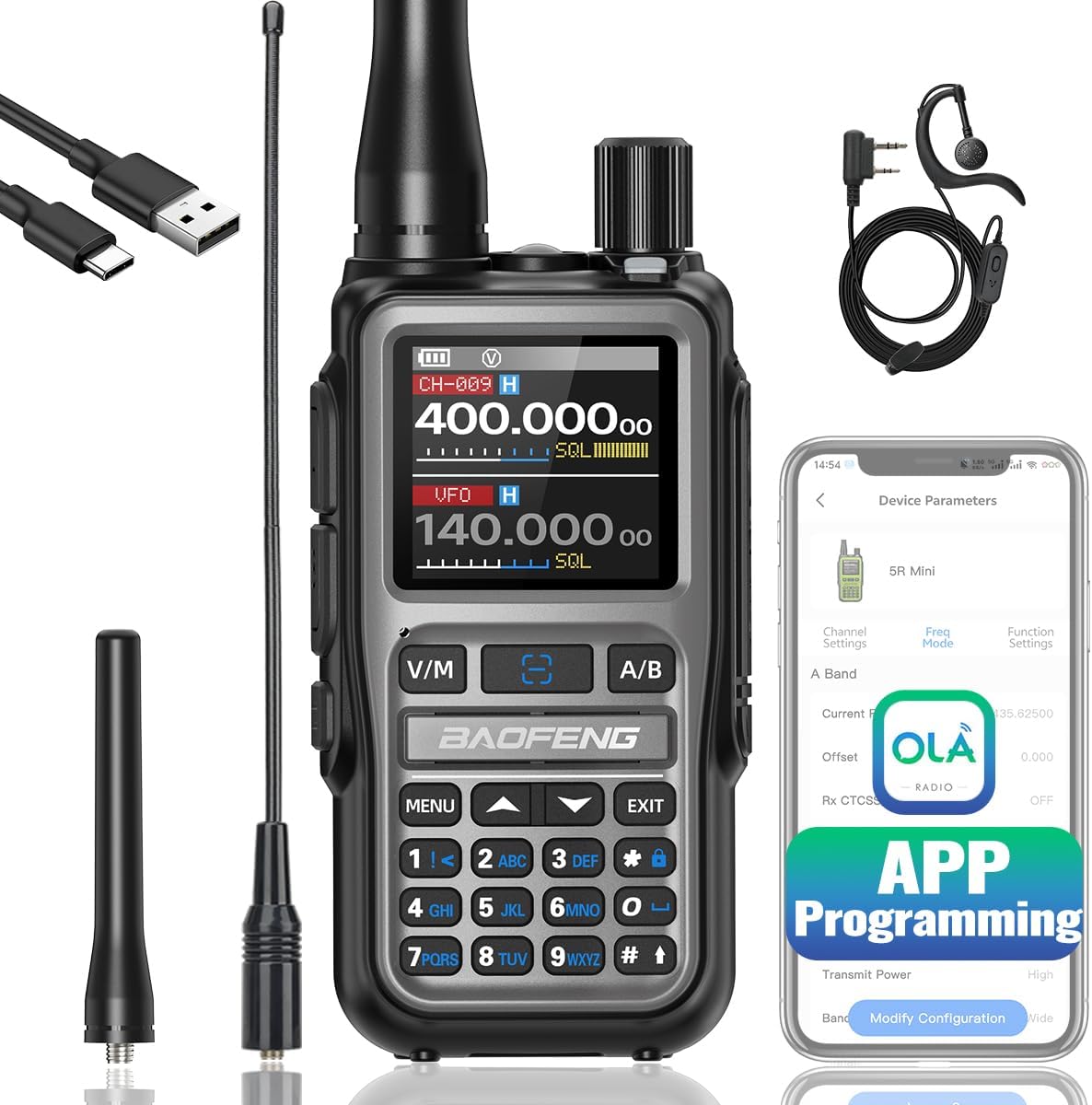
The Baofeng UV-5R Mini is a compact, budget-minded dual-band handheld transceiver that takes the familiar UV-5R platform and shrinks it into an even more pocketable form while adding a handful of modern conveniences such as USB-C charging and simplified app-based programming options. It aims at new hams and casual users who want a low-cost entry to VHF/UHF operations, local repeaters, NOAA weather monitoring, and short-range emergency communications without a heavy or bulky unit.

Design and Build
Physically, the Mini keeps a straightforward, no-frills layout: a small but readable display, a numeric keypad for direct frequency entry, PTT and function buttons, and a removable antenna. The body is light and compact — easy to carry on a belt or slip into a jacket pocket — and the simpler control layout makes it approachable for beginners. The casing is typically plastic with a matte finish; it’s adequate for everyday handling but not as rugged-feeling as higher-end handhelds.

The USB-C charging port is a welcome, modern update that removes the need for proprietary chargers or older micro-USB cables. Many packages include a rechargeable battery and a basic charger cable; battery capacity varies by seller and bundle but generally supports a full day of casual use. Some bundles include an earpiece/headset; connector type for external audio (3.5mm vs two-pin Kenwood-style) varies by variant, so buyers should check what their specific kit contains.

Radio Performance and RF Features
At its core the UV-5R Mini remains a dual-band VHF/UHF transceiver capable of transmit and receive on the popular 2-meter and 70-centimeter amateur bands. It receives public-service broadcasts and NOAA weather channels, which is useful for monitoring weather alerts and local broadcasts.

Transmit power on most Baofeng handhelds is selectable (high/low) and typically sufficient for simplex work and for hitting nearby repeaters when used with a decent antenna and proper location. Range in real-world terms depends heavily on antenna, terrain, height, local noise, and repeater placement — expect neighborhood to several miles in typical suburban conditions, and substantially farther if you can place the antenna high or use repeaters.

Receiver sensitivity and selectivity are surprisingly capable for the price: the Mini will pull in local repeaters,-weather and aircraft/airband (receive-only, if equipped to) reasonably well. That said, it does not match the front-end filtering or audio fidelity of more expensive commercial or hobbyist radios, so in very crowded RF environments you may notice handling of strong out-of-band signals is not as robust.

Channels, Memory and Features
One of the marketing hooks is large channel memory counts (advertised 999 channels on some models). Practically, the memory system lets you store frequencies, offsets and tones for repeaters, weather channels, and simplex buddies. The front panel allows manual frequency entry and navigation through stored memories.

Other common features include dual-watch/dual-standby (monitor two channels/frequencies), FM broadcast reception, CTCSS/DCS tone support for repeater access, VOX (hands-free transmit), and an emergency alarm function in some firmware versions. The Mini also often includes a “frequency copy” or wireless frequency copy feature allowing two radios of the same model to copy programmed channels to each other without a computer — handy for field operations and quick setup.

Programming: App, Cable, and Software
Programming options are flexible. For users who prefer GUI programming, many sellers bundle a USB programming cable and the radio can be programmed using PC software such as CHIRP — though support and cable compatibility may vary with clones and firmware revisions. The increasingly common alternative is smartphone app programming: a Bluetooth or proprietary app can write frequencies and memories to the radio, which appeals to users who dislike dealing with desktop software. App functionality and reliability vary by vendor and third-party app developer; some apps are straightforward and work well for the basics while others are limited.

If you rely on USB-C for charging only and still need the traditional programming cable, double-check the bundle contents. The radio’s keypad and small screen permit manual programming, but that is slower and error-prone for many channels compared to software upload.

Audio and Accessories
On receive and transmit, audio clarity is acceptable for casual use. Speaker volume is adequate in quiet conditions; in noisy environments or when clear audio is vital, a headset or external speaker improves intelligibility. Many kits include a basic earpiece/mic; higher-quality aftermarket accessories with secure connectors improve comfort and durability.

Common accessory purchases include upgraded antennas (better whip or telescoping designs), high-capacity batteries for longer operating time, belt clips, and carry cases. Antenna upgrades often yield better range and performance than changing radio settings.

Battery Life and Charging
Battery life varies with transmit duty cycle, power level, and battery capacity. For intermittent use (monitoring and occasional transmissions), a standard rechargeable pack typically lasts many hours; for heavy transmit use (net control, long data bursts), life shortens. The USB-C charging option is convenient for field use with power banks and modern chargers — a practical advantage over older micro-USB or proprietary charge ports.

Safety, Regulations, and Practical Use
Important: transmitting on amateur bands requires an appropriate license in most countries (for example, an FCC amateur radio license in the United States). Users should obtain the correct license and operate within permitted frequencies and power limits. Additionally, do not transmit on public safety, aviation, or other restricted frequencies — many handhelds can receive such bands but transmitting there is illegal and dangerous. Learn local regulations and program only authorized frequencies.

Real-World Experience and Usability
For new hams, the Mini is an accessible, low-cost way to learn the basics: making simplex contacts, checking into local repeaters, monitoring NOAA weather, and understanding radio etiquette. Its light weight and small size encourage taking it along on hikes, RV trips, or local events.

Ease-of-use depends on the user’s patience with small menus and a compact keypad. Those comfortable with programming via PC or app will set up the radio quickly. For group deployments or emergency prep, the wireless frequency copy function (if present) and app-based sharing are practical features that speed distributing channel plans among multiple units.

Limitations and Trade-Offs
The UV-5R Mini is a budget device and shows it in several ways: build materials are economical, front-end filtering is limited compared to mid- or high-end handhelds, and audio fidelity and ergonomics are basic. Some users report variability across different batches or vendor clones, so quality control can be inconsistent. The small form factor also means smaller buttons and a smaller display, which can be a nuisance for large-gloved hands or for users who value large, tactile controls.

Many advanced features common in pricier radios — superior receiver front-end, better shielding against strong-signal overload, more robust firmware, superior ergonomics, and more reliable accessory connectors — are absent here. If you plan frequent contesting, serious weak-signal work, or professional-grade reliability, stepping up to a higher-tier radio is worth considering.

Pros and Cons (concise)
Pros: Extremely affordable; pocketable; dual-band VHF/UHF; NOAA/weather receive; USB-C charging; multiple programming options including app and cable; good entry-level feature set.

Cons: Build and audio quality are basic; front-end performance limited in crowded RF environments; possible variation between suppliers/clones; small keypad/display; some bundle inconsistencies (battery size, headset type).

Who Is This Radio For?
The UV-5R Mini is best for beginners who want an inexpensive, portable way to get on the air and learn. It’s useful for hikers, campers, event volunteers, and anyone who wants a low-cost handheld for local communications, weather monitoring, and basic repeater use. It is less suited to users requiring professional durability, heavy-duty contest performance, or the best possible receiver performance in noisy RF environments.

Verdict
The Baofeng UV-5R Mini delivers a compelling value proposition for its price: a compact, modernized take on a popular low-cost handheld platform that includes practical updates like USB-C charging and app-friendly programming. It won’t match the refinement or performance of mid-range handhelds, but for newcomers, hobbyists on a budget, and those needing a light, inexpensive backup radio, it’s an attractive choice. As with any inexpensive radio, buyers should be mindful of bundle differences, confirm exact features before purchase, and plan on learning basic programming and radio etiquette to get the most out of it.

Final Notes and Tips
Learn the local band plan and licensing requirements where you live. Program NOAA weather channels and a few local repeater memories before heading out. Invest in a better antenna and a spare battery if you expect regular use. Use the radio’s lower power setting for short-range contacts to conserve battery life, and reserve high power for reaching distant repeaters when needed.

🎅See The Baofeng Mini On Amazon!🎅

Friday, July 18, 2025

Yaesu FT-891 HF/50 MHz All Mode Analog Transceiver Review


The Yaesu FT-891 is a compact, powerful, and versatile HF/50 MHz transceiver designed for amateur radio operators who demand high performance in a small footprint. Built with serious mobile and portable operators in mind, the FT-891 delivers a full 100 watts of power, all-mode functionality, a rugged design, and a user-friendly interface that caters to both newcomers and seasoned hams. This review takes an in-depth look at its features, performance, usability, and how it fits into a modern ham shack or mobile setup.


Design and Build Quality

The FT-891’s design is truly one of its strongest suits. Measuring just 6.1" x 2.0" x 8.6" and weighing about 4.2 pounds, the unit is compact enough to mount in most vehicles or tight operating spaces, yet it feels solid and well-constructed. Its all-black housing with a removable front panel makes mobile installations more convenient. The display is a crisp white-on-black OLED that provides excellent readability in various lighting conditions, including direct sunlight and nighttime environments.

The knobs and buttons are well-placed and have a durable feel, offering quick access to the most-used features like tuning, power, volume, mode selection, and noise blanking.


Power and Performance

With 100 watts of power output on HF and 6-meter bands, the FT-891 packs a strong punch for a radio of its size. The radio supports all traditional amateur modes: SSB, CW, AM, FM, and digital (with external interfaces). It is equipped with a triple-conversion superheterodyne receiver architecture and a 32-bit DSP unit for outstanding selectivity and filtering capabilities.

The receiver sensitivity is impressive, even in crowded band conditions. The 3 kHz roofing filter, combined with advanced DSP noise reduction, notch filtering, and variable bandwidth, ensures that weak signals can be extracted cleanly from noisy environments. The noise blanker and automatic gain control (AGC) options further enhance the operator's ability to deal with challenging RF conditions.


User Interface and Controls

Though compact, the FT-891 has a fairly intuitive menu system, with shortcut keys and programmable function buttons that reduce the learning curve. The front-facing USB port is particularly useful for firmware updates and digital mode operation when connected to a PC. While the screen may appear small compared to larger base station rigs, the essential operating information is clearly displayed.

The multi-function knob and quick function buttons give access to commonly adjusted parameters such as filter bandwidth, DSP settings, and power output. Some users may find the deep menu system a bit cumbersome at first, but Yaesu's logic remains consistent throughout, and with use, the layout becomes familiar.


DSP Capabilities

One of the key highlights of the FT-891 is its powerful 32-bit floating point DSP (Digital Signal Processor), which allows fine-grained signal manipulation. Adjustable filters include IF shift, notch filters (both manual and automatic), and noise reduction algorithms. These tools are especially valuable for working in noisy environments or during contesting and DXing.

The digital noise reduction (DNR) feature is particularly effective in removing background hiss and electrical noise without degrading the quality of the incoming signal. The DNF (Digital Notch Filter) automatically removes heterodyne carriers and whistling tones, making operation on crowded bands far more pleasant.


Mobile Use and Portability

The FT-891 is a natural fit for mobile operations, thanks to its detachable front panel, compact footprint, and included mounting bracket. The microphone and control cable are well suited for in-vehicle setups, and the front panel detachment allows for flexible placement options. Heat management is handled well via a large, quiet cooling fan that only engages when necessary, preventing overheating during extended transmissions.

Despite its small size, the FT-891 can serve well in base station roles when paired with a quality power supply and antenna tuner. While it lacks an internal tuner, many users combine it with external tuners such as the Yaesu FC-50 or third-party solutions to achieve a versatile home setup.


Connectivity and Digital Modes

The FT-891 includes a mini USB port for CAT control and firmware updates, which can also be used with popular digital mode software like FT8, PSK31, and RTTY when paired with appropriate interfaces. It lacks a built-in sound card, so an external sound card interface (like the SignaLink USB) is needed for full digital integration.

Although Bluetooth or Wi-Fi connectivity is not present, CAT control allows integration with logging software and rig control programs, making it a useful rig for field day or remote operations with a laptop.


Warranty and Support

The FT-891 includes a solid 3-year manufacturer’s warranty from Yaesu, which reflects confidence in the durability and reliability of the radio. Yaesu is known for strong customer support, and the widespread popularity of the FT-891 means there is a large user community, with plenty of resources and tutorials available to help operators get the most out of the rig.


Conclusion

The Yaesu FT-891 is a powerhouse in a small package. With 100 watts of HF/6m power, strong DSP filtering, and mobile-friendly features, it's a compelling option for anyone looking for a compact and capable transceiver. Whether you're a seasoned operator looking for a rugged mobile unit or a beginner stepping into HF for the first time, the FT-891 delivers solid performance, reliability, and value.

While it lacks some convenience features found in more expensive base rigs—like an internal tuner or built-in sound card—the FT-891's core performance and build quality more than make up for it. For portable, mobile, or space-conscious operators, it's an outstanding choice.

See The Yaesu FT-891 On Amazon!

Friday, May 23, 2025

Radtel RT-880G GPS APRS 10W Ham Radio Walkie Talkie – A Comprehensive Review


For amateur radio enthusiasts seeking a feature-rich, high-performance handheld radio, the Radtel RT-880G presents an intriguing choice. This portable two-way radio combines GPS capability, APRS support, cross-band repeater functionality, and an impressive 10 watts of power in a compact body. Equipped with a 2.4-inch color display, HF SSB receive capability, and an SW/MW antenna, the RT-880G is designed to meet the demands of both advanced hobbyists and serious field operators.

Build and Design

The RT-880G boasts a sturdy, rugged construction designed for reliable use in a variety of environments. Its form factor strikes a balance between portability and usability, making it easy to carry while still offering tactile, well-spaced buttons for field operation. The 2.4-inch color display is a standout feature, offering clear readability in both daylight and low-light conditions. The interface is intuitive, allowing users to navigate through the menus and features without needing to constantly refer to a manual.

A high-capacity battery powers the unit, giving it extended runtime even at higher transmission power levels. The radio is also equipped with a detachable antenna and includes an SW/MW-capable model, which adds flexibility for monitoring a wider range of frequencies.

Transmission and Reception

One of the core strengths of the RT-880G is its 10-watt maximum transmission power, which provides a notable boost over standard 5-watt handheld units. This added power improves communication range, especially in areas with minimal obstruction. The radio supports UHF and VHF bands, making it suitable for a wide variety of amateur radio applications.

Additionally, the RT-880G offers HF SSB receive functionality. While it does not transmit on HF, the ability to receive single side band signals gives users access to a much broader scope of the amateur radio spectrum. This is especially useful for those who want to monitor long-distance communications or simply expand their listening experience.

APRS and GPS Functionality

The integration of APRS (Automatic Packet Reporting System) and GPS makes the RT-880G a valuable tool for location tracking and tactical communication. The GPS is built-in and works reliably, providing real-time position data. This data can be transmitted over APRS, allowing others in the network to track your location, which is particularly beneficial during group expeditions, search-and-rescue operations, or emergency scenarios.

APRS also supports sending and receiving messages, status updates, and weather data, giving this radio a strong advantage for those who operate in the field or participate in public service events.

Cross-Band Repeater Capability

Another advanced feature included in the RT-880G is cross-band repeat functionality. This allows the radio to receive a signal on one band and retransmit it on another. It's an essential tool for extending communication coverage when operating in hilly terrain or dense urban areas. Setting up cross-band repeat is straightforward, and it works efficiently, making the radio a potential backbone for a temporary communication network in remote locations.

Channel Capacity and Programming

With 1024 memory channels, the RT-880G provides ample storage for various frequencies, talk groups, and custom configurations. Users can organize their channel list for quick access during operations. Channel scanning is responsive and supports various scan modes to suit user preferences.

The radio includes a programming cable, simplifying the process of customizing settings via software. Programming through a PC is fast and intuitive, giving users granular control over frequencies, CTCSS/DCS tones, power levels, and other operational parameters.

Audio Quality and User Experience

The audio output from the built-in speaker is clear and sufficiently loud for outdoor use. The microphone provides strong modulation without distortion, even when used in high-wattage mode. The user interface is efficient, with labeled buttons, a responsive keypad, and a menu system that balances complexity with usability.

The color screen not only improves visual appeal but also enhances practical use. Menu navigation is intuitive, and the display is bright enough for use in direct sunlight, with sufficient backlighting for nighttime operation.

Accessories and Expandability

The RT-880G ships with a suite of accessories that includes a belt clip, antenna, programming cable, and a desktop charging cradle. The included antenna performs adequately for general use, though serious operators may choose to upgrade to a higher-gain antenna for improved range and signal clarity.

Thanks to the radio’s standard connectors, users can expand its functionality with third-party accessories, including external microphones, headsets, and high-gain antennas, enhancing its versatility even further.

Practical Use Scenarios

The RT-880G is an excellent option for a wide range of scenarios. Field communicators, emergency responders, and outdoor enthusiasts will appreciate the GPS and APRS integration. Radio hobbyists will benefit from the HF SSB receive function, and those working in team environments can utilize the cross-band repeater to maintain communication over large areas. The high output power and rich feature set make this radio a viable option for both casual users and advanced operators.

Final Thoughts

The Radtel RT-880G stands out as a powerful and feature-rich handheld ham radio that caters to the needs of both experienced operators and demanding field users. Its combination of high transmission power, GPS/APRS integration, cross-band repeat, and a vibrant display makes it a compelling option in its class.

While it might have a steeper learning curve for newcomers due to its extensive feature set, the functionality it offers is well worth the investment. Whether you’re operating in remote terrain, coordinating an event, or simply exploring the amateur radio bands, the RT-880G is a versatile tool that performs admirably across the board.

Find The Radtel RT-880G On Amazon!

Friday, April 18, 2025

In-Depth Review: AnyTone AT-5555N II Upgraded 10 Meter Radio High Power Mobile Transceiver


The AnyTone AT-5555N II is a high-powered, feature-rich mobile transceiver designed specifically for amateur radio operators who want strong performance, versatility, and ease of use in the 10-meter band. This upgraded version builds on the foundation of its predecessor, the AT-5555, and brings a range of improvements that appeal to both seasoned ham operators and newcomers who are stepping into the world of high-frequency mobile communication. In this review, we’ll delve into the capabilities, performance, build quality, and overall user experience of the AnyTone AT-5555N II to help you decide if it’s the right radio for your setup.

Power and Performance

One of the key selling points of the AnyTone AT-5555N II is its impressive power output. It offers 60 watts on AM and SSB modes, and 45 watts on FM. This power level is significant for a mobile 10-meter transceiver, allowing users to reach out further and communicate more reliably even under less-than-ideal propagation conditions. Whether you’re operating in AM, FM, or single sideband (SSB) modes, the radio delivers clear and consistent audio, with minimal distortion even at high output.

The radio covers 28.000 to 29.700 MHz in standard configuration, but it can be expanded for additional frequencies, making it more flexible for different operating preferences. Once expanded, it can serve a wider range of users looking to experiment with CB frequencies or use it as an export radio.

Signal Clarity and Audio Quality

Transmit and receive clarity is another strong suit of the AT-5555N II. Users will appreciate the crisp and natural-sounding audio both from the built-in speaker and when using an external speaker or mic. The microphone itself is robust and ergonomic, with up/down buttons and a channel switch, giving users convenient access to frequent adjustments.

Reception sensitivity is excellent, picking up weak signals with clarity. The squelch and RF gain controls allow for fine-tuning reception, helping to cut through noise and focus on the signals that matter. For those who use SSB frequently, the radio includes clarifier functionality that allows for precise tuning of voice signals, a critical feature for maintaining intelligible communication over long distances.

Build Quality and Display

Physically, the AT-5555N II is solidly built with a rugged chassis designed to endure the demands of mobile operation. The controls have a satisfying feel, and the front panel is logically laid out for intuitive operation. The volume, squelch, RF gain, and clarifier knobs are smooth and responsive, and the push buttons have a quality feel that suggests durability.

One of the standout improvements in the upgraded version is the multi-color LCD display. The screen is bright, readable in various lighting conditions, and can be customized to suit individual preferences. This includes the ability to change backlight colors, which is both a cosmetic and practical feature, especially for night-time operation. The display shows key operating information such as frequency, mode, power level, and signal strength, all in a clean, easily digestible layout.

Features and Functionality

The AT-5555N II comes with a suite of features that enhance its flexibility and usability. These include:

  • Multi-band support (post-expansion) for users who want more than just 10-meter capability

  • Automatic and manual squelch control, helping reduce unwanted noise

  • VOX (voice-operated transmit) for hands-free operation

  • NB/ANL (noise blanker and automatic noise limiter) for improved noise reduction

  • Dual Watch, which allows monitoring of two frequencies at once

  • Scan functions, which are useful for finding active frequencies quickly

  • Adjustable mic gain and RF power output, giving users control over performance

Programming the radio can be done manually via the front panel or with software for those who prefer PC-based control and memory management. This makes it easier to configure and store multiple channels and settings for specific communication needs.

Ease of Use

Despite its professional-grade features, the AnyTone AT-5555N II is surprisingly approachable for new users. The manual operation is straightforward, and those familiar with ham radios will find the menu system intuitive. For newcomers, there might be a slight learning curve, especially with understanding SSB operation and menu navigation, but nothing that a bit of hands-on time can’t overcome.

The user-friendly interface, combined with flexible controls and powerful performance, makes this radio suitable for both mobile and base station use. It’s compact enough to fit in most vehicles, and the front-facing speaker design helps ensure audio is heard clearly even in noisy environments.

Final Thoughts

The AnyTone AT-5555N II stands out as a powerful, dependable, and versatile mobile transceiver for the 10-meter amateur radio band. Its high output power, superior audio clarity, and extensive feature set make it an appealing choice for both hobbyists and serious operators. The ability to expand its frequency range and the inclusion of adjustable parameters offer a high degree of customization to suit different user preferences and conditions.

While it may be more advanced than basic CB radios, the AT-5555N II bridges the gap between entry-level and high-end ham gear by offering excellent value and performance. For those looking for a rugged, high-performance mobile transceiver with modern features and strong output capabilities, the AnyTone AT-5555N II is a solid investment.

Find The Anytone AT-5555N II On Amazon!

Thursday, February 27, 2025

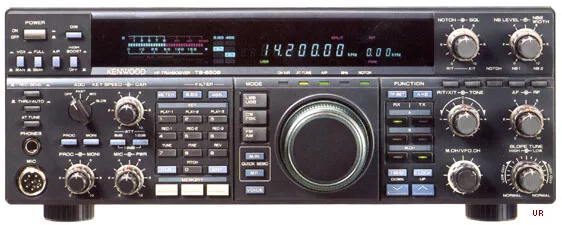
Kenwood TS-850S HF Transceiver Review: A Classic Workhorse for Amateur Radio Enthusiasts


The Kenwood TS-850S is one of the most respected HF transceivers ever produced, renowned for its performance, reliability, and excellent receiver q hearts of amateur radio operators. With a solid build, exceptional filtering, auality. Introduced in the late 1980s, this rig continues to hold a special place in thend a clean transmit signal, the TS-850S remains a sought-after radio for those who appreciate classic gear that stands the test of time.

Design and Build Quality

The TS-850S has a rugged and professional appearance, typical of Kenwood's high-quality engineering. The front panel is well-organized, featuring an easy-to-read fluorescent display, a large tuning dial, and a logical arrangement of controls that make operation intuitive. Despite being an older model, it has a timeless design that continues to impress users with its durability and user-friendly interface.

The transceiver weighs around 9.8 kg (21.6 lbs), providing a sturdy feel that ensures stability on the desk. Its solid-state construction enhances reliability, and many units in operation today remain in excellent working condition, a testament to Kenwood’s craftsmanship.

Performance and Receiver Quality

One of the standout features of the TS-850S is its superb receiver. It offers excellent sensitivity and selectivity, making it a top choice for serious HF operators. The dynamic range and low-noise floor allow for clear reception even in crowded bands or weak signal conditions. This is particularly useful for DXing and contesting, where the ability to filter out interference is crucial.

The built-in IF shift and notch filter significantly improve the ability to reduce adjacent signal interference. The automatic gain control (AGC) operates smoothly, providing consistent audio quality without abrupt fluctuations. Many users praise the audio clarity, which remains one of the strongest points of this transceiver.

Transmit Quality

The TS-850S delivers a clean and stable transmit signal with up to 100 watts output. It features a high-quality speech processor that enhances voice clarity, making it a great choice for SSB operation. The rig’s ability to maintain a solid and distortion-free signal ensures that transmissions are easily readable, even under challenging conditions.

For CW operators, the full break-in (QSK) operation is another advantage. The radio provides smooth and responsive keying, making it a favorite among CW enthusiasts who need fast and accurate performance.

Filtering and DSP Capabilities

Although the TS-850S predates modern digital signal processing (DSP) features found in newer rigs, it includes excellent analog filters that provide strong interference rejection. The optional YK-88C and YK-88CN filters further enhance the radio’s ability to handle crowded bands, making it a strong performer in high-noise environments.

The auto notch filter effectively removes unwanted carriers, and the IF shift allows fine-tuning to reduce adjacent signal interference. While it lacks the more advanced filtering options found in today's transceivers, its built-in features still perform exceptionally well for a rig of its era.

Tuner and Antenna Matching

The TS-850S does not come with a built-in antenna tuner, requiring an external tuner for impedance matching. However, it pairs well with Kenwood’s AT-850 automatic antenna tuner or other external tuners, allowing operators to achieve optimal performance across different bands.

Connectivity and Modifications

The transceiver includes standard accessory ports, making it compatible with amplifiers and other external devices. One notable feature is the CW and RTTY narrow filter options, which can be installed for enhanced digital mode operation.

Many operators have modified their TS-850S units over the years, adding upgrades such as DSP units, enhanced filters, and even modern computer control interfaces. These modifications help bring the radio closer to contemporary standards while maintaining its classic performance.

Reliability and Common Issues

Kenwood is known for building long-lasting equipment, and the TS-850S is no exception. However, like any older transceiver, it has some known issues. One of the most commonly reported problems is the failure of electrolytic capacitors in the carrier board, which can cause audio distortion or loss of output power. Many users opt to replace these capacitors to extend the radio’s lifespan.

Another potential issue is the DDS (Direct Digital Synthesis) unit, which may develop instability over time. Regular maintenance and periodic servicing can help prevent these problems, ensuring continued reliable operation.

Final Verdict

The Kenwood TS-850S remains an outstanding choice for amateur radio enthusiasts who appreciate high-quality receiver performance, clean audio, and a rugged design. While it lacks modern DSP features and a built-in tuner, its filtering capabilities, strong transmit quality, and overall reliability make it a worthy addition to any ham shack.

For operators who enjoy vintage transceivers that still deliver exceptional performance, the TS-850S is a fantastic investment. With proper care and occasional maintenance, it continues to be one of the best HF transceivers available, proving that great engineering stands the test of time.

Check Out The Kenwood TS-850S On Ebay!

Friday, February 7, 2025

HYS TC-978 HF SDR Transceiver Review: A Comprehensive Analysis


When it comes to high-frequency (HF) transceivers, the HYS TC-978 HF SDR Transceiver has garnered significant attention in the amateur radio community. This multifunctional instrument is packed with a variety of features that appeal to both seasoned ham radio operators and newcomers alike. In this review, we will explore the specifications, performance, features, and overall value of the HYS TC-978 to determine whether it is a worthwhile investment for amateur radio enthusiasts.


Key Specifications

The HYS TC-978 HF SDR Transceiver is an all-band transceiver that offers a robust set of transmission and reception capabilities. Below are the key specifications:

  • Frequency Range: HF (160m to 10m bands)

  • Modes Supported: SSB (J3E), CW, AM, FM, Free-DV

  • Output Power: Variable, up to 100W

  • Receiver Sensitivity: 0.3μV @ 10dB S/N

  • SDR Technology: Software-Defined Radio architecture for enhanced performance

  • Display: High-resolution LCD screen

  • Connectivity: USB, CAT control, and external speaker support

  • Power Supply: 13.8V DC ±15%

  • Dimensions: Compact and lightweight design

  • Antenna Connector: SO-239 (standard for HF transceivers)

These specifications place the TC-978 in a competitive position against other HF transceivers in its price range.


Design and Build Quality

The HYS TC-978 features a solid and compact design, making it an excellent choice for both base station and portable use. The unit is housed in a durable metal casing, which ensures longevity and resistance to external damage. The LCD screen is bright and easy to read, even in low-light conditions. The control buttons and knobs are well-placed, providing an intuitive interface for users to navigate through the transceiver's functions.

One standout aspect is the ergonomic layout, which allows for ease of access to commonly used functions, reducing operational complexity. Additionally, the cooling system prevents overheating, ensuring extended operational use without performance degradation.


Performance and Signal Clarity

The TC-978 delivers exceptional signal clarity, thanks to its advanced SDR technology. The receiver sensitivity is commendable, allowing it to pick up weak signals with minimal noise. The selectivity and filtering options effectively eliminate interference, making it an excellent choice for crowded HF bands.

Key performance highlights:

  • Stable transmission power ensures reliable communication over long distances.

  • DSP noise reduction significantly improves audio clarity.

  • Automatic gain control (AGC) maintains consistent volume levels.

  • Effective notch filtering helps in reducing unwanted interference.

  • Free-DV digital voice mode allows for high-fidelity digital voice transmission.

Operators will appreciate the flexibility in modulation modes, especially for those who enjoy experimenting with different communication methods.


Connectivity and SDR Functionality

One of the main selling points of the HYS TC-978 is its Software-Defined Radio (SDR) capability. SDR allows users to fine-tune the receiver performance via software updates, giving them enhanced customization and better long-term usability. The USB and CAT control options make it easy to integrate with external devices, such as:

  • PC-based SDR software for advanced signal processing

  • Digital mode interfaces (FT8, PSK31, etc.)

  • Remote operation setups

These connectivity features make the TC-978 a future-proof choice, as users can continually upgrade their system with new firmware and software enhancements.


Ease of Use

For beginners, the HYS TC-978 offers a relatively smooth learning curve. The user interface is designed to be intuitive, with well-organized menus and easy-to-understand settings. Experienced ham radio operators will appreciate the detailed manual adjustments available for fine-tuning performance.

Setting up the transceiver is straightforward, and the included user manual provides clear instructions on operating different modes, adjusting power settings, and utilizing the SDR features.


Pros and Cons

Pros:

  • Excellent signal clarity with SDR-based receiver

  • Multiple operating modes including SSB, CW, AM, FM, and Free-DV

  • Customizable settings for advanced users

  • Compact and durable design suitable for both home and field use

  • Good connectivity options for digital modes and external software

  • Competitive pricing compared to similar HF transceivers

Cons:

  • Limited brand recognition compared to more established manufacturers like Icom or Yaesu

  • Firmware updates may require technical knowledge

  • External speaker required for optimal audio output


Who Should Buy the HYS TC-978?

The HYS TC-978 HF SDR Transceiver is ideal for:

  • New ham radio operators looking for an affordable yet feature-rich transceiver.

  • Experienced operators who want a secondary transceiver with SDR capabilities.

  • Portable operators who need a compact and lightweight unit for field use.

  • Digital mode enthusiasts who want to experiment with SDR and Free-DV modes.


Final Verdict: Is the HYS TC-978 Worth It?

The HYS TC-978 HF SDR Transceiver offers outstanding value for money with its advanced SDR technology, multiple operating modes, and solid build quality. While it may not have the brand prestige of higher-end models from Icom or Yaesu, it delivers comparable performance at a more affordable price point.

For those looking for a versatile and high-performance HF transceiver, the HYS TC-978 is certainly worth considering. Whether you’re a seasoned amateur radio operator or just starting in the hobby, this transceiver provides the functionality and flexibility needed for an enjoyable ham radio experience.

See The HYS TC-978 On Amazon!

Retevis RA89R Ham Radio Review: A Feature-Packed Dual-Band Handheld with Cross-Band Repeater Capability

  The Retevis RA89R is one of the most feature-rich handheld amateur radios available in its price range. Rather than focusing solely on ...

Search This Blog