Showing posts with label Mini. Show all posts

Friday, June 19, 2026

TYT TH-8600 Mini 25 Watt Dual Band Amateur Radio Review


The TYT TH-8600 has developed a loyal following among amateur radio operators looking for a compact, rugged, and affordable dual-band mobile radio. Unlike many mobile transceivers that are designed primarily for passenger vehicles, the TH-8600 was built with outdoor use in mind. Its compact size, IP67 waterproof rating, and solid 25-watt output make it a unique offering in the amateur radio market.

For operators who need a radio capable of surviving harsh weather, dusty trails, motorcycles, UTVs, boats, and emergency communications deployments, the TYT TH-8600 deserves a close look.

First Impressions

The first thing most operators notice about the TH-8600 is its size. This is not a large mobile radio that takes up valuable dashboard space. Measuring roughly 4.2 inches wide, 1.8 inches high, and 5 inches deep, it can fit almost anywhere. Despite its compact footprint, the radio feels solid and well-built. The chassis is sturdy, and the waterproof design gives confidence that it can handle environments that would quickly destroy many traditional mobile rigs.

The included programming cable is a welcome bonus. Many manufacturers require buyers to purchase a separate cable, adding additional cost before the radio can even be programmed.

Frequency Coverage

The TH-8600 covers the most popular amateur radio bands:

  • 144-148 MHz (2 Meter Band)
  • 420-450 MHz (70 Centimeter Band)

Receive coverage extends beyond the amateur allocations, allowing monitoring of additional VHF and UHF frequencies where legally permitted. The radio offers dual-band operation with dual display and dual watch capabilities, making it convenient for monitoring two frequencies simultaneously.

For most amateur operators, these two bands provide access to local repeaters, simplex communication, emergency networks, public service events, and general day-to-day ham radio activity.

Power Output

The TH-8600 delivers:

This power level sits between a handheld transceiver and a traditional 50-watt mobile radio. For many operators, this is actually an ideal compromise.

Twenty-five watts is sufficient to reliably access repeaters throughout most metropolitan and rural areas while reducing current draw and heat generation compared to higher-powered mobiles. It also makes the radio an attractive choice for portable operations, field deployments, and battery-powered emergency communications setups.

Waterproof Design

One of the TH-8600's most compelling features is its IP67 waterproof rating.

Most amateur mobile radios are designed for dry vehicle interiors. The TH-8600 takes a different approach. The radio and microphone are designed to withstand exposure to water and dust, making them suitable for:

IP67 certification means the radio is protected against dust intrusion and can survive temporary water immersion under controlled conditions. This level of environmental protection remains uncommon among amateur mobile transceivers.

For operators who regularly work outdoors, this feature alone may justify choosing the TH-8600 over competing radios.

Display and User Interface

The radio features a color LCD display that is surprisingly easy to read considering its compact size. The dual-frequency display allows operators to monitor both VHF and UHF activity simultaneously. Four programmable function keys provide quick access to commonly used features.

Menu navigation takes some time to learn, particularly for operators accustomed to Yaesu, Icom, or Kenwood interfaces. However, after spending a few days with the radio, most users become comfortable with the menu structure.

The included microphone provides direct access to several operating functions and feels durable enough for mobile use.

Programming

Programming can be accomplished through the front panel or through computer software using the included programming cable.

Most operators will prefer software programming, especially when loading numerous repeaters and simplex channels. The radio supports 200 memory channels, which is more than sufficient for most amateur radio applications.

As with many TYT radios, the factory programming software can sometimes feel dated. Once programmed correctly, the radio performs reliably and is straightforward to manage.

Audio Performance

Transmit audio is generally clear and understandable. The radio includes CTCSS and DCS encoding and decoding, DTMF functions, and support for 2-tone and 5-tone signaling. Audio output from the internal speaker is strong enough for typical vehicle environments.

For noisy off-road vehicles or industrial environments, many operators may still choose to add an external speaker for improved intelligibility.

Real-World Performance

In actual operation, the TH-8600 performs better than many operators expect from a compact Chinese mobile radio.

Many users successfully employ the radio in:

  • Mobile installations
  • Off-road vehicles
  • Base station setups
  • Portable field operations
  • Emergency communications kits

Long-term users often report the radio handling dirt, mud, vibration, and rough conditions without failure. The radio offers reliable repeater performance and dependable operation over extended periods.

That said, some operators have reported occasional quality-control concerns and programming quirks. These reports are not unusual within the budget mobile radio market and should be considered when comparing the TH-8600 with higher-priced offerings from Japanese manufacturers.

Using the TH-8600 as a Base Station

Although marketed primarily as a mobile radio, the TH-8600 can function effectively as a small base station.

By pairing it with:

Operators can build a capable VHF/UHF station at relatively low cost.

The radio's modest current requirements make it particularly attractive for emergency power systems, solar setups, and portable communications kits. Users have successfully used the TH-8600 both in vehicles and as desktop base stations.

Pros

Cons

  • Not true dual receive
  • Programming software could be improved
  • Menu system has a learning curve
  • Lower output power than traditional 50-watt mobiles
  • Quality control can vary between units

Who Should Buy the TYT TH-8600?

The TH-8600 is an excellent choice for:

  • New amateur radio operators
  • Emergency preparedness enthusiasts
  • Off-road vehicle owners
  • Motorcycle operators
  • Portable radio enthusiasts
  • Operators building compact go-box systems
  • Anyone needing a weather-resistant mobile radio

Those seeking maximum transmit power, advanced digital modes, or premium receiver performance may prefer higher-end radios from major Japanese manufacturers. However, operators prioritizing ruggedness, compact size, and affordability will find the TH-8600 extremely appealing.

Final Verdict

The TYT TH-8600 occupies a unique niche in the amateur radio market. Few radios offer its combination of compact size, waterproof construction, dual-band capability, and reasonable price.

While it may not have the refinement of premium mobile transceivers, it delivers solid performance where it matters most. The radio's rugged design makes it particularly attractive for outdoor operators, emergency communicators, and anyone who needs a radio capable of surviving conditions that would challenge traditional mobile equipment.

For amateur radio operators seeking a durable dual-band mobile transceiver that can transition between vehicle, portable, and base station use, the TYT TH-8600 remains one of the most interesting and practical options available today.

Overall Rating: 4.3 out of 5 Stars.

See The TYT TH-8600 On Amazon!

Friday, January 2, 2026

AnyTone AT-779UV Mini Size Dual Band Transceiver Mobile Radio VHF/UHF Two Way Radio Review


Overview
The AnyTone AT-779UV is a compact dual band mobile transceiver designed for vehicle installation. It operates on both VHF (136–174 MHz) and UHF (400–490 MHz) amateur bands and is aimed at operators who want solid mobile performance without a large radio body taking up valuable dashboard space. Despite its small size, the AT-779UV offers a feature set typically found in larger mobile radios, making it a popular choice for budget-conscious amateur radio operators and mobile communicators.

Design and Build Quality
One of the strongest points of the AT-779UV is its compact, space-saving design. The radio body is small enough to fit easily under a seat, inside a console, or in tight dash locations, making it ideal for smaller vehicles. The metal chassis gives it a solid and durable feel while also helping with heat dissipation during extended transmissions.

The front panel includes a bright color display that provides clear visibility of frequency, channel name, signal strength, and operating status. Buttons are logically laid out and responsive. The included handheld microphone features additional buttons that allow for channel changes and quick access to common functions, reducing the need to interact directly with the main unit while driving.

Power and Performance
The AnyTone AT-779UV delivers up to approximately 25 watts on VHF and around 20 watts on UHF, with multiple selectable power levels. This flexibility allows users to conserve power when operating locally or increase output for longer-distance communication when needed. Receiver sensitivity is strong for a radio in this class, providing clear reception even on weaker signals.

Audio quality is another highlight. Transmit audio is clean and natural, while receive audio is loud enough for mobile environments, even with road noise. The built-in noise reduction and compander functions help maintain intelligibility in challenging signal conditions, which is especially useful for mobile operation.

Frequency Coverage and Features
The AT-779UV supports dual band operation, covering the most commonly used VHF and UHF amateur radio frequencies. It supports wide and narrow bandwidth settings, making it adaptable to different repeater systems and local operating practices.

The radio includes a full set of signaling options such as CTCSS, DCS, DTMF, 2-Tone, and 5-Tone. These features allow for repeater access, selective calling, and quiet monitoring. Scanning functions are included, enabling the user to search for active channels or monitor multiple frequencies efficiently.

Memory Channels and Programming
With support for hundreds of memory channels, the AT-779UV provides ample storage for repeaters, simplex frequencies, and special-purpose channels. Each memory channel can be customized with power level, tone settings, and channel names.

Manual programming from the front panel is possible but can be time-consuming, especially for users with many channels. Most owners prefer to use the manufacturer’s programming software with a USB programming cable. Once programmed via computer, daily operation becomes straightforward and user-friendly.

Mobile Installation Experience
Installation is simple thanks to the compact size and included mounting bracket. The radio runs on standard 12-volt vehicle power, and the supplied power cable is adequate for typical mobile setups. Because the unit is not water-resistant, it should be mounted in a dry location away from moisture. Pairing the radio with a quality external antenna significantly improves performance and overall user satisfaction.

Pros
The AT-779UV offers excellent value for its size and capabilities. It provides strong transmit power, clear audio, and a wide range of features in a very compact form. The display is easy to read, and the microphone controls enhance safety and convenience during mobile use.

Cons
The main drawback is the learning curve associated with programming, particularly for new users. The documentation can be basic, and software programming is almost essential for efficient setup. Additionally, the radio lacks advanced features such as APRS or Bluetooth, which may be important to some operators.

Ideal Use Cases
This radio is well suited for amateur radio operators looking for a compact mobile solution for daily commuting, road trips, or emergency preparedness. It works well as a primary mobile rig in small vehicles or as a secondary radio in larger setups. Its balance of size, power, and functionality makes it a practical choice for operators who prioritize simplicity and reliability.

Final Thoughts
The AnyTone AT-779UV Mini Size Dual Band Transceiver Mobile Radio delivers impressive performance for its compact footprint. It combines solid build quality, dependable VHF and UHF operation, and a generous feature set at an accessible price point. While it may lack some advanced modern features, its reliability, audio quality, and ease of installation make it a strong contender for anyone seeking a straightforward and capable mobile two-way radio for vehicle use.

See The AnyTone AT-779UV On Amazon!

Saturday, December 13, 2025

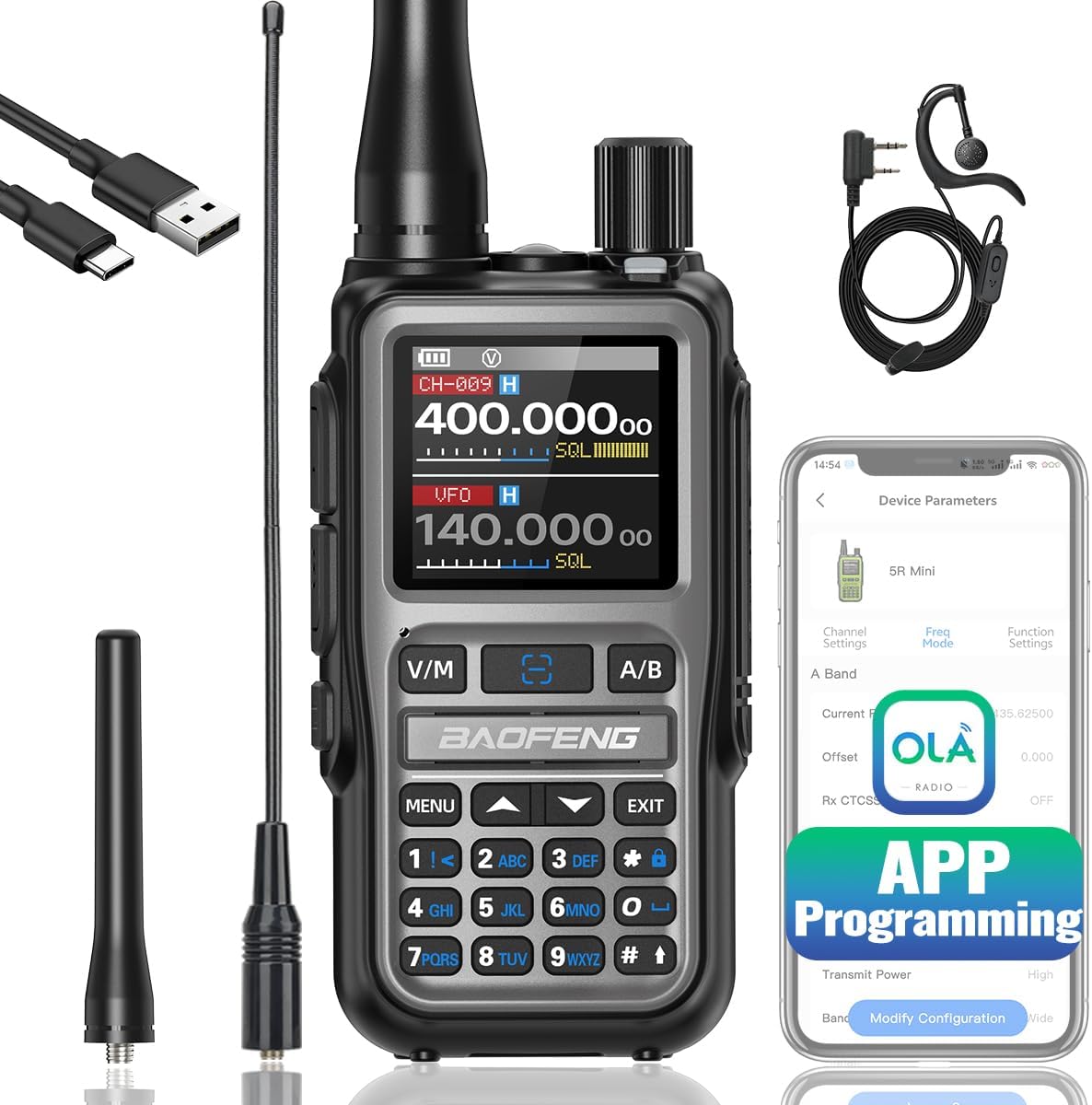
Baofeng UV-5R Mini Ham Radio — In-Depth Review


Overview
The Baofeng UV-5R Mini is a compact, budget-minded dual-band handheld transceiver that takes the familiar UV-5R platform and shrinks it into an even more pocketable form while adding a handful of modern conveniences such as USB-C charging and simplified app-based programming options. It aims at new hams and casual users who want a low-cost entry to VHF/UHF operations, local repeaters, NOAA weather monitoring, and short-range emergency communications without a heavy or bulky unit.

Design and Build
Physically, the Mini keeps a straightforward, no-frills layout: a small but readable display, a numeric keypad for direct frequency entry, PTT and function buttons, and a removable antenna. The body is light and compact — easy to carry on a belt or slip into a jacket pocket — and the simpler control layout makes it approachable for beginners. The casing is typically plastic with a matte finish; it’s adequate for everyday handling but not as rugged-feeling as higher-end handhelds.

The USB-C charging port is a welcome, modern update that removes the need for proprietary chargers or older micro-USB cables. Many packages include a rechargeable battery and a basic charger cable; battery capacity varies by seller and bundle but generally supports a full day of casual use. Some bundles include an earpiece/headset; connector type for external audio (3.5mm vs two-pin Kenwood-style) varies by variant, so buyers should check what their specific kit contains.

Radio Performance and RF Features
At its core the UV-5R Mini remains a dual-band VHF/UHF transceiver capable of transmit and receive on the popular 2-meter and 70-centimeter amateur bands. It receives public-service broadcasts and NOAA weather channels, which is useful for monitoring weather alerts and local broadcasts.

Transmit power on most Baofeng handhelds is selectable (high/low) and typically sufficient for simplex work and for hitting nearby repeaters when used with a decent antenna and proper location. Range in real-world terms depends heavily on antenna, terrain, height, local noise, and repeater placement — expect neighborhood to several miles in typical suburban conditions, and substantially farther if you can place the antenna high or use repeaters.

Receiver sensitivity and selectivity are surprisingly capable for the price: the Mini will pull in local repeaters,-weather and aircraft/airband (receive-only, if equipped to) reasonably well. That said, it does not match the front-end filtering or audio fidelity of more expensive commercial or hobbyist radios, so in very crowded RF environments you may notice handling of strong out-of-band signals is not as robust.

Channels, Memory and Features
One of the marketing hooks is large channel memory counts (advertised 999 channels on some models). Practically, the memory system lets you store frequencies, offsets and tones for repeaters, weather channels, and simplex buddies. The front panel allows manual frequency entry and navigation through stored memories.

Other common features include dual-watch/dual-standby (monitor two channels/frequencies), FM broadcast reception, CTCSS/DCS tone support for repeater access, VOX (hands-free transmit), and an emergency alarm function in some firmware versions. The Mini also often includes a “frequency copy” or wireless frequency copy feature allowing two radios of the same model to copy programmed channels to each other without a computer — handy for field operations and quick setup.

Programming: App, Cable, and Software
Programming options are flexible. For users who prefer GUI programming, many sellers bundle a USB programming cable and the radio can be programmed using PC software such as CHIRP — though support and cable compatibility may vary with clones and firmware revisions. The increasingly common alternative is smartphone app programming: a Bluetooth or proprietary app can write frequencies and memories to the radio, which appeals to users who dislike dealing with desktop software. App functionality and reliability vary by vendor and third-party app developer; some apps are straightforward and work well for the basics while others are limited.

If you rely on USB-C for charging only and still need the traditional programming cable, double-check the bundle contents. The radio’s keypad and small screen permit manual programming, but that is slower and error-prone for many channels compared to software upload.

Audio and Accessories
On receive and transmit, audio clarity is acceptable for casual use. Speaker volume is adequate in quiet conditions; in noisy environments or when clear audio is vital, a headset or external speaker improves intelligibility. Many kits include a basic earpiece/mic; higher-quality aftermarket accessories with secure connectors improve comfort and durability.

Common accessory purchases include upgraded antennas (better whip or telescoping designs), high-capacity batteries for longer operating time, belt clips, and carry cases. Antenna upgrades often yield better range and performance than changing radio settings.

Battery Life and Charging
Battery life varies with transmit duty cycle, power level, and battery capacity. For intermittent use (monitoring and occasional transmissions), a standard rechargeable pack typically lasts many hours; for heavy transmit use (net control, long data bursts), life shortens. The USB-C charging option is convenient for field use with power banks and modern chargers — a practical advantage over older micro-USB or proprietary charge ports.

Safety, Regulations, and Practical Use
Important: transmitting on amateur bands requires an appropriate license in most countries (for example, an FCC amateur radio license in the United States). Users should obtain the correct license and operate within permitted frequencies and power limits. Additionally, do not transmit on public safety, aviation, or other restricted frequencies — many handhelds can receive such bands but transmitting there is illegal and dangerous. Learn local regulations and program only authorized frequencies.

Real-World Experience and Usability
For new hams, the Mini is an accessible, low-cost way to learn the basics: making simplex contacts, checking into local repeaters, monitoring NOAA weather, and understanding radio etiquette. Its light weight and small size encourage taking it along on hikes, RV trips, or local events.

Ease-of-use depends on the user’s patience with small menus and a compact keypad. Those comfortable with programming via PC or app will set up the radio quickly. For group deployments or emergency prep, the wireless frequency copy function (if present) and app-based sharing are practical features that speed distributing channel plans among multiple units.

Limitations and Trade-Offs
The UV-5R Mini is a budget device and shows it in several ways: build materials are economical, front-end filtering is limited compared to mid- or high-end handhelds, and audio fidelity and ergonomics are basic. Some users report variability across different batches or vendor clones, so quality control can be inconsistent. The small form factor also means smaller buttons and a smaller display, which can be a nuisance for large-gloved hands or for users who value large, tactile controls.

Many advanced features common in pricier radios — superior receiver front-end, better shielding against strong-signal overload, more robust firmware, superior ergonomics, and more reliable accessory connectors — are absent here. If you plan frequent contesting, serious weak-signal work, or professional-grade reliability, stepping up to a higher-tier radio is worth considering.

Pros and Cons (concise)
Pros: Extremely affordable; pocketable; dual-band VHF/UHF; NOAA/weather receive; USB-C charging; multiple programming options including app and cable; good entry-level feature set.

Cons: Build and audio quality are basic; front-end performance limited in crowded RF environments; possible variation between suppliers/clones; small keypad/display; some bundle inconsistencies (battery size, headset type).

Who Is This Radio For?
The UV-5R Mini is best for beginners who want an inexpensive, portable way to get on the air and learn. It’s useful for hikers, campers, event volunteers, and anyone who wants a low-cost handheld for local communications, weather monitoring, and basic repeater use. It is less suited to users requiring professional durability, heavy-duty contest performance, or the best possible receiver performance in noisy RF environments.

Verdict
The Baofeng UV-5R Mini delivers a compelling value proposition for its price: a compact, modernized take on a popular low-cost handheld platform that includes practical updates like USB-C charging and app-friendly programming. It won’t match the refinement or performance of mid-range handhelds, but for newcomers, hobbyists on a budget, and those needing a light, inexpensive backup radio, it’s an attractive choice. As with any inexpensive radio, buyers should be mindful of bundle differences, confirm exact features before purchase, and plan on learning basic programming and radio etiquette to get the most out of it.

Final Notes and Tips
Learn the local band plan and licensing requirements where you live. Program NOAA weather channels and a few local repeater memories before heading out. Invest in a better antenna and a spare battery if you expect regular use. Use the radio’s lower power setting for short-range contacts to conserve battery life, and reserve high power for reaching distant repeaters when needed.

🎅See The Baofeng Mini On Amazon!🎅

TYT TH-8600 Mini 25 Watt Dual Band Amateur Radio Review

The TYT TH-8600 has developed a loyal following among amateur radio operators looking for a compact, rugged, and affordable dual-band mob...

Search This Blog