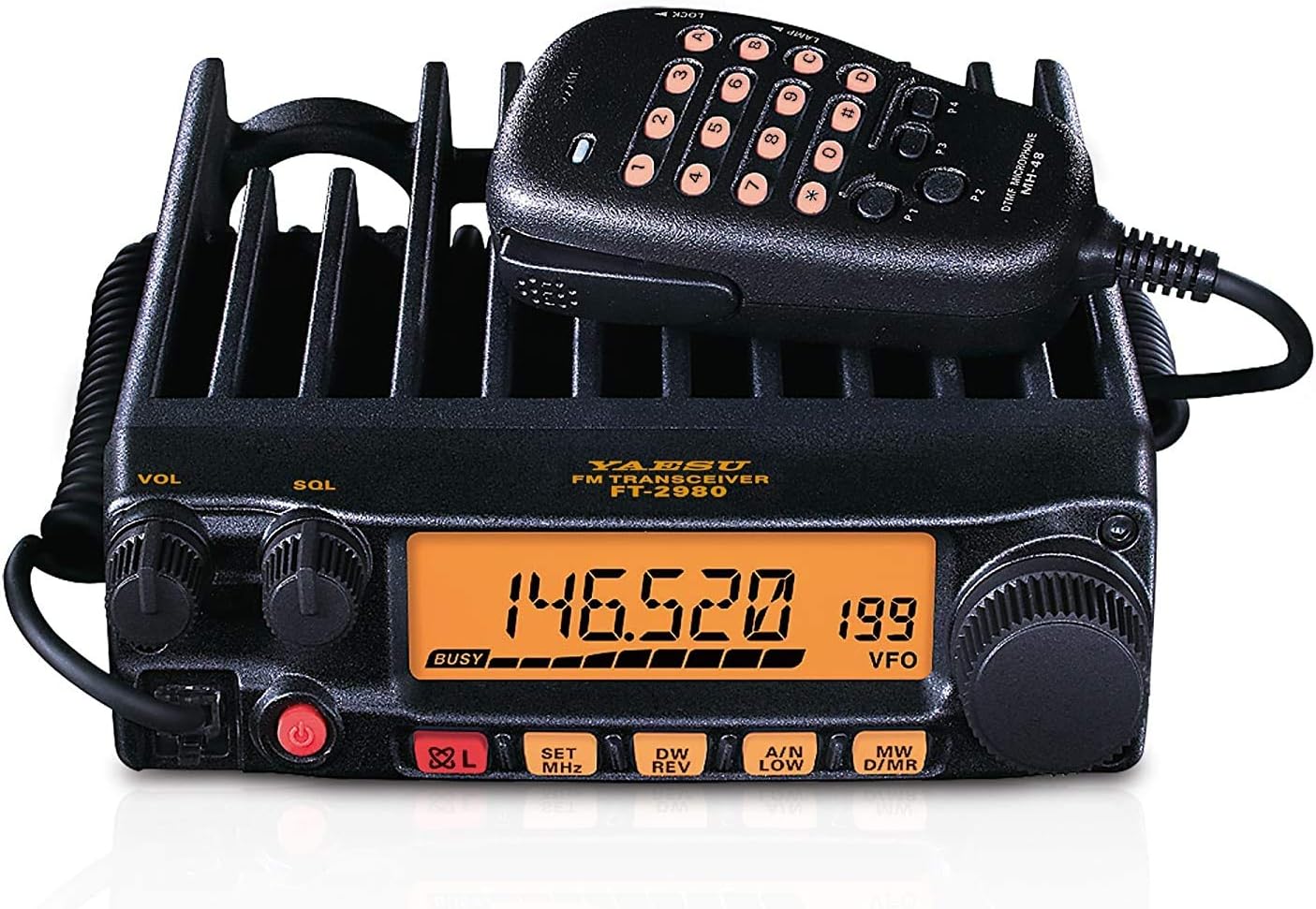
The Yaesu FT-2980R is a radio that takes a deliberately straightforward approach to amateur radio. Instead of trying to combine HF, VHF, UHF, digital voice, touchscreen controls, Bluetooth, GPS, and dozens of modern networking features into one package, Yaesu built the FT-2980R around one primary purpose: providing a powerful and rugged 2-meter FM mobile transceiver.
Its headline feature is right in the specifications. The FT-2980R can produce up to 80 watts on the 144 MHz amateur band, with selectable output levels of 80, 30, 10, and 5 watts. It uses a large heatsink rather than a cooling fan, and Yaesu designed the radio around conventional analog FM operation.
That simplicity is actually one of the most interesting things about the FT-2980R. For an operator who primarily works 2 meters, there is something appealing about having a dedicated VHF radio that concentrates on doing its job rather than attempting to do everything.
Design and Build Quality
The FT-2980R has the appearance of a traditional mobile amateur radio. It is approximately 6.3 inches wide, 2 inches high, and 7.3 inches deep, with a weight of about 4.2 pounds. The relatively substantial weight is partly a result of the radio's heavy-duty construction and large heatsink.
The physical design is particularly well suited to mobile installation. The chassis is substantial without being excessively large, and the mounting bracket allows the radio to be positioned conveniently beneath a dashboard, in a console, or in another suitable location.
One of the defining characteristics of the FT-2980R is its massive heatsink. Yaesu designed the radio to dissipate the heat generated by its high-power transmitter without requiring a cooling fan. This makes the radio mechanically simpler and eliminates the noise and potential maintenance associated with a fan.
For mobile operators, this is an important design decision. A fanless radio is inherently attractive when the radio is mounted inside a vehicle, particularly for operators who prefer a quiet operating environment.
The Front Panel
The front panel is traditional and practical rather than flashy. The radio features a large six-character backlit LCD display that provides good visibility while operating the radio. The display can show operating frequency information as well as alphanumeric memory labels.
The large display is particularly useful when operating while seated in a vehicle. A mobile radio should be readable without forcing the operator to stare closely at the screen, and the FT-2980R's relatively large display reflects that philosophy.
The radio also provides four levels of display dimming, allowing the brightness to be adjusted for different lighting conditions.
The controls are based around physical buttons, knobs, and the main tuning control. Operators who prefer conventional amateur-radio controls will likely find the layout familiar.
80 Watts of VHF Power
The biggest selling point of the FT-2980R is undoubtedly its 80-watt transmitter.
The radio provides four selectable output levels:
80 watts
30 watts
10 watts
5 watts
The selected power level can also be stored in memory, which makes it possible to use different power settings for different programmed channels.
The advantage of having multiple power levels is that maximum power does not have to be used all the time. A nearby repeater may require very little transmitter power, while a weak simplex contact may benefit from additional output.
The 80-watt setting is particularly useful when conditions call for maximum available transmitter power. However, it is important to understand that increasing transmitter power does not automatically produce a proportional increase in communication range. Antenna height, antenna efficiency, feed-line losses, terrain, receiver location, and propagation often have a much greater effect on VHF communication range.
The radio's maximum transmitter current consumption is approximately 15 amps at the 80-watt setting, so a properly installed power connection is important.
The 80-watt output is therefore not simply a specification to advertise on a box. It requires an appropriately sized electrical system, good connections, suitable fusing, and an antenna system capable of handling the RF power.
Fanless High-Power Operation
One of the most interesting engineering characteristics of the FT-2980R is its ability to produce 80 watts without a cooling fan.
Yaesu specifically designed the radio around a large heatsink that handles the heat generated by the transmitter.
This has several practical advantages.
First, there is no fan noise. Second, there is no cooling fan that can become clogged with dust or eventually develop mechanical problems. Third, the radio remains relatively simple internally.
There is a trade-off, however. The heatsink needs to be able to transfer heat into the surrounding environment. That means the installation should not restrict airflow around the chassis or bury the radio in a tightly enclosed location.
The heatsink can also become hot during extended high-power transmissions. This is normal for a high-power analog FM transmitter and is another reason to install the radio in a location that allows heat to dissipate.
The 144 MHz Focus
Unlike a dual-band radio, the FT-2980R concentrates on the 144 MHz amateur band.
For operators who primarily use 2 meters, that can be an advantage rather than a limitation.
The U.S. version transmits on 144–148 MHz and provides receiver coverage from approximately 136–174 MHz. Frequency steps include 5, 10, 12.5, 15, 20, 25, 50, and 100 kHz.
The radio is primarily an FM transceiver, making it especially appropriate for conventional 2-meter repeater and simplex operation.
It does not attempt to compete with multimode radios that provide HF, 6 meters, 2 meters, 70 centimeters, digital voice, or other modes. Instead, the FT-2980R remains focused on VHF FM.
That specialization is one of its defining characteristics.
Receiver Performance
A powerful transmitter is only half of a useful amateur radio. The receiver is equally important.
Yaesu equipped the FT-2980R with a double-conversion superheterodyne receiver and an Advanced Track Tuning RF front end designed to provide protection against intermodulation distortion.
The published receiver sensitivity is better than 0.4 microvolts at 12 dB SINAD under the specified measurement conditions. Receiver selectivity is specified at 12 kHz/28 kHz for wide FM and 9 kHz/22 kHz for narrow FM.
In practical terms, the FT-2980R is designed to be a serious VHF receiver rather than merely a high-powered transmitter.
The RF front-end design is particularly important in areas where multiple VHF signals are present. Strong signals from nearby transmitters can sometimes cause problems for receivers, so good front-end filtering can make a significant difference.
For operators in busy VHF environments, the receiver design is one of the more important reasons to consider the FT-2980R.
Three Watts of Audio
Another useful feature is the built-in three-watt audio amplifier.
Yaesu designed the FT-2980R with relatively strong internal audio output for use in noisy environments. The published specification is 3 watts into a 4-ohm load at 10 percent THD.
This makes sense for a mobile radio. Road noise, engine noise, ventilation systems, and other environmental sounds can make weak radio audio difficult to hear.
The radio also supports an external speaker, giving operators another option if the internal speaker is not sufficient for their installation.
CTCSS and DCS
The FT-2980R includes both CTCSS and DCS encoding and decoding.
These tone systems are commonly used with amateur repeaters and can also be useful for controlling which signals open the receiver squelch.
An important feature is that CTCSS and DCS information can be stored independently with memory channels. The radio also supports split-tone operation, allowing different tone systems to be used for transmit and receive when required.
For repeater users, this makes the radio considerably more flexible than a basic VHF transceiver.
Repeater Operation
The FT-2980R is well suited to conventional 2-meter repeater operation.
It supports standard repeater shifts and programmable offsets, as well as automatic repeater shift in appropriate operating configurations. The radio also supports CTCSS and DCS tones, which cover many common repeater-access requirements.
For someone programming a collection of local repeaters, the memory system becomes particularly useful.
Once the repeater frequency, offset, tone, power level, and other settings are stored, switching between repeaters becomes much easier than manually entering every setting.
The Memory System
The FT-2980R provides a surprisingly comprehensive memory system for a radio with such a straightforward operating philosophy.
Yaesu specifies 221 memory locations in total: 200 regular memories, 10 pairs of band-limit memories, and a dedicated Home channel.
The regular memories can store important operating information such as frequency, repeater shift, CTCSS or DCS information, power level, scanning status, and alphanumeric labels.
That means the memory system can be used for much more than simply storing frequencies.
For example, one memory can be programmed for a local repeater at 30 watts, another for a simplex frequency at 10 watts, and another for a distant repeater at 80 watts.
The ability to store the power setting with the memory is particularly useful.
Alphanumeric Labels
The radio supports alphanumeric labels of up to six characters for memory channels.
This is a small feature that becomes increasingly valuable as the memory bank fills.
Instead of remembering which memory contains which frequency, the operator can use labels to identify channels.
For example, a memory can be labeled with a short repeater identifier, location, or other abbreviation.
For mobile operation, this can make the radio easier to use because the operator does not have to memorize a long list of frequencies.
NOAA Weather Reception
The U.S. version includes a dedicated group of 10 NOAA Weather Broadcast memories. The FT-2980R can also use a 1050-Hz weather alert function to notify the operator when a qualifying severe-weather alert signal is received.
This is a useful additional capability for a mobile VHF radio.
Rather than manually tuning through weather frequencies, the operator can access the dedicated weather channels directly.
The weather alert capability can also be configured to monitor the weather channels and respond when the appropriate alert tone is detected.
Smart Search
Another useful feature is Yaesu's Smart Search function.
Smart Search automatically scans a portion of the band and can load active frequencies into dedicated memory locations. Yaesu describes this as particularly useful when an operator is visiting an unfamiliar area and wants to identify active frequencies.
This is a nice feature for exploring the local VHF environment without manually checking every frequency.
Scanning Features
The FT-2980R includes multiple scanning capabilities.
The memory system supports scan-related functions, and the radio includes programmable band-limit memory pairs. This allows operators to define portions of the frequency range for scanning.
Memory scanning can also be useful when monitoring a collection of frequently used repeaters or simplex channels.
For an operator who spends a lot of time monitoring VHF activity, scanning can turn the FT-2980R into a useful monitoring receiver rather than simply a push-to-talk radio.
DTMF Microphone
The supplied MH-48A6JA microphone includes DTMF controls.
This is important because the microphone can provide direct access to functions that would otherwise require interaction with the radio's front panel.
DTMF is also useful for interacting with systems that use DTMF commands, including certain Internet-linked repeater systems.
The microphone's keypad makes frequency entry and certain control functions more convenient.
WIRES and Internet-Linked Repeater Access
The FT-2980R includes a dedicated capability for accessing Yaesu WIRES-related functions and other Internet-linked repeater systems that use DTMF control.
This gives the radio a connection to a much broader amateur-radio ecosystem while keeping the actual transceiver itself relatively simple.
It is important to understand that the radio is still fundamentally an analog FM transceiver. The Internet linking occurs through compatible repeater infrastructure rather than through the FT-2980R becoming an Internet-connected radio by itself.
Wide and Narrow FM
The FT-2980R supports both wide and narrow deviation settings.
The published specifications list maximum deviation of ±5 kHz for wide FM and ±2.5 kHz for narrow FM.
This provides flexibility when operating on different VHF systems.
It is important to use the appropriate bandwidth for the channel and operating requirements rather than assuming that wide FM is always preferable.
RF Squelch
In addition to conventional squelch operation, the FT-2980R provides RF squelch functionality.
This can be useful for controlling receiver operation based on signal strength rather than simply relying on a conventional squelch threshold.
The feature adds another level of control for operators who want more flexibility when monitoring VHF activity.
Power Requirements
The FT-2980R operates from a nominal 13.8-volt DC supply. The specifications allow an operating voltage range of approximately 11.7 to 15.8 volts.
The most important point for installation is the current requirement at high power.
At 80 watts, the transmitter can draw approximately 15 amps.
This means the power wiring should be appropriately sized and properly fused.
A high-power VHF radio should not be installed using undersized wiring or questionable connectors. Voltage drop can become a problem, particularly when the radio is transmitting at maximum output.
The supplied DC power cable and appropriate fusing should be used as part of a properly planned installation.
Antenna Considerations
The FT-2980R uses a standard 50-ohm antenna system.
The radio's 80 watts of RF output makes antenna quality particularly important. A poor antenna installation can waste much of the transmitter's power while also creating unwanted reflected power.
A good 2-meter antenna mounted in a favorable location can make a much larger difference than simply increasing transmitter output.
For a mobile installation, antenna placement, ground-plane considerations, feed-line quality, connector installation, and antenna tuning all deserve attention.
For a base station, antenna height becomes particularly important because VHF communications are strongly influenced by line of sight and terrain.
Simplex Operation
The FT-2980R is also an excellent platform for 2-meter simplex operation.
The four selectable power levels allow the operator to choose an appropriate output for the situation.
Five watts may be sufficient for a short-range contact. Ten or 30 watts can provide additional margin. Eighty watts gives the radio its maximum transmitter capability when conditions require it.
However, operators should remember that higher power does not eliminate the basic characteristics of VHF propagation.
A good antenna at a good location is often more valuable than simply adding more watts.
The Importance of Antenna Height
One of the biggest mistakes new operators can make is assuming that an 80-watt radio automatically means extremely long range.
VHF communication is heavily influenced by antenna height and line of sight.
An 80-watt FT-2980R connected to a poor antenna mounted in a poor location can perform worse than a lower-powered radio connected to a good antenna mounted high above surrounding obstructions.
This is why the complete station should be considered as a system.
The radio, coaxial cable, connectors, antenna, mounting location, and surrounding terrain all contribute to the final result.
Mobile Installation
The FT-2980R makes a natural choice for a dedicated 2-meter mobile installation.
Its relatively compact chassis allows it to fit into many vehicles, while the mounting bracket provides a secure method of installation.
The radio should be installed where the display and controls can be accessed safely and where the heatsink has adequate room to dissipate heat.
The microphone should also be mounted in a convenient location that allows it to be used without creating an unsafe distraction while driving.
Base Station Use
Although designed as a mobile radio, the FT-2980R can also serve effectively as a 2-meter base station.
A suitable 13.8-volt power supply can provide the required DC power, while an external antenna can provide substantially greater performance than a typical mobile antenna.
A base station installation also makes it easier to take advantage of antenna height.
A properly installed outdoor VHF antenna can significantly expand the coverage area compared with an antenna mounted inside a vehicle.
Programming the Radio
The FT-2980R can be programmed directly from its controls and microphone.
The basic learning curve is reasonable, but the radio has enough functions that new operators should spend some time with the manual.
The menus provide access to numerous configuration options, and the memory system is considerably more sophisticated than the radio's simple exterior might suggest.
The best approach is to program frequently used frequencies and repeaters first, then gradually learn the additional functions.
This avoids overwhelming a new operator with every feature at once.
Who Is the FT-2980R For?
The FT-2980R is particularly well suited to several types of amateur-radio operators.
It is an excellent choice for someone who wants a dedicated 2-meter mobile radio.
It also makes sense for operators who value high transmitter power.
It is appealing to people who prefer physical controls and a conventional radio interface.
It is also a good fit for operators who want a strong analog FM receiver and transmitter without paying for features they may never use.
For a dedicated 2-meter station, the FT-2980R's specialization can actually be a benefit.
Who Might Want Something Else?
The FT-2980R is not a universal amateur-radio transceiver.
Someone looking for both 2 meters and 70 centimeters will need a dual-band radio.
Someone interested in C4FM System Fusion, DMR, D-STAR, APRS, integrated GPS, touchscreen interfaces, or other modern digital features should look at radios specifically designed around those capabilities.
Likewise, an operator who wants HF operation will need a different transceiver.
The FT-2980R is best understood as a specialized 144 MHz FM radio rather than a do-everything amateur transceiver.
The Advantages of 80 Watts
The 80-watt capability is the feature that immediately separates the FT-2980R from many conventional VHF mobile radios.
More power can provide additional signal margin when communicating through marginal conditions, particularly when combined with an efficient antenna system.
However, the 80-watt capability is most useful when treated as additional operating headroom rather than as a guarantee of extended range.
The operator still has to contend with terrain, antenna height, feed-line loss, receiver performance, interference, and propagation.
The ability to select 5, 10, 30, or 80 watts makes the radio much more flexible than a transmitter that operates at only one power level.
The Advantages of a Fanless Design
The fanless design is another major strength.
A large passive heatsink is mechanically simple, quiet, and does not depend on a cooling fan.
For an amateur-radio operator who wants a radio that can sit in a vehicle or shack for years with relatively little mechanical complexity, this is an appealing design.
The trade-off is that installation needs to allow the heatsink to dissipate heat effectively.
Build Quality and Longevity
The FT-2980R has the kind of design that gives it an old-school amateur-radio feel.
It is not trying to be fashionable.
It is trying to be useful.
The large heatsink, physical controls, traditional display, straightforward analog FM architecture, and dedicated VHF design all contribute to a radio that feels purpose-built.
That approach can be especially attractive to operators who prefer equipment that concentrates on fundamental radio functions.
One important consideration when buying any older or legacy radio is availability. Yaesu currently lists the FT-2980R among its legacy products, so buyers should pay attention to whether they are purchasing new old stock, remaining dealer inventory, or a used unit.
Overall Performance
The FT-2980R's strongest characteristic is that it is exceptionally focused.
It does not try to do everything.
It is a high-power 2-meter FM mobile transceiver with a strong receiver, substantial cooling system, useful memory capacity, good repeater support, weather reception on the U.S. version, and straightforward controls.
The 80-watt transmitter gives the operator considerable output capability, while the selectable 30-, 10-, and 5-watt settings make it possible to use substantially less power when maximum output is unnecessary.
The receiver's Advanced Track Tuning front end, 3-watt audio output, CTCSS/DCS support, scanning functions, Smart Search, and extensive memory system make it much more capable than its simple appearance might suggest.
Final Thoughts
The Yaesu FT-2980R is a classic example of the idea that a radio does not have to be complicated to be useful.
Its entire design revolves around 144 MHz FM operation.
The 80-watt transmitter is the headline feature, but the radio is much more than simply a high-power transmitter. Its receiver, memory system, repeater functions, CTCSS and DCS capabilities, Smart Search, weather functions, DTMF microphone, scanning features, strong audio output, and rugged heatsink make it a very capable 2-meter station.
The fanless cooling system is particularly appealing, and the ability to select four different power levels makes the radio practical for everything from short-range local operation to situations where maximum transmitter output is useful.
Its biggest limitation is also its defining characteristic: it is a single-band analog FM radio.
For an operator who wants a modern digital, dual-band, multimode, or HF transceiver, there are other choices that provide those capabilities.
For the operator who wants a dedicated, powerful, straightforward 2-meter FM mobile radio, however, the FT-2980R remains an interesting piece of Yaesu engineering.
It is a radio built around a simple philosophy: concentrate on 2 meters, provide a strong transmitter, give the receiver serious attention, make the controls practical, and build the chassis to handle the heat.
That straightforward approach is what makes the FT-2980R worth considering for anyone building a dedicated 2-meter amateur-radio station.
Key Specifications
Model: Yaesu FT-2980R
Band: 144 MHz amateur band
U.S. transmit range: 144–148 MHz
Receiver coverage: approximately 136–174 MHz
Modes: FM and narrow FM
Maximum transmit power: 80 watts
Selectable power: 80, 30, 10, and 5 watts
Memory system: 221 total memory locations, including 200 regular memories, band-limit memories, and Home channel
CTCSS: Built in
DCS: Built in
NOAA Weather: 10-channel weather memory system on the U.S. version
Audio output: 3 watts
Supply voltage: 13.8 volts DC nominal
Maximum transmit current: approximately 15 amps at 80 watts
Dimensions: approximately 6.3 x 2.0 x 7.3 inches
Weight: approximately 4.2 pounds
Cooling: Large heatsink with no cooling fan
Overall, the Yaesu FT-2980R is a powerful, focused, traditional 2-meter FM mobile transceiver that emphasizes transmitter power, receiver performance, durability, and straightforward operation rather than unnecessary complexity.


