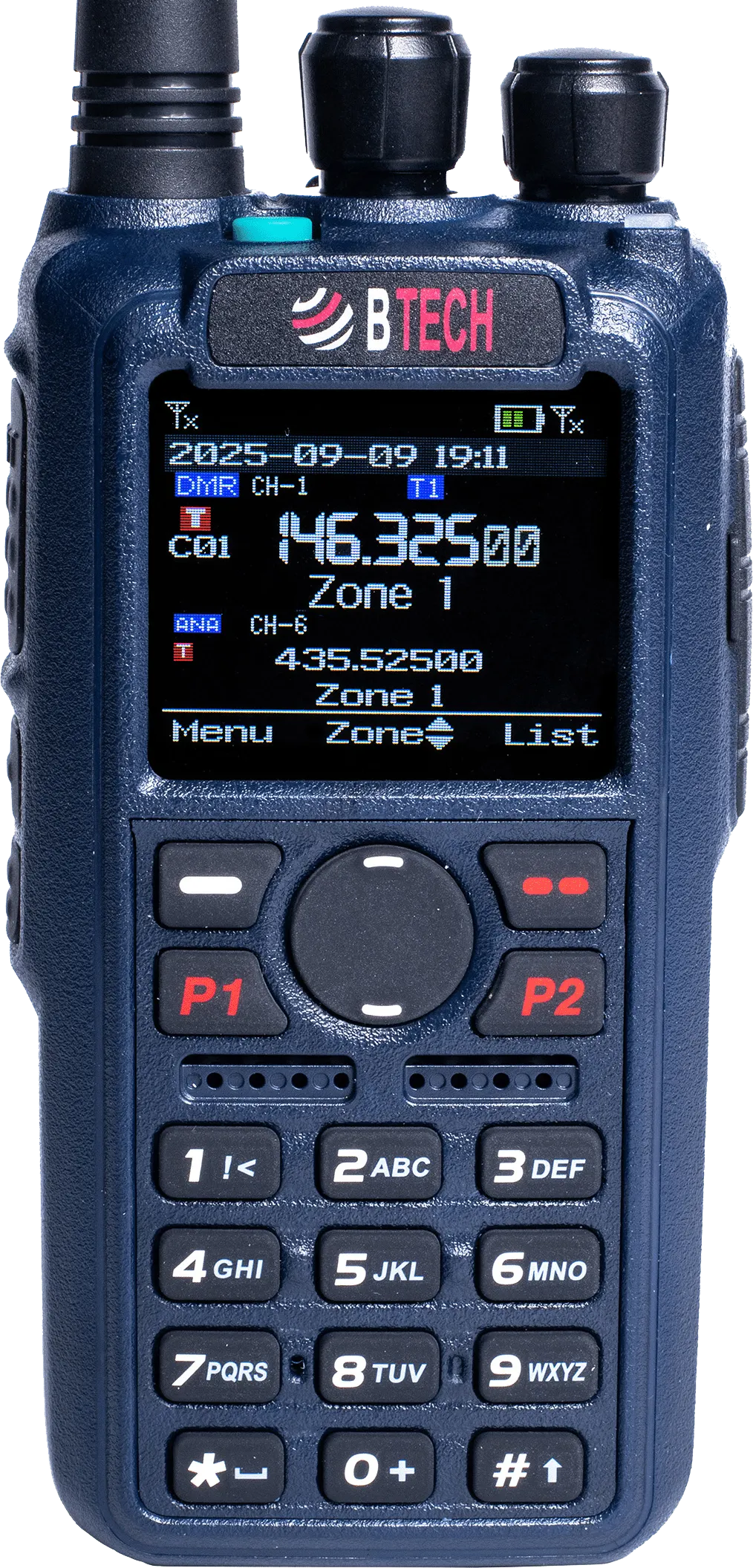
The AnyTone AT-D578UVIII Plus Tri-Band DMR Mobile Radio is an impressive option for amateur radio operators who want to combine digital communications, traditional analog radio, GPS-based location reporting, and versatile receiving capabilities in one well-equipped mobile transceiver. Designed for installation in a vehicle or a home radio shack, this radio brings together a broad collection of features that make it appealing to experienced operators, DMR enthusiasts, emergency communications volunteers, and hams looking to expand their capabilities.
What makes the AT-D578UVIII Plus particularly attractive is the combination of three amateur radio bands, high-power VHF and UHF transmission, Digital Mobile Radio (DMR) support, APRS location reporting, Bluetooth audio, and aircraft-band reception. Rather than requiring several separate radios to explore different types of local communications, operators can use this single unit as a central part of their station.
The advertised 50-watt VHF and 45-watt UHF output ratings provide substantial transmitting power for mobile operation, while the additional 220 MHz band opens another area of amateur radio to explore. Its color display, extensive channel capacity, programmable controls, GPS functionality, and included programming accessories make it a compelling choice for operators who appreciate having considerable control over their radio setup.
Another attractive aspect of this particular offering is the advertised free codeplug and training course. DMR programming can seem complicated to newcomers, so having additional programming resources can make the transition into digital amateur radio much easier.
The AnyTone AT-D578UVIII Plus is not simply a basic mobile transceiver with a few digital features added. It is a versatile communications platform designed to bring together multiple capabilities in one package.
A Closer Look at the AnyTone AT-D578UVIII Plus
AnyTone has developed a strong presence in the amateur radio market with equipment that combines analog operation with modern digital communication features. The AT-D578UVIII Plus follows that approach by giving operators access to both familiar FM communications and DMR digital voice.
Its tri-band configuration is one of its most appealing characteristics. Many mobile amateur radios concentrate on the two most commonly used local communication bands, 2 meters and 70 centimeters. This model also supports the 1.25-meter amateur band, commonly called the 220 MHz band in the United States.
That additional band is valuable for operators who have access to local 220 MHz repeaters or who want to experiment with another part of the amateur radio spectrum. Local activity varies by region, but having all three bands available in one radio provides useful flexibility.
The AT-D578UVIII Plus also incorporates GPS, APRS, Bluetooth, digital contacts, talk groups, repeater roaming, and a color display. These features make it suitable for operators who enjoy customizing their stations and taking advantage of the capabilities available through contemporary amateur radio networks.
For someone building a capable mobile station, this combination of features makes the radio particularly interesting.
Tri-Band Operation: VHF, UHF, and 220 MHz
One of the most important selling points of the AT-D578UVIII Plus is its ability to operate across three amateur radio bands.
The principal bands are:
2 meters (VHF), covering the U.S. amateur transmitting range of 144–148 MHz.
1.25 meters (220 MHz), covering 222–225 MHz.
70 centimeters (UHF), covering the U.S. amateur transmitting range of 420–450 MHz.
These bands each have their own characteristics, repeater networks, propagation considerations, and local operating communities. Having access to all three allows operators to select the band that best suits their communication needs and available infrastructure.
The 2-meter band is widely used for local FM communication, repeaters, emergency communication groups, and simplex contacts. Its widespread adoption makes it an essential part of many amateur radio stations.
The 70-centimeter band offers another major avenue for local communication. Many communities have UHF repeaters, and the band is also widely used by digital amateur radio networks. Its characteristics can make it particularly convenient for urban and suburban communications, although actual coverage depends on terrain, antenna placement, repeater locations, and surrounding structures.
The 220 MHz band adds another dimension. While local activity may be more limited than on 2 meters or 70 centimeters, operators who have access to 220 MHz repeaters can take advantage of a band that is not available on many conventional dual-band radios.
The ability to keep these three bands accessible from one mobile unit is a meaningful advantage. It can simplify a vehicle installation and reduce the need for multiple transceivers, microphones, power connections, and control arrangements.
For hams who enjoy exploring different bands, the tri-band design is one of the strongest reasons to consider this radio.
High-Power Transmitting Performance
The AT-D578UVIII Plus offers substantial transmitting power for a mobile amateur radio. Its commonly advertised U.S. model ratings are 50 watts on VHF and 45 watts on UHF, with lower selectable power levels for situations where maximum output is unnecessary. The 220 MHz band operates at lower power, with a commonly specified maximum of 5 watts.
These ratings provide plenty of capability for ordinary mobile operation, repeater access, and local simplex communications when paired with an appropriate antenna system.
Higher transmitter power can be useful when operating from a vehicle in areas with weak repeater coverage or when trying to improve the reliability of a simplex contact. However, power alone does not determine communication range. Antenna efficiency, antenna height, feed-line losses, terrain, receiver sensitivity, and propagation conditions all play important roles.
An efficient antenna mounted in a good location can make a substantial difference. A well-installed mobile station using the AT-D578UVIII Plus can be a strong combination for local communications and travel.
The radio also provides lower power settings, which are useful when operating near a repeater, communicating with another nearby station, or conserving electrical resources. Selecting the lowest power that reliably accomplishes the communication is often a sensible operating practice.
Because this is a high-power mobile transceiver, a suitable 13.8-volt DC power supply or vehicle electrical connection is important. The installation should use appropriately rated wiring, fusing, and connections, with enough current capacity to support transmission at the selected output level. The radio's installation instructions should be followed when choosing a power source.
For operators who want a substantial amount of VHF and UHF power in a single compact radio, the AT-D578UVIII Plus makes a strong case for itself.
Digital Mobile Radio: A Major Strength of This Transceiver
DMR is one of the most attractive capabilities of the AT-D578UVIII Plus. Digital Mobile Radio allows amateur radio operators to communicate through compatible digital repeaters and networks, opening up opportunities beyond conventional analog FM.
Unlike a traditional analog FM conversation, DMR uses digitally encoded voice and a structured system of talk groups, time slots, color codes, and radio identification numbers. Once configured correctly, this allows operators to participate in local and wider-area digital communication networks.
For amateur radio enthusiasts interested in worldwide contacts, digital voice can be especially appealing. Depending on the network, repeater infrastructure, internet connections, and talk-group availability, a local radio can provide access to conversations and contacts well beyond the immediate coverage area.
The AT-D578UVIII Plus supports DMR operation alongside analog modes, making it useful for operators who do not want to abandon traditional FM communications while exploring digital radio.
That flexibility is important because analog repeaters remain widely used. Some operators spend most of their time on analog FM, while others primarily use digital networks. The AnyTone gives users a way to work with both.
DMR Talk Groups and Digital Contacts
Talk groups help organize digital communications around particular regions, interests, or operating communities. An operator might use one talk group for local activity, another for regional communications, and another for broader conversations.
The radio's substantial digital contact and talk-group capacity makes it well suited to an extensive programmed channel collection. The manufacturer and distributor specifications list support for thousands of talk groups and a very large digital contact database, depending on the programming software and database version being used.
A well-organized codeplug can make these features much easier to use. Instead of repeatedly entering frequencies and digital settings, operators can select a programmed channel and communicate through the intended repeater or talk group.
DMR requires more preparation than a basic analog FM radio, but that preparation opens the door to a much broader range of communication options.
Digital Voice Quality
One of DMR's main attractions is its clear, consistent digital voice when the received signal is strong enough for reliable decoding. Digital transmissions can sound clean and intelligible without the familiar background hiss of analog FM.
As the signal becomes too weak or corrupted, however, digital audio can deteriorate abruptly. This is a normal characteristic of digital communication rather than a unique flaw of this radio.
The AT-D578UVIII Plus gives operators the opportunity to enjoy digital communications while retaining analog FM for contacts and repeaters that do not use DMR.
For anyone wanting to make DMR a central part of their amateur radio activities, that combination is a significant advantage.
The Free Codeplug and Training Course: A Valuable Bonus
One of the most appealing elements of the advertised package is the inclusion of a free codeplug and training course.
For newcomers, DMR programming can initially appear intimidating. A channel may require the correct frequency, transmit offset, color code, time slot, talk group, contact information, and other settings before everything works as expected. Simply knowing the repeater frequency is not always enough.
A codeplug is the programmed collection of channels, zones, contacts, talk groups, and other radio settings. It provides the structure that makes a DMR radio convenient to operate.
An appropriate starter codeplug can save time by providing a useful foundation for building a personal channel list. Rather than starting from an empty programming file, a user may be able to load a compatible configuration and adapt it to local repeaters and individual preferences.
The training course is also a welcome addition because understanding the programming process is more valuable than simply loading a file. Operators who learn how the settings work can troubleshoot problems, add new repeaters, organize zones, and keep their programming current.
Why a Starter Codeplug Matters
A properly prepared codeplug can make the initial setup much less frustrating. It may contain commonly used channels, digital contacts, and talk groups appropriate to a particular region or operating community.
However, codeplugs are not universally interchangeable. They must match the radio model and, where applicable, the firmware and programming software version. A codeplug prepared for another region may also contain repeaters or talk groups that are not useful to a particular operator.
The best approach is to use the advertised codeplug as a starting point, verify the local repeater information, and save a personal backup before making major changes.
With that foundation, the AT-D578UVIII Plus becomes easier to configure and more enjoyable to use.
For buyers who want to get into DMR without learning every programming detail from scratch, the additional training resources can make this package especially attractive. Buyers should confirm the exact course contents and codeplug compatibility with the seller.
APRS Location Reporting: Useful Information Beyond Voice
Automatic Packet Reporting System (APRS) is another major feature of the AT-D578UVIII Plus. APRS allows amateur radio stations to exchange position information and other data using compatible radio systems and networks.
When properly configured, the radio's GPS capability can supply location information for APRS transmissions. Other stations equipped to receive and interpret those packets may then display the transmitting station's position on a compatible mapping or tracking system.
This can be useful for mobile operators, amateur radio events, organized activities, and groups interested in sharing station locations.
For example, an operator traveling between towns might use APRS to make a station's approximate location available to other APRS users. During a radio event, participating stations may be able to monitor the movement of mobile operators or see where different stations are located.
APRS is not limited to transmitting coordinates. Depending on the network and configuration, the broader APRS system can carry station identifiers, status information, and certain types of messages.
The AT-D578UVIII Plus is advertised with analog and digital APRS capabilities, allowing operators to explore location reporting in different operating environments.
GPS Integration
Having GPS built into the radio simplifies the overall station arrangement. Rather than requiring a separate GPS receiver for basic position reporting, the radio can obtain positioning information through its integrated system when it has a suitable GPS signal.
GPS reception is affected by the installation location. A radio or antenna positioned inside a vehicle with limited sky visibility may not receive satellite signals as reliably as a properly positioned GPS antenna.
Once configured, GPS-assisted APRS can add a useful layer of information to mobile radio operation.
APRS for Events and Mobile Stations
APRS is particularly interesting for operators who travel, participate in public service events, or enjoy experimenting with radio data systems.
During a group ride, club activity, or organized amateur radio event, APRS-equipped stations may be able to share their approximate positions with compatible stations and services. This can improve situational awareness and make it easier to follow the movement of participating operators.
As with any radio-based system, performance depends on the coverage available, packet settings, antenna placement, and the presence of stations or infrastructure capable of receiving and relaying the information.
For operators interested in combining voice communications with location data, the AT-D578UVIII Plus offers a particularly useful collection of tools.
Aircraft Band Reception: An Interesting Extra Capability
Another welcome feature is AM aircraft-band reception. The radio can receive civilian aviation communications in the 108–136 MHz range, allowing appropriately configured users to monitor compatible aircraft-band transmissions.
This feature adds listening flexibility beyond the usual amateur radio bands. Aviation enthusiasts may appreciate the ability to listen to aircraft communications while traveling or operating from a suitable location.
Depending on location, antenna performance, and the activity of nearby aircraft, the receiver may allow users to hear air traffic control communications and pilot transmissions.
Aircraft-band reception is a receive-only capability. It does not turn the radio into an aviation transmitter, nor does it replace dedicated aviation communication equipment.
The ability to listen to aviation frequencies from the same radio used for amateur VHF, UHF, and 220 MHz communications is a useful bonus. It expands the range of radio activity an owner can explore without requiring a separate receiver.
For hams who enjoy monitoring different kinds of radio traffic, this is a feature that adds practical value.
Bluetooth Audio and Wireless Convenience
Bluetooth support brings a modern convenience to the AT-D578UVIII Plus. For mobile operators, reducing cable clutter and making radio controls easier to access can improve the overall operating experience.
The radio's Bluetooth functionality and compatible push-to-talk accessories can provide a wireless control option, while supported Bluetooth audio arrangements can make hands-free operation more convenient.
This can be useful when the radio is installed under a dashboard, behind a vehicle console, or in another location where reaching the main unit is inconvenient.
A compatible Bluetooth accessory may allow the operator to manage selected functions without having to handle the radio itself. Compatibility depends on the accessory and the specific Bluetooth function being used, so it is worth confirming which accessories are supported.
Bluetooth in a Vehicle
A clean mobile installation can make a big difference in how often a radio is used. A wireless push-to-talk accessory can help reduce the number of cables running across the dashboard or center console.
That can be especially welcome in vehicles where space is limited or where the radio body is mounted away from the driver.
Bluetooth does not eliminate the importance of safe driving practices. Radio controls should be configured and positioned so that operating the equipment does not distract the driver, and applicable hands-free laws should always be followed.
For a modern mobile station, Bluetooth is a useful convenience rather than merely a novelty.
Loud Speaker Audio and Clear Communications
Good audio is essential for a radio that will be used regularly in a vehicle. A strong signal is of limited value if the operator cannot comfortably hear the other station.
The AT-D578UVIII Plus supports external speaker arrangements, and its advertised loud-speaker capability makes it appealing for mobile installations where road noise, ventilation fans, or other background sounds can make ordinary radio audio difficult to hear.
The ability to position an external speaker separately from the transceiver can help an operator create a more comfortable station layout. The speaker can be placed closer to the driver or listener rather than relying entirely on audio coming from a radio mounted under a seat or inside a console.
A good speaker placement can improve perceived intelligibility without changing the actual received signal.
Audio quality will still depend on the incoming transmission, the selected audio settings, the speaker used, and the acoustic environment. Nevertheless, the option to build a more audible mobile setup is an important practical advantage.
For daily commuting, highway travel, and routine repeater monitoring, clear and comfortably audible communications can make the radio more enjoyable to use.
Color Display and Front-Panel Controls
The AT-D578UVIII Plus includes a color TFT display that provides a modern interface for viewing channel information and operating status.
A well-organized display is especially useful on a feature-rich radio. With analog and digital modes, multiple bands, GPS information, channel lists, and programmable functions available, clear access to essential information helps keep routine operation manageable.
The radio supports a single-channel or dual-channel display arrangement. This provides flexibility for operators who want to focus on one active channel or keep more than one channel visible.
Dual-channel viewing is particularly helpful for monitoring different communications channels, although the exact behavior of the receiver and simultaneous monitoring depends on the selected operating configuration.
The display also supports customization options, allowing operators to adjust aspects of its appearance to their preferences.
The front panel and supplied microphone controls provide access to radio functions, while computer programming allows more extensive configuration away from the radio itself.
For operators who enjoy tailoring their equipment, the display and control options make the radio feel like a configurable station rather than a basic fixed-function transceiver.
Extensive Channel Capacity and Programming Flexibility
The AT-D578UVIII Plus offers capacity for up to 4,000 memory channels, along with extensive digital contact and talk-group storage.
That is a substantial amount of room for organizing an active radio station. Operators can build channel lists for local repeaters, nearby towns, travel routes, digital networks, simplex frequencies, and other commonly used communications.
Zones help group related channels together. A mobile operator might create one zone for a home region, another for a frequently traveled route, and another for digital repeaters. Someone using the radio primarily from a home shack might organize zones around local clubs, operating bands, or specific types of communication.
A thoughtful channel arrangement makes a considerable difference in daily usability. The goal is to make frequently used channels easy to find without forcing the operator to scroll through a long, unorganized list.
Computer programming is especially valuable when configuring a radio with this much capacity. It allows the operator to manage a large number of channels more efficiently than entering every setting individually from the front panel.
The included USB programming cable and compatible programming software provide a route for building and maintaining that configuration.
A good backup strategy is recommended. Saving a copy of the working codeplug before making substantial changes makes it easier to restore a known-good configuration if an experiment or programming update causes unexpected behavior.
Built-In GPS, Repeater Roaming, and Additional Features
The AT-D578UVIII Plus offers more than voice transmission and reception. Its GPS and roaming capabilities add useful tools for operators who travel or maintain extensive repeater lists.
Repeater roaming can help the radio search for or transition among configured repeaters according to the available roaming settings. This is especially relevant to digital mobile operation, where an operator may travel through multiple repeater coverage areas.
The usefulness of roaming depends on how the radio and channel data are programmed, as well as the participating repeater network. It is not a guarantee of uninterrupted communications everywhere, but it can help reduce the need for constant manual channel selection when configured appropriately.
The radio also supports cross-band repeater functionality, allowing certain compatible configurations to relay communications between supported bands. This can be valuable for experimentation and specialized station arrangements.
Cross-band operation requires careful configuration and compliance with the rules governing the frequencies and services involved. It should not be treated as an automatic replacement for a dedicated repeater system.
Additional features described in the radio's documentation include digital monitoring, analog tone functions, messaging, and other programmable options. The exact availability and operation of individual features can depend on the firmware, configuration, and version of the radio.
Taken together, these functions make the AT-D578UVIII Plus an appealing platform for operators who want to learn, experiment, and develop a more advanced station over time.
Analog FM Operation: Still an Important Part of the Package
Although DMR receives much of the attention, analog FM remains an important part of the AT-D578UVIII Plus.
Many amateur radio operators continue to use analog FM repeaters for everyday conversations, club communications, travel, and local simplex contacts. Keeping analog capability alongside DMR means users can participate in these established communities without maintaining a separate transceiver.
The radio supports conventional analog functions, including tone squelch options such as CTCSS and DCS, where configured for the intended channel.
These settings help an operator access repeaters or communicate with stations using particular tone arrangements. They do not provide privacy or encryption, but they can help manage which signals open the receiver's squelch.
The combination of analog and digital operation is one of the radio's most practical strengths. Owners can gradually expand into DMR while continuing to use the analog channels they already know.
This makes the radio suitable for both experienced digital operators and licensed hams who are beginning to explore digital voice.
Mobile Installation and Home-Shack Use
The AT-D578UVIII Plus is designed as a mobile transceiver, but its capabilities also make it suitable for a permanent amateur radio station.
Installation in a Vehicle
For mobile use, the radio's compact body can be installed in a suitable location while the microphone and controls remain accessible to the operator. The mounting bracket helps secure the unit, and a properly selected external speaker can improve listening comfort.
A well-planned installation should account for ventilation, access to controls, safe cable routing, antenna placement, and the vehicle's electrical system.
A properly installed antenna is particularly important. A multiband antenna designed for the bands being used can provide access to the radio's capabilities without requiring a separate antenna for every band, although the antenna's actual coverage and performance must be checked.
The radio's output power makes sound electrical installation important. Wiring, connectors, fuses, and the power source should be rated for the intended current demand.
Installation in a Home Radio Shack
The same radio can serve as a fixed station when connected to a suitable regulated 13.8-volt DC supply with sufficient current capacity.
A home installation offers more opportunities to use an efficient antenna mounted in a favorable location. An outdoor antenna, correctly installed coaxial cable, and an appropriate mounting arrangement can all contribute to better communications.
The radio can then serve as a central VHF, UHF, and 220 MHz station, with DMR and analog channels organized around the owner's operating interests.
Its broad feature set can make it a useful addition to a station that already includes HF equipment. While it does not replace an HF transceiver for traditional long-distance HF operation, it can complement one by providing local and regional VHF/UHF communications and digital voice access.
For hams who want a capable local-communications station at home and in a vehicle, the AT-D578UVIII Plus is a versatile option.
Build Quality and Everyday Appeal
A radio intended for regular mobile operation needs to be practical, configurable, and dependable in its intended environment. The AT-D578UVIII Plus combines a compact transceiver body with a separate microphone, mounting hardware, and programming support.
Its design emphasizes functionality, with a color display and controls suited to a radio offering a large number of operating options.
The radio's value also comes from the way its features work together. Tri-band operation provides frequency flexibility. DMR opens digital networks. GPS and APRS add location information. Bluetooth provides additional operating convenience. Aircraft-band reception adds listening capability beyond the amateur bands.
That combination is what makes the model stand out. Instead of concentrating on just one specialty, it gives the operator a broad set of capabilities to explore as interests develop.
A well-planned installation and a carefully maintained codeplug can help make the most of those features for everyday operation.
Getting Started with the AT-D578UVIII Plus
For a new owner, a sensible setup process can make the radio much easier to learn.
First, read the manual and confirm the exact model version, firmware, and programming software required. Save the factory programming data before making major changes, following the manufacturer's instructions.
Next, install the appropriate programming software and cable, then build a small initial channel list. Begin with a few local analog repeaters and simplex channels before moving on to DMR.
For DMR operation, confirm the repeater's receive and transmit frequencies, offset, color code, time slot, talk group, and other required settings. Make sure the radio ID and contact configuration are appropriate for the networks being used.
Once basic voice communication is working, add more channels and organize them into useful zones. Then explore GPS and APRS configuration, Bluetooth accessories, dual-channel monitoring, and roaming.
Testing one feature at a time is usually more productive than changing many settings at once. It also makes troubleshooting easier because the operator can identify which change affected the radio's behavior.
The advertised codeplug and training course can be particularly helpful during this process, provided the materials match the exact radio and intended operating region.
Finally, verify that the antenna and power installation are appropriate for the selected band and power level. A little care during initial setup can pay dividends in convenience and reliable operation later.
Who Should Consider the AnyTone AT-D578UVIII Plus?
This radio is especially appealing to several types of amateur radio operators.
The DMR enthusiast: Operators who want access to digital repeaters, talk groups, and digital contacts will appreciate the combination of DMR and conventional analog operation.
The mobile operator: Hams who spend considerable time traveling can take advantage of the three amateur bands, programmable channels, GPS features, Bluetooth options, and repeater roaming.
The experienced amateur: Operators who enjoy programming, customizing channels, and experimenting with digital features will find considerable room to build a personalized setup.
The operator upgrading from a basic dual-band radio: Someone who has outgrown a simple VHF/UHF transceiver may appreciate the additional 220 MHz capability, DMR functionality, and extensive programming options.
The home-shack builder: A ham assembling a versatile local-communications station can use the radio as a central VHF/UHF/220 MHz transceiver with analog, digital, and APRS capabilities.
The radio hobbyist: Aircraft-band reception, GPS, and APRS provide additional ways to explore radio technology beyond routine voice contacts.
The radio may be more feature-rich than someone needs if their only goal is occasional analog FM communication. For operators who intend to use its broader capabilities, however, that flexibility is part of its appeal.
Important Specifications at a Glance
The following summarizes the principal features commonly listed for the U.S. tri-band AT-D578UVIII Plus configuration.
Radio type: Tri-band digital and analog mobile transceiver.
Digital mode: DMR, including Tier II operation.
Analog mode: Conventional analog FM.
VHF amateur transmitting range: 144–148 MHz.
220 MHz amateur transmitting range: 222–225 MHz.
UHF amateur transmitting range: 420–450 MHz.
Advertised VHF output: Up to 50 watts.
Advertised UHF output: Up to 45 watts.
220 MHz output: Up to approximately 5 watts, depending on the specified configuration.
Aircraft-band reception: AM reception across 108–136 MHz.
Location features: Built-in GPS and APRS functionality.
Wireless features: Bluetooth functionality with compatible accessories.
Memory capacity: Up to 4,000 channels.
Display: Color TFT screen with single- and dual-channel display options.
Power requirement: Nominal 13.8-volt DC supply.
Programming: Computer-based programming with compatible software and cable.
Additional capabilities: Repeater roaming, digital contacts and talk groups, and cross-band repeater functionality.
Specifications and included accessories can vary by regional model, firmware, and retailer package. The exact unit and supplied accessories should be confirmed with the seller before purchase.
Final Verdict: A Feature-Rich Mobile Radio with Plenty to Offer
The AnyTone AT-D578UVIII Plus Tri-Band DMR Mobile Radio is an attractive choice for amateur radio operators who want more than a conventional analog mobile transceiver.
Its combination of VHF, UHF, and 220 MHz operation provides useful band flexibility, while the advertised 50-watt VHF and 45-watt UHF output levels give it substantial mobile transmitting capability. DMR support expands the radio's communication possibilities, and analog FM compatibility keeps it useful for traditional local repeaters and simplex contacts.
GPS and APRS add location-reporting capabilities, aircraft-band reception provides an additional listening option, and Bluetooth offers modern convenience for compatible mobile installations. The color display, extensive memory capacity, programming software support, and configurable channel organization further strengthen the overall package.
The advertised free codeplug and training course are welcome additions, especially for operators who want to get started with DMR without having to learn every programming detail entirely on their own.
Perhaps the biggest advantage of this radio is its versatility. It can serve as a mobile communications center, a capable home-shack transceiver for local bands, or a platform for exploring digital voice and location reporting. Owners can begin with basic analog operation and gradually incorporate more advanced functions as their interests grow.
For licensed amateur radio operators looking for a powerful, modern, feature-packed tri-band mobile radio, the AnyTone AT-D578UVIII Plus deserves serious consideration. It combines a broad range of capabilities in one unit and offers plenty of room for an operator's station and skills to develop over time.
Overall assessment: The AnyTone AT-D578UVIII Plus stands out as a versatile and well-equipped choice for hams who want tri-band coverage, DMR digital voice, APRS, GPS, Bluetooth convenience, aircraft-band reception, and substantial VHF/UHF power in a single mobile transceiver.