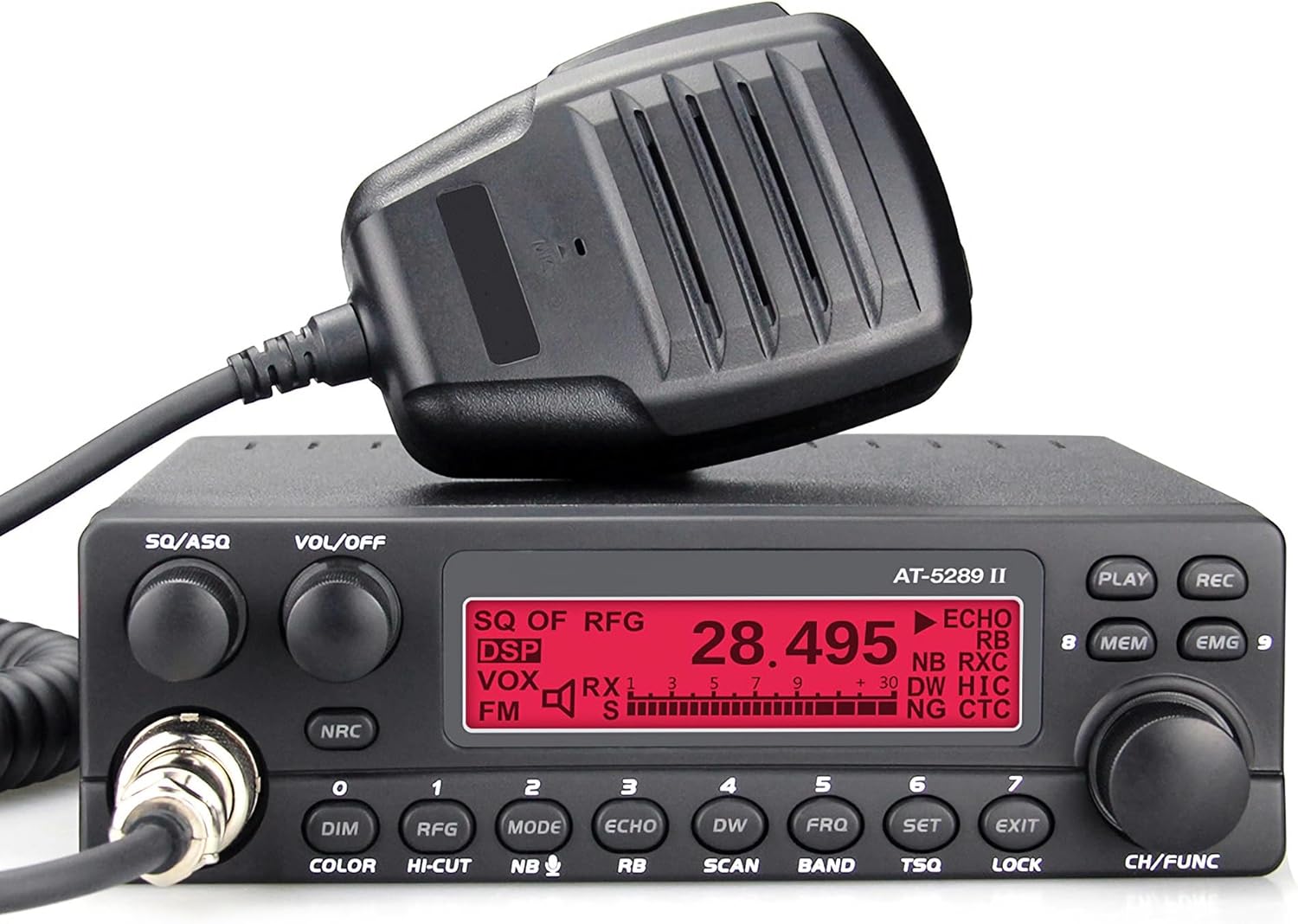
The world of 10 meter amateur radio continues to grow in popularity, especially among operators who enjoy long-distance contacts, mobile installations, and powerful AM/FM communication. The HESENATE AT-5289 II enters this market as a feature-packed 50 watt mobile transceiver designed for operators who want strong performance without stepping into the price range of premium export radios. With programmable functions, NRC noise reduction, dual watch capability, recording features, SWR monitoring, and CTCSS/DCS support, this radio offers far more than a basic 10 meter mobile rig.
The AT-5289 II is designed for operators who want flexibility. Whether mounted in a vehicle, installed as a compact base station, or used for highway communications and skip conditions, this radio tries to balance modern digital conveniences with traditional radio operation. It supports both AM and FM modes, offers customizable programming, and includes several audio enhancement tools that improve overall usability.
One of the first things operators notice about the AT-5289 II is its bold appearance. The large front display uses multi-color lighting with adjustable brightness levels, making it easy to read during daytime driving or nighttime operation. The layout feels modern while still maintaining the familiar look of classic mobile radios. Large buttons, a multifunction control knob, and an easy-to-read meter display give the radio a professional appearance.
Build quality is surprisingly solid for a radio in this category. The chassis feels durable and well suited for mobile use. The cooling system is effective, especially during longer transmissions at higher power levels. Heat management is important in a 50 watt radio, and the AT-5289 II handles it fairly well during extended operation.
Performance is where this radio begins to stand out. The 50 watt output provides strong transmit capability across the 10 meter band. Operators using properly tuned antennas will appreciate the extra power when band conditions begin opening up. On AM, the radio delivers loud and clean audio with impressive modulation. FM operation is equally strong and stable, making local contacts easy and enjoyable.
Receiver performance is also quite respectable. Weak signals remain understandable, and the radio handles crowded band conditions reasonably well. One of the major highlights is the NRC noise reduction system. This feature helps reduce background static and road noise, particularly in mobile environments. Operators driving on highways or using the radio near electrical interference sources will likely notice a major improvement in audio clarity.
The NRC system is especially useful during poor band conditions. Instead of constantly fighting static and hiss, operators can engage noise reduction to make incoming signals cleaner and easier to understand. While it will not completely eliminate atmospheric noise, it does improve the listening experience significantly compared to older radios without DSP-style filtering.
Another useful feature is dual watch operation. This allows operators to monitor two frequencies or channels at once. For mobile users, this is extremely helpful because it allows monitoring of local calling frequencies while still keeping track of another active conversation or repeater frequency.
The built-in recording feature is another uncommon addition in this class of radio. Operators can record conversations or voice notes directly from the radio, which can be useful for logging contacts, remembering frequencies, or reviewing important information later. While not every operator will use this daily, it is a feature many radios in this price range simply do not offer.
SWR monitoring and protection are also valuable additions. A poor antenna match can quickly damage high-power radios, especially during extended transmission periods. The AT-5289 II includes SWR display functionality and protection systems that help reduce the risk of damage when antenna conditions are not ideal. This makes the radio friendlier for newer operators who may still be learning antenna tuning and installation.
The radio also includes repeater shift functions and programmable settings, giving advanced users additional flexibility. Operators who enjoy modifying frequencies and customizing operation will appreciate the programmable nature of the radio. The menu system may take some time to learn initially, but most operators become comfortable with it after regular use.
Microphone audio quality is another strong point. The included microphone delivers loud and clear transmit audio with good punch on AM. Many operators report that export-style radios either sound overly compressed or distorted at higher power levels, but the AT-5289 II generally maintains clean communication when adjusted correctly.
The front speaker produces decent audio volume, though external speakers can further improve clarity in noisy vehicles. Like many mobile radios, adding a quality external speaker can greatly enhance the overall listening experience.
The display system deserves additional praise. Multi-color illumination options allow operators to customize the appearance of the radio to match their vehicle dashboard or operating environment. Adjustable dimming also helps reduce eye strain during nighttime driving.
For operators who enjoy customization, the programmable function keys are extremely useful. Frequently used functions can be assigned for quick access, reducing the need to dig through menus while operating mobile. This improves safety and convenience during driving.
One area where some users may experience a learning curve is the menu system itself. Because the radio includes many advanced functions, navigating through all settings can initially feel overwhelming for operators used to simpler radios. However, once familiar with the controls, the radio becomes much easier to operate efficiently.
Another consideration is that 10 meter operation depends heavily on band conditions. During solar peaks and active propagation periods, the radio truly shines with long-distance skip communication. During quieter conditions, operators may rely more heavily on local FM activity. Fortunately, the strong receiver and high transmit power help maximize performance whenever openings occur.
The AT-5289 II is particularly appealing to operators who enjoy export-style radios but want modern features often absent from older designs. Features like NRC noise reduction, recording capability, programmable controls, and SWR protection give the radio a much more current feel compared to traditional analog-only mobiles.
Specifications
| Attribute | HESENATE AT-5289 II |
|---|---|
| Power Output | 50 Watts |
| Modes | AM / FM |
| Noise Reduction | RX/TX NRC |
| Dual Watch | Yes |
| Recording Function | Yes |
| SWR Meter | Built-In |
| CTCSS/DCS | Supported |
| Repeater Shift | Yes |
| Display | Multi-Color LCD |
| Programming | Programmable Functions |
| Mobile Friendly | Excellent |
Final Thoughts
Overall, the HESENATE AT-5289 II is an impressive 10 meter transceiver that delivers strong value for operators wanting modern features, high transmit power, and flexible operation. It combines the personality of classic export radios with several updated technologies that improve daily usability. The NRC noise reduction system, recording functions, dual watch operation, and built-in SWR protection make it stand out from many competing radios in its class.
For mobile operators, highway communicators, and 10 meter enthusiasts looking for a powerful and feature-rich transceiver, the AT-5289 II offers an excellent combination of performance, customization, and capability. While the menu system may require some learning, the overall feature set and operating experience make this radio a strong contender in the growing 10 meter mobile market.


