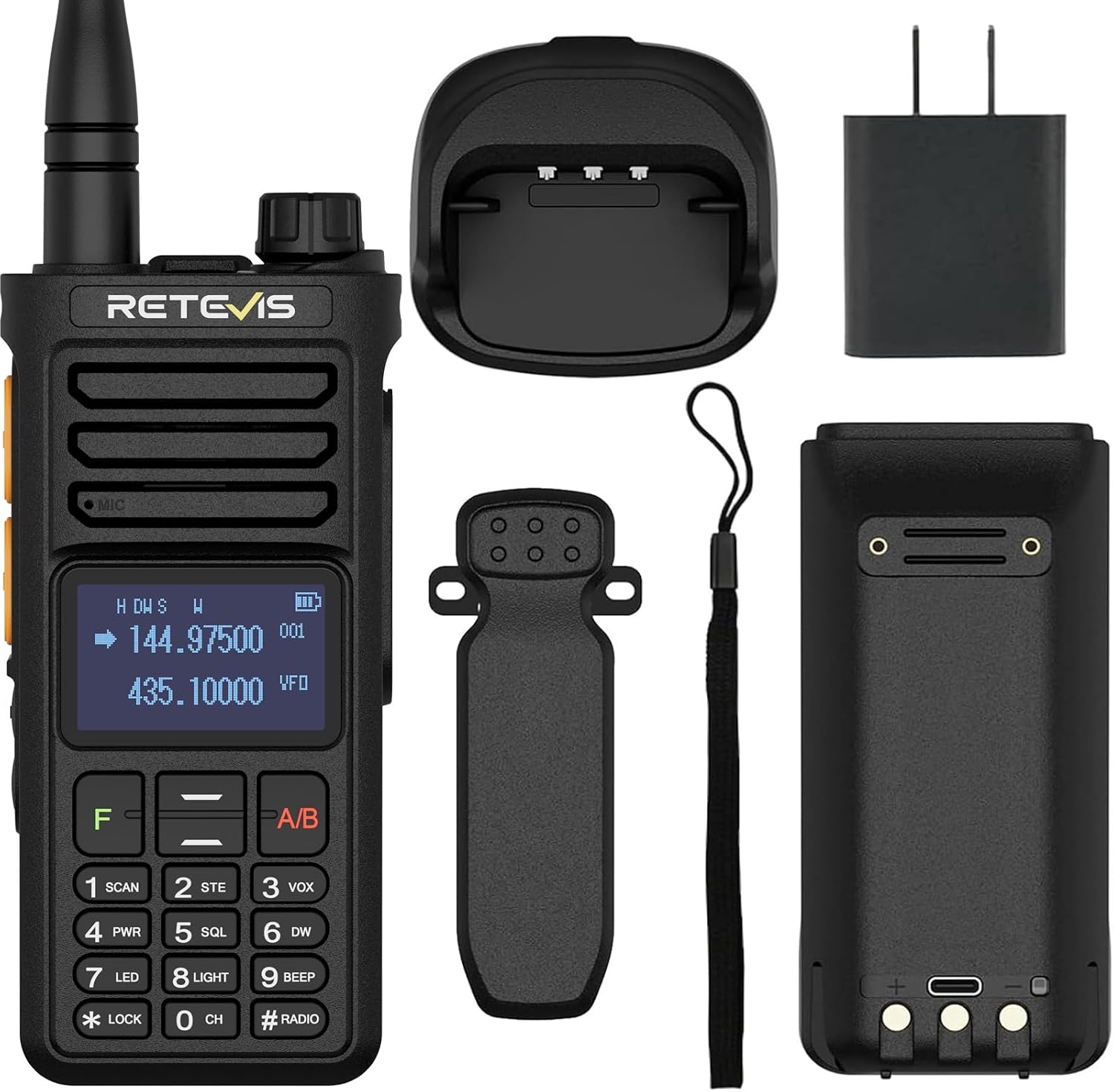
The Retevis RA89R is one of the most feature-rich handheld amateur radios available in its price range. Rather than focusing solely on higher transmit power or a larger battery, the RA89R combines modern smartphone connectivity with advanced amateur radio capabilities that are typically found on more expensive mobile transceivers.
Designed for licensed amateur radio operators, this dual-band VHF/UHF handheld includes Bluetooth app programming, USB-C charging and programming, dual watch, NOAA weather alerts, aviation band reception, and one of its most impressive features—a built-in cross-band repeater. These capabilities make it much more than an ordinary handheld radio and position it as an excellent choice for emergency communications, outdoor adventures, and everyday amateur radio operation.
Whether you are a new ham, an experienced operator, an ARES volunteer, an off-road enthusiast, or a prepper looking for a dependable communications tool, the RA89R offers an outstanding combination of performance, convenience, and value.
Specifications
- Dual-band VHF/UHF operation
- Cross-band repeater capability
- Bluetooth smartphone programming
- USB-C charging and programming
- 2800mAh rechargeable lithium-ion battery
- High, medium, and low transmit power settings
- Up to 200 memory channels
- Dual Watch
- Dual PTT buttons
- NOAA Weather Alert
- AM aviation band reception
- FM broadcast receiver
- CTCSS and DCS signaling
- VOX hands-free operation
- Two-tone and five-tone signaling
- IP54 dust and water resistance
- Firmware upgrade capability
First Impressions
The RA89R immediately gives the impression of being a well-built and thoughtfully designed radio. It feels solid in the hand without becoming excessively heavy, and the controls are easy to reach and operate. The buttons provide good tactile feedback, while the knobs rotate smoothly and precisely.
The display is bright and easy to read, making it suitable for both indoor and outdoor use. Unlike many budget handhelds that closely resemble one another, the RA89R has a modern appearance and an ergonomic design that makes it comfortable to use during extended operating sessions.
One of the first features users will appreciate is the inclusion of USB-C charging, eliminating the need to carry proprietary charging equipment.
Build Quality
Retevis has done an excellent job creating a radio that feels durable enough for regular field use. The housing is sturdy, and the radio has a quality feel that inspires confidence during outdoor activities.
Its IP54 rating provides protection from dust and water splashes, making it suitable for:
- Hiking
- Camping
- Parks on the Air (POTA)
- Search and rescue support
- Storm spotting
- Emergency communications
- Off-road adventures
- Field Day operations
Although it is not designed for complete submersion in water, it offers enough environmental protection for most amateur radio activities.
Cross-Band Repeater Capability
One of the RA89R's biggest selling points is its built-in cross-band repeater function.
Cross-band repeat allows the radio to receive signals on one amateur band while simultaneously retransmitting them on another. For example, it can receive on UHF and retransmit on VHF, or receive on VHF and retransmit on UHF.
This feature is uncommon on handheld radios and is usually reserved for higher-priced mobile transceivers.
Cross-band repeat opens numerous possibilities, including:
- Extending handheld communication range
- Temporary event communications
- Emergency communication networks
- Remote base operation
- Off-road convoy communications
- Campground communications
- Portable repeater applications
For operators who participate in public service events or emergency communications, this capability can significantly increase the radio's usefulness.
Bluetooth App Programming
Programming handheld radios has traditionally required a programming cable and a computer. The RA89R simplifies this process with Bluetooth smartphone programming.
Using the companion app, operators can easily manage:
- Frequencies
- Memory channels
- Channel names
- Power levels
- Various radio settings
Being able to update radio programming directly from a smartphone is extremely convenient, especially during field operations where access to a computer may not be available.
For clubs, emergency response groups, and traveling operators, wireless programming is a major advantage.
USB-C Charging
USB-C charging is one of the most practical features included with the RA89R.
Because USB-C has become the standard charging connector for many electronic devices, operators can recharge the radio using:
- USB wall chargers
- Vehicle chargers
- Portable power banks
- Solar charging systems
- Laptop USB ports
This flexibility is especially valuable for emergency preparedness and extended outdoor operations, reducing the need to carry specialized charging equipment.
Battery Performance
The included 2800mAh battery provides impressive operating time for a handheld radio.
Under normal operating conditions, most users should expect a full day of use before requiring a recharge. Battery life will naturally vary depending on several factors, including transmit power, receive time, scanning activity, display brightness, and cross-band repeater usage.
The large battery capacity gives the RA89R an advantage over many entry-level handheld radios that use smaller battery packs.
Audio Performance
The RA89R delivers clear and natural audio quality on both transmit and receive.
Incoming audio is loud enough for outdoor environments without sounding harsh or distorted. Transmitted audio is generally clear and easy for other operators to understand, making it well suited for repeater use and simplex communications.
The radio also supports Bluetooth accessories, allowing for hands-free operation in a variety of situations.
Receiver Performance
Receiver sensitivity is very good for a handheld radio in this price range.
The RA89R provides reliable reception across the amateur VHF and UHF bands while also including several additional listening capabilities.
These include:
- Amateur repeaters
- Simplex frequencies
- NOAA weather channels
- FM broadcast radio
- AM aviation communications
The ability to monitor aviation traffic adds another layer of usefulness for aviation enthusiasts and emergency communicators.
User Interface
The menu system is organized logically and is relatively easy to navigate after a short learning period.
The bright display, dedicated function buttons, dual PTT controls, and straightforward menu layout make operating the radio comfortable even during extended use.
Experienced amateur radio operators should become familiar with the controls quickly, while newer operators will appreciate the availability of smartphone programming to simplify setup.
Programming Options
The RA89R offers several methods for programming and configuring the radio.
Users can choose from:
- Front panel programming
- Bluetooth smartphone programming
- USB-C computer programming
- Manufacturer programming software
Having multiple programming methods provides flexibility depending on the operating environment and user preference.
Emergency Communications
The RA89R is particularly well suited for emergency communication applications.
Its feature set includes many capabilities valued by emergency communication groups, including:
- Cross-band repeater operation
- NOAA Weather Alerts
- Long battery life
- USB-C charging
- Dual Watch
- High transmit power
- Rugged construction
- Smartphone programming in the field
These features make it an excellent option for:
- ARES
- RACES
- CERT
- Storm spotting
- Disaster preparedness
- Community emergency response
Outdoor Performance
Outdoor operators will find the RA89R to be a dependable companion for a wide variety of activities.
It performs well during:
- Hiking
- Backpacking
- Camping
- Hunting
- Fishing
- Jeep and off-road trips
- Overlanding
- Parks on the Air activations
- Search and rescue support
The combination of rugged construction, large battery capacity, and flexible charging options makes it particularly attractive for extended field operations.
Advantages
The RA89R offers an impressive list of strengths, including:
- Built-in cross-band repeater capability
- Bluetooth smartphone programming
- USB-C charging and programming
- Large 2800mAh battery
- Bright and easy-to-read display
- Excellent receiver sensitivity
- NOAA Weather Alerts
- Aviation band reception
- FM broadcast receiver
- Dual Watch
- Dual PTT buttons
- Firmware upgrade support
- Rugged construction
- Excellent value for the price
Disadvantages
While the RA89R has many strengths, there are a few areas that some users may consider drawbacks.
Potential disadvantages include:
- Slightly larger and heavier than compact handheld radios
- IP54 protection rather than full waterproof construction
- Advanced features may require some learning for beginners
- Cross-band repeater operation consumes battery power more quickly
- Some third-party programming software may not fully support all features
Who Should Buy the Retevis RA89R?
The RA89R is an excellent choice for a wide variety of amateur radio operators, including:
- Newly licensed hams
- Experienced operators
- Emergency communicators
- ARES and RACES volunteers
- CERT members
- Preppers
- Campers
- Off-road enthusiasts
- Search and rescue volunteers
- Parks on the Air operators
- Anyone looking for an advanced handheld radio without paying premium prices
Its combination of modern technology and advanced amateur radio capabilities makes it suitable for both casual operating and serious emergency communications.
Final Verdict
The Retevis RA89R stands out in the crowded handheld radio market by offering an exceptional collection of advanced features at an attractive price point. The inclusion of built-in cross-band repeater capability alone makes it unique among many competing handheld radios, while Bluetooth smartphone programming, USB-C charging, aviation band reception, NOAA weather alerts, and a high-capacity battery further increase its overall value.
The radio combines rugged construction with excellent receiver performance, clear audio quality, and flexible programming options, making it suitable for everything from daily repeater conversations to emergency communications and outdoor adventures.
Although it is slightly larger than some compact handhelds and may require a bit of time to master its advanced features, these are minor compromises considering everything the RA89R offers.
For amateur radio operators seeking a dependable, modern, and feature-rich dual-band handheld that goes well beyond the basics, the Retevis RA89R is an outstanding choice. It successfully blends traditional amateur radio functionality with today's convenience features, making it one of the most capable handheld transceivers currently available in its class.
Overall Rating: 4.8 out of 5 Stars
The Retevis RA89R is a versatile and highly capable handheld radio that offers excellent performance, modern connectivity, rugged construction, and advanced operating features. Whether your interests include everyday ham radio operation, emergency preparedness, outdoor adventures, or public service communications, the RA89R is a radio that is well worth considering.


