Showing posts with label radioddity. Show all posts

Friday, September 11, 2026

Radioddity DB35-UV Dual Band Mobile Radio 35W Review


The Radioddity DB35-UV is a compact dual-band mobile radio designed for amateur radio operators who want more capability than a handheld transceiver can provide without moving up to a large, complicated mobile station. With 35 watts of output power, VHF/UHF operation, a detachable faceplate, multiple operating modes and a relatively compact installation footprint, the DB35-UV is an interesting option for vehicles, home stations, field operations and emergency communications.

Radioddity has become increasingly well known for producing affordable radios aimed at both newcomers and experienced operators. The DB35-UV fits that philosophy particularly well because it attempts to combine the useful features of a traditional mobile transceiver with an installation-friendly design.

What Is the Radioddity DB35-UV?

The Radioddity DB35-UV is a dual-band mobile transceiver intended primarily for amateur radio use on the VHF and UHF bands. Its 35-watt output places it between a typical handheld radio and the 50- to 75-watt mobile radios commonly found in larger vehicle installations.

One of its most useful design features is the detachable control head. Instead of having the entire radio body mounted directly behind the dashboard or within easy reach of the operator, the main radio chassis can be installed elsewhere while the faceplate and controls are positioned where they are convenient to access.

That can make a significant difference in modern vehicles where dashboard space is limited.

The radio is also small enough to work well in applications where a full-size mobile transceiver would be inconvenient.

Design and Build Quality

The DB35-UV has the appearance of a modern compact mobile radio rather than a traditional large amateur transceiver. Its relatively small footprint makes it easier to install in vehicles, workshops, temporary communications stations and other locations where space is limited.

The detachable faceplate is arguably one of its most important physical features.

For vehicle operators, this provides much greater flexibility when deciding where the radio should be installed. The radio chassis can be positioned under a seat, inside a suitable compartment or elsewhere in the vehicle, while the control head can be mounted in a convenient location.

This is particularly useful for vehicles that have limited dashboard space.

The compact design also makes the DB35-UV interesting for portable communications setups. A radio of this size can be incorporated into an emergency communications box or field station without consuming the space required by a larger mobile transceiver.

As with any compact radio, however, installation should provide adequate ventilation. Even though the DB35-UV is not an extremely high-powered transmitter, transmitting at higher power for extended periods generates heat.

35 Watts of Transmitting Power

The 35-watt output is one of the biggest advantages of the DB35-UV.

A typical handheld amateur radio operates at only a few watts. Increasing transmitter power to 35 watts can provide considerably more effective communication capability when combined with a properly installed external antenna.

It is important to remember that transmitter power alone does not determine range.

A 35-watt mobile radio connected to a poor antenna can perform worse than a lower-powered radio connected to an excellent antenna.

For mobile operation, antenna location, antenna efficiency, feed-line quality and vehicle installation all matter.

Nevertheless, 35 watts provides a useful amount of power for:

The additional power is especially useful when the radio is being used with a good roof-mounted mobile antenna.

Dual-Band Operation

The DB35-UV is designed for operation on both VHF and UHF amateur radio frequencies.

This gives the operator considerably more flexibility than a single-band mobile transceiver.

VHF is commonly used for 2-meter amateur radio communications, while UHF is widely used for 70-centimeter communications. Both bands have extensive repeater networks throughout the United States.

Having both available in the same radio means an operator does not need separate radios for basic VHF and UHF mobile communications.

This can be especially useful for someone traveling between different areas because repeater systems vary considerably from location to location.

A dual-band radio can also be useful during emergency communications when one band is being used for a primary communications channel and another is being used for coordination or monitoring.

The Detachable Faceplate

The detachable faceplate deserves special attention because it changes how the radio can be installed.

Traditional mobile radios generally require the complete radio chassis and control panel to occupy the same location. That can be difficult in newer vehicles where manufacturers have integrated large infotainment screens, climate controls and other electronics into the dashboard.

With the DB35-UV, the radio's main body can be placed somewhere else.

This opens up several installation possibilities.

The control head could potentially be positioned near the driver while the radio chassis is installed underneath a seat or in another appropriate location.

For a home station, the detachable design can also make it easier to place the radio controls on a desk while keeping cables and the main chassis organized elsewhere.

For an emergency communications box, the detachable faceplate may allow the operator to create a much cleaner installation.

Display and Controls

The control interface is designed around the needs of mobile radio operators.

A mobile transceiver needs to allow the operator to quickly identify the active frequency or channel, adjust settings and change operating parameters without spending excessive amounts of time navigating menus.

This becomes particularly important when the radio is being used inside a moving vehicle.

The DB35-UV's control head makes it possible to keep the important controls within reach while the main radio remains out of the way.

New operators may need some time to become familiar with the menu system. This is common with modern amateur radios because manufacturers increasingly provide a large number of functions in relatively small radios.

Once configured, however, many operators will likely spend most of their time using stored channels rather than manually entering frequencies.

Repeater Operation

One of the primary reasons many amateur radio operators install a mobile radio is repeater access.

The DB35-UV can be used for conventional VHF and UHF repeater communications when properly programmed for the repeater's frequency, offset and tone requirements.

A properly programmed repeater channel can make mobile operation extremely convenient.

Instead of manually entering the repeater frequency every time, the operator can simply select the stored channel.

This is especially useful when traveling.

An operator can program repeaters along a planned route before leaving home and then move through the channel list as they travel.

Programming

Programming is an important part of getting the most from any modern mobile radio.

The DB35-UV offers numerous programmable settings, allowing the operator to configure frequencies and other operating parameters.

For someone purchasing the radio as a first mobile transceiver, programming can initially seem complicated.

That isn't necessarily a criticism of this particular radio. Modern amateur radios simply have a lot of functionality packed into a relatively small package.

The best approach is to create an organized channel plan.

For example, an operator might create groups for:

Local Repeaters

Nearby repeaters can be programmed together for everyday communications.

Travel Repeaters

Repeaters along frequently traveled routes can be stored separately.

Simplex Channels

Common VHF and UHF simplex frequencies can be organized into their own group.

Emergency Communications

Locally appropriate emergency and public-service channels can be programmed according to applicable amateur-radio rules and local communications plans.

A well-organized memory system can make the radio much easier to use.

Mobile Performance

The DB35-UV makes a lot of sense as a vehicle radio.

Its 35-watt output provides a substantial increase over a handheld transceiver, while the compact chassis helps simplify installation.

The biggest performance improvement will generally come from combining the radio with a good external antenna.

A properly installed dual-band antenna mounted in a favorable location can make a tremendous difference.

A magnetic-mount antenna can be convenient for temporary installations, while a permanently mounted antenna can provide a more robust long-term solution.

For serious mobile operation, antenna placement should be given at least as much attention as the radio itself.

Home Station Use

Although the DB35-UV is marketed as a mobile radio, there is no reason it cannot serve as the centerpiece of a small VHF/UHF home station.

With an appropriate power supply and outdoor antenna, the radio can become a useful local communications station.

This can be an attractive option for someone who does not need HF capability but wants dependable VHF/UHF communications.

A home operator could use it for:

  • Local repeater communications
  • VHF simplex
  • UHF simplex
  • Community communications
  • Weather monitoring
  • Amateur radio club activities
  • Emergency communications
  • Public-service events

The radio can also serve as a useful secondary station alongside an HF transceiver.

Emergency Communications

The DB35-UV has considerable potential as an emergency communications radio.

The combination of dual-band operation, 35 watts of power and a detachable control head makes it suitable for vehicle-based emergency communications.

During a power outage or other emergency, a properly equipped vehicle can become a useful communications platform.

An operator could have the radio connected to an external antenna, powered by the vehicle electrical system and used to access local repeaters or simplex networks.

It can also be incorporated into a dedicated emergency communications box.

For preparedness-minded amateur radio operators, this is an appealing characteristic.

The radio isn't a complete emergency communications system by itself, however.

A serious emergency setup should also include backup power, spare fuses, suitable coaxial cable, antenna options, backup communication methods and a way to operate if the vehicle becomes unavailable.

Power Requirements

Like other mobile transceivers, the DB35-UV needs a suitable DC power source capable of supplying the necessary current during transmission.

A vehicle battery and charging system normally provide the required power for mobile operation.

For home use, the radio should be paired with an appropriate regulated DC power supply.

One advantage of a 35-watt radio is that it doesn't require the same level of power infrastructure as a high-power HF station.

That makes it easier to integrate into portable and backup-power systems.

For emergency use, operators should consider how long they expect to operate and how much battery capacity will be required.

Receiving generally consumes considerably less power than transmitting, so operating style has a major impact on battery endurance.

Audio Quality

Audio is an important consideration for any mobile transceiver.

The operator needs to clearly hear other stations, particularly when driving or operating in environments with significant background noise.

The DB35-UV's compact design means the speaker arrangement and installation location can have an impact on perceived audio quality.

Mounting the radio or control head where the speaker is not obstructed can help.

For noisy vehicles, an external speaker can also be considered if the installation supports one.

This is one area where installation matters almost as much as the radio itself.

Who Is the DB35-UV Best For?

The Radioddity DB35-UV is particularly well suited to several types of amateur radio operators.

New Amateur Radio Operators

Someone who has earned a Technician license and wants to move beyond a handheld radio may find the DB35-UV appealing.

It provides substantially more output power than a typical handheld while retaining access to the popular VHF and UHF bands.

Mobile Operators

This is perhaps the radio's strongest target audience.

The compact chassis and detachable faceplate make it particularly attractive for vehicle installations.

Emergency Communications Operators

Operators interested in emergency preparedness can use the DB35-UV as part of a larger mobile communications system.

Field Operators

Its compact size makes it practical for temporary communications stations where space and portability are important.

Home VHF/UHF Operators

Someone who primarily uses local repeaters and simplex communications may not need an expensive high-end base station.

The DB35-UV can provide a relatively compact alternative.

Who Might Want Something Else?

The DB35-UV is not going to satisfy every amateur radio operator.

An operator interested primarily in HF DXing, contesting or long-distance HF communications will need a radio designed for those bands.

Likewise, someone who wants maximum transmitter power may prefer a larger 50-watt or 75-watt mobile transceiver.

Operators who want advanced digital networking capabilities should also carefully compare the radio's capabilities with their requirements before purchasing.

The DB35-UV is best understood as a compact VHF/UHF mobile transceiver rather than an all-band communications platform.

Advantages

The DB35-UV has several characteristics that make it attractive.

35-watt output provides substantially more power than a handheld.

Dual-band capability allows access to both VHF and UHF communications.

Detachable faceplate provides installation flexibility.

Compact design makes the radio suitable for vehicles with limited space.

Mobile and base-station versatility allows it to be used in more than one environment.

Emergency communications potential makes it useful as part of a preparedness communications setup.

External antenna compatibility allows the operator to significantly improve performance compared with a handheld antenna.

Potential Disadvantages

There are also some considerations to keep in mind.

The radio's compact size means that the operator needs to become familiar with its controls and menu system.

Programming modern radios can also require some patience, particularly for new operators.

The 35-watt output is useful but isn't equivalent to a high-power mobile transceiver.

And as with every VHF/UHF radio, the antenna installation can have a tremendous effect on real-world performance.

A poor antenna cannot be completely compensated for by additional transmitter power.

Antenna Recommendations

If you purchase a DB35-UV, don't overlook the antenna.

A good dual-band antenna can dramatically improve the usefulness of the radio.

For vehicle installations, a quality roof-mounted dual-band antenna is an excellent choice when permanent installation is practical.

For temporary installations, a magnetic-mount antenna may be more convenient.

For home stations, an outdoor vertical antenna mounted as high and clear as practical can provide much better coverage than a small indoor antenna.

Coaxial cable should also be selected carefully and installed properly.

The radio, coax and antenna should be considered one complete RF system.

Final Verdict

The Radioddity DB35-UV is an interesting compact mobile transceiver for amateur radio operators who want more power and capability than a handheld without installing a large mobile radio.

Its combination of 35 watts, dual-band VHF/UHF operation and a detachable faceplate gives it considerable flexibility.

The detachable control head is particularly valuable for modern vehicle installations because it allows the operator to separate the controls from the main radio chassis.

For someone building a mobile amateur radio station, an emergency communications vehicle, a compact home VHF/UHF station or a portable field communications system, the DB35-UV deserves serious consideration.

Its greatest strength isn't simply the 35-watt transmitter. It is the combination of useful power, dual-band operation and installation flexibility in a relatively compact package.

As with any amateur radio installation, however, the final performance will depend heavily on the antenna, installation, programming and operating environment.

For operators who primarily need reliable VHF and UHF communications, the Radioddity DB35-UV represents a practical and versatile approach to mobile amateur radio.

See The Radioddity DB35-UV On Amazon!

Friday, May 1, 2026

Radioddity GD-168 DMR Handheld Radio – Full In-Depth Review


Introduction

The Radioddity GD-168 is a feature-packed dual-band DMR handheld radio that targets amateur radio operators and professionals looking for modern digital functionality without the premium price tag. With support for both analog and digital modes, satellite communication features, noise reduction, and an impressive 500,000 contact capacity, it positions itself as a serious contender in the mid-range DMR market.

This review takes a deep dive into its design, performance, real-world usability, strengths, and limitations.


Design and Build Quality

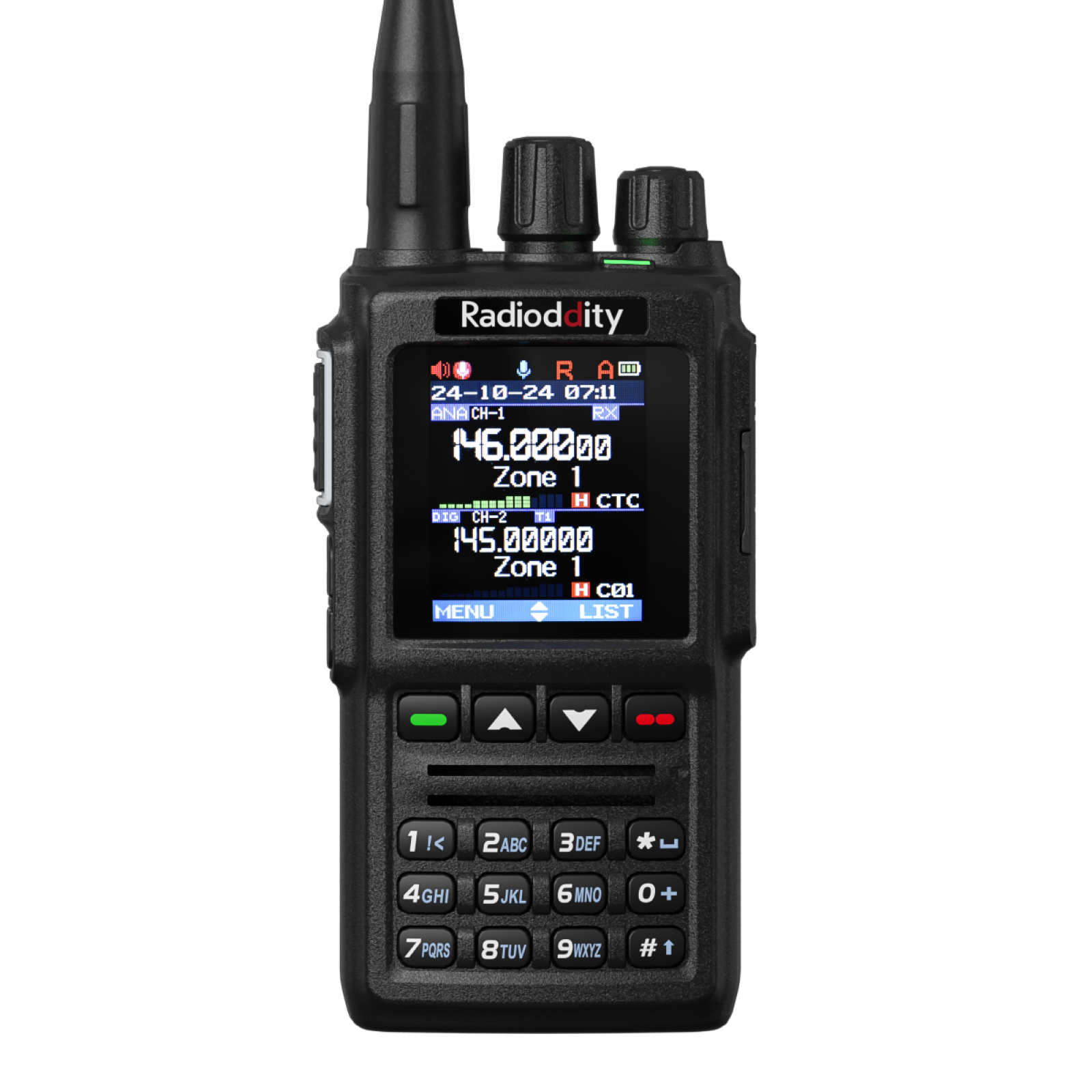
The first impression of the GD-168 is that it feels solid without being overly bulky. It weighs around 220 grams with the battery installed, making it comfortable for extended handheld use. The layout is intuitive, with well-placed buttons and two programmable keys for quick access to important functions.

The 1.77-inch color TFT screen is a standout feature. It’s bright, easy to read outdoors, and provides significantly more information than older monochrome displays. Menu navigation is relatively straightforward once you get used to DMR terminology.

Included in the box:

This “complete kit” approach is a major advantage, especially for beginners.


Key Features

Dual Band Dual Mode (Analog + DMR)

The GD-168 operates on both VHF (136–174 MHz) and UHF (400–480 MHz), giving it flexibility across a wide range of amateur and commercial frequencies. It supports both analog FM and DMR digital modes, with automatic detection between the two, making it highly versatile for mixed environments.


Massive Contact Capacity

One of the most impressive specifications is its ability to store up to 500,000 contacts and 10,000 talk groups. This allows users to load a large portion of the global DMR database, enabling callsigns and user details to appear on screen rather than just numeric IDs.


Satellite Communication & APRS

The GD-168 includes satellite prediction capability along with both analog and digital APRS transmit and digital APRS receive. These features expand the radio’s usefulness beyond standard repeater and simplex communication, allowing for position reporting and satellite operation.

In practice, satellite prediction may require some manual verification for accurate operation, but it remains a valuable addition at this price point.


Noise Reduction Technology

The radio includes both transmit and receive noise reduction, which helps improve clarity in challenging environments. This results in cleaner audio, reduced background noise, and better intelligibility, especially when operating in noisy or mobile conditions.


Power Flexibility

The GD-168 offers multiple selectable power levels:

This flexibility allows users to conserve battery when full power is unnecessary or maximize range when needed.


Dual Batteries for Extended Use

A major advantage of the GD-168 is the inclusion of two batteries:

This setup significantly extends operating time, making the radio suitable for long outings, emergency preparedness, or field operations without constant recharging.


USB-C Charging and Programming

The inclusion of USB-C support is a modern and highly practical feature. It allows for both charging and programming using a standard cable, eliminating the need for proprietary accessories and making it easy to use with power banks, laptops, and other common devices.


Performance and Real-World Use

Audio Quality

Audio quality is strong overall, with clear and loud output. The noise reduction system contributes to improved clarity, especially in environments with background interference.


Range

With a maximum output of 5 watts, the GD-168 delivers typical handheld performance:

  • Urban environments: a few miles depending on buildings and obstacles
  • Open areas: significantly greater range

Using the included longer antenna can provide noticeable improvements in signal performance.


Programming and Learning Curve

Like most DMR radios, the GD-168 is not a plug-and-play device. Programming requires an understanding of codeplugs, talk groups, and digital contacts. The included CPS software allows for full customization, but new users should expect a learning curve.

Once properly configured, the radio becomes much easier to operate and highly efficient in daily use.


Firmware and Compatibility

The GD-168 shares design similarities with other DMR radios, which can be beneficial for experienced users familiar with similar interfaces. However, firmware and software compatibility should be approached carefully, especially when exploring unofficial options.


Pros and Cons

Pros

  • Excellent value for the features offered
  • Large 500,000 contact capacity
  • Dual batteries included for extended use
  • USB-C charging and programming
  • Effective noise reduction for clearer audio
  • APRS and satellite functionality included
  • Bright and informative color display

Cons


Who This Radio Is For

The GD-168 is well suited for:

  • Amateur radio operators exploring DMR
  • Users wanting advanced features without a high cost
  • Field operators and emergency preparedness enthusiasts
  • Hobbyists interested in APRS and satellite communication

It may not be the best fit for users seeking a simple, ready-to-use radio with minimal setup.


Final Verdict

The Radioddity GD-168 stands out as a powerful and versatile DMR handheld radio that delivers an impressive range of features for its price. From dual-band operation and massive contact storage to APRS and USB-C convenience, it offers capabilities typically found in more expensive models.

While it does require time and effort to learn and configure, the result is a highly capable communication tool that can handle everything from local analog use to advanced digital operations.

For users willing to invest in learning the system, the GD-168 represents outstanding value and a strong addition to any radio lineup.

See The GD-168 At Radioddity!

Friday, November 28, 2025

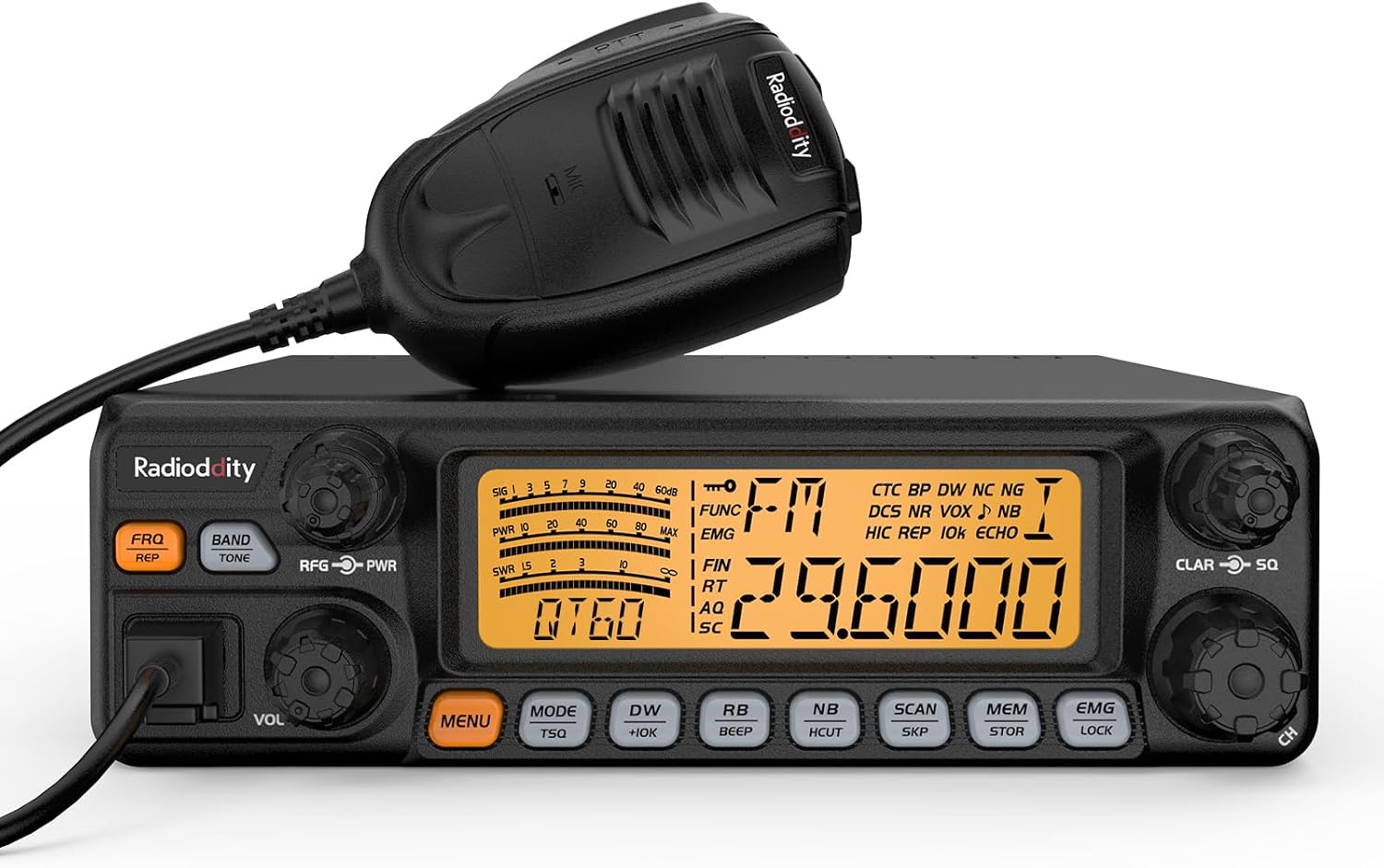
Radioddity QT60 Pro — In-depth Review


Overview
The Radioddity QT60 Pro is a modern 10-meter mobile transceiver designed for amateur operators who want a high-power, feature-rich radio in a compact vehicle-friendly package. It supports SSB, AM, FM, and PA modes, offers up to 60 watts of output power, includes a large backlit LCD display, and provides both RX and TX noise reduction. Additional conveniences such as NOAA weather reception with alert capability, CTCSS/DCS tones, and adjustable squelch/ASQ make it a versatile radio for mobile or portable use.

What’s in the box and first impressions
Inside the box you find the radio, a mobile mounting bracket, a fused power cable, a standard microphone, and the user manual. The radio feels solidly built with a dense chassis and a front panel layout that is intuitive. Buttons and the main tuning encoder have a good feel, and the microphone is perfectly serviceable for everyday use. The overall construction gives the impression of a radio built to handle the bumps and vibrations of mobile operation.

Design and build quality
The QT60 Pro follows Radioddity’s compact design philosophy. The matte finish, large display, and clean button layout are practical for vehicle installations. The front panel is dominated by a clear LCD that shows frequency, mode, signal strength, and menu functions. The chassis is rigid, the connectors feel secure, and the radio has enough weight to stay stable once mounted. Build quality is strong for a mobile 10-meter transceiver in this class.

Display, ergonomics and controls
The LCD display is one of the standout features. It is bright, clear, and readable in bright sunlight or low-light conditions. Controls are straightforward: the primary tuning dial is smooth, the push buttons are responsive, and the menu system is organized logically. While some deeper features require menu navigation, basic functions such as changing modes, adjusting power, or selecting memory channels are quick and simple.

Receive and transmit audio performance
Receive audio from the built-in speaker is loud and clean enough for use in a noisy vehicle. Voice audio on SSB and AM is clear, with noise reduction helping improve intelligibility. Transmit audio using the stock microphone is good for most contacts, but those who operate SSB extensively or participate in nets may prefer an upgraded microphone for more natural tone and improved clarity. The radio’s TX noise reduction aids in cutting background noise when speaking in a moving vehicle.

Transmit power and operating modes
Radioddity rates the QT60 Pro at up to 60 watts depending on the mode. This offers a noticeable advantage for mobile 10-meter operation where every watt matters when conditions are marginal. SSB usually delivers the highest practical power, with AM and FM often slightly lower. As with any mobile HF-band radio, actual performance depends heavily on antenna tuning, power cable quality, and overall system grounding. In practice, the radio delivers strong, reliable output when properly installed.

Receiver performance and filtering
The QT60 Pro has respectable sensitivity and provides enough filtering flexibility for typical 10-meter SSB, AM, and FM operation. Adjustable squelch and ASQ reduce operator fatigue from noise and weak interferences. The noise reduction features are especially useful in mobile environments. While extremely strong nearby signals can overload many compact radios, the QT60 Pro handles ordinary band conditions quite well for its class.

Noise reduction, ASQ and extra features
The radio includes both RX and TX noise reduction, adjustable squelch, automatic squelch (ASQ), and multiple filtering options depending on mode. These features combine to create a comfortable listening experience, especially on long drives. The QT60 Pro is also compatible with data-mode operation when connected to appropriate sound card interfaces. Programming software and firmware updates are available, making it easier to manage memory channels and parameters.

NOAA weather, CTCSS/DCS and PA mode
Having built-in NOAA weather channels with alert capability makes the QT60 Pro well suited for long trips, seasonal weather, or emergency driving situations. CTCSS and DCS tone functions provide selective access for FM channels and reduce unwanted chatter. The PA mode allows you to route audio to an external PA speaker, useful in certain field or emergency scenarios.

Programming and software
Radioddity provides programming software that lets you manage memory channels, frequencies, tone settings, and other options from a PC. This is much faster than relying solely on front-panel programming. Firmware updates add future functionality and fix issues, giving the QT60 Pro better longevity.

Installation and power considerations
To get the best performance, use a high-quality, properly gauged power cable directly connected to the vehicle’s battery. Good grounding is essential for reducing noise and ensuring stable high-power output. Because the radio is capable of significant transmit wattage, heat buildup can occur, so mount it in a space with adequate ventilation. A properly tuned 10-meter antenna with low SWR is mandatory not only for performance but also for protecting the finals from damage.

Antenna and real-world range
10 meters can provide both short-range ground communication and impressive long-distance DX when the band opens. With a well-installed mobile antenna and favorable propagation, the QT60 Pro’s high power can help you reach distant stations more reliably. In poor conditions, antenna quality matters far more than power, so investing in a good 10-meter whip is strongly recommended.

Who should buy this radio
The Radioddity QT60 Pro is ideal for operators who want a dedicated 10-meter mobile transceiver with multiple voice modes and strong performance. It is well suited for:
Mobile hams who enjoy SSB and AM operation
Operators who want NOAA weather monitoring built into their radio
Users who need high power in a compact form factor
Beginners who want a modern, easy-to-navigate 10-meter radio
Anyone who values PC programmability and good filtering options

Areas for improvement
The stock microphone works but serious voice operators might prefer an upgrade. The radio’s high power requires careful installation to prevent overheating in tight spaces. Finally, those operating in extremely busy or high-interference areas may want external filtering, though this is common among radios in this price bracket.

Pros
High transmit power up to 60W
Large, easy-to-read LCD
SSB, AM, FM, and PA capability
Effective noise reduction features
NOAA weather channels with alerts
CTCSS/DCS support
Good PC programming options

Cons
Stock microphone is average
Needs careful power and heat management
Some menu functions require a learning curve
Optional external filtering may be needed in harsh RF environments

Final verdict
The Radioddity QT60 Pro offers tremendous value for hams who want a capable, modern 10-meter mobile transceiver with real SSB performance, strong output power, and a robust feature set. It balances functionality, clarity, and convenience in a compact form that fits well into most vehicles. With a properly matched antenna and a thoughtful installation, the QT60 Pro performs well for everyday mobile QSOs, DX attempts during band openings, and general 10-meter enjoyment.

Get The Radioddity QT60 Pro On Amazon!

Tuesday, October 28, 2025

Radioddity GS-10B 10W Ham Radio Handheld — Full Review


Overview
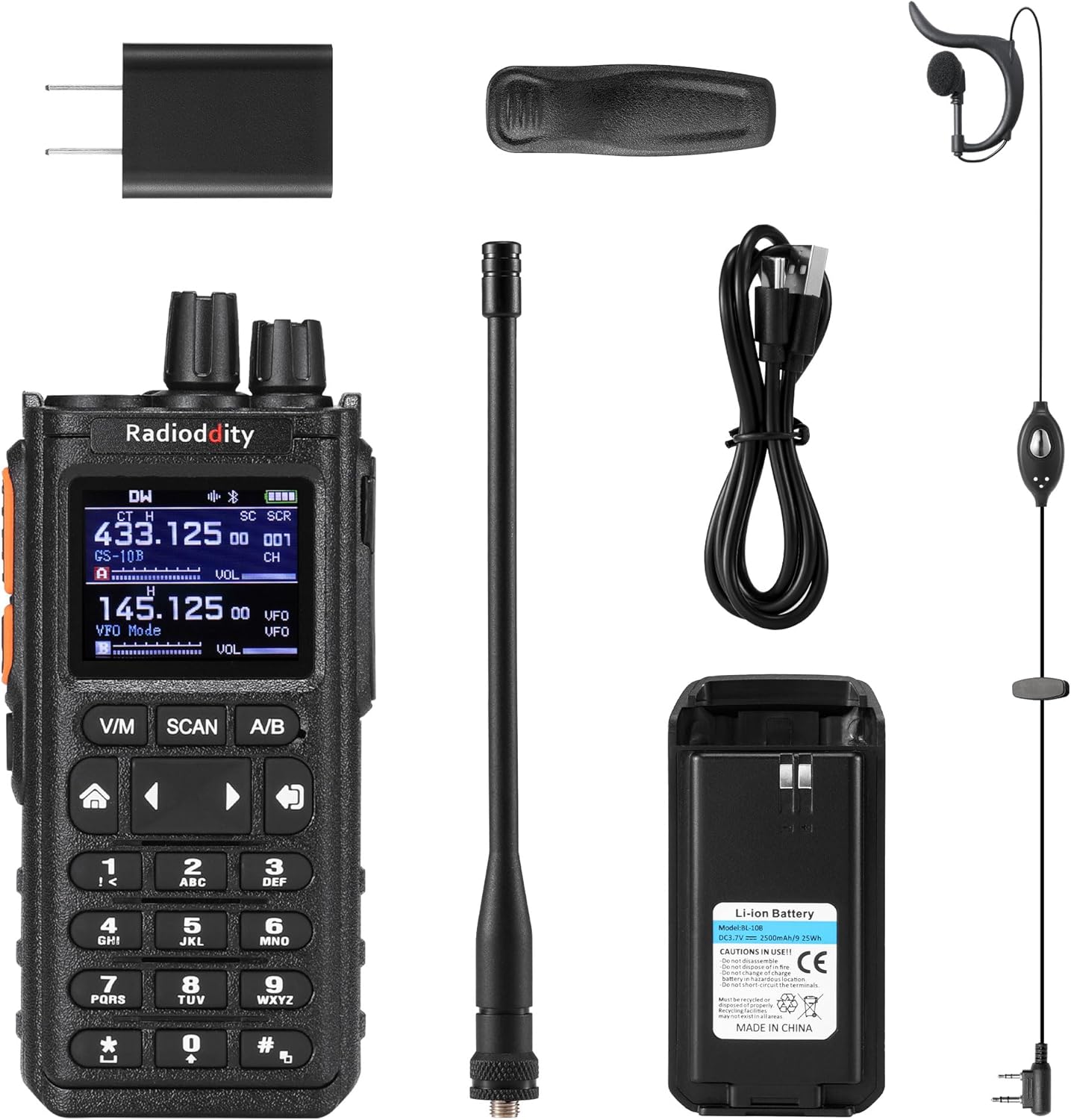
The Radioddity GS-10B positions itself as a feature-packed, budget-friendly handheld aimed at hams and radio hobbyists who want more transmit power, flexible programming, and modern conveniences like USB-C charging and app control. At its core it’s a dual-band VHF/UHF transceiver with a claimed 10-watt high-power mode, a 2500 mAh battery, dual PTT capability, aviation and NOAA receiver features, and wireless APP programming. In this review I’ll cover design and build, radio performance (receive and transmit), user interface and programming, battery and charging, real-world range expectations, audio and noise handling, accessories and expandability, pros and cons, and who the GS-10B is best for.

Design and build quality
The GS-10B follows the familiar pocket HT form factor but leans slightly toward the robust side. The housing is plastic but feels sturdier than the cheapest no-name handhelds. Controls are conventional: a rotary volume/encoder, a multi-function keypad, PTT on the side, and two PTT buttons for dual-PTT operation. The display is a compact backlit LCD that shows essential information — frequency, mode, battery, and basic status. The keypad legends and labeling are serviceable; they aren’t premium but are clear enough for everyday use.

The battery pack (2500 mAh) attaches to the back with a flush fit and the USB-C port for charging is conveniently placed — a modern touch that simplifies charging compared with older micro-USB-equipped HTs. Antenna thread appears standard SMA or similar (confirm before ordering aftermarket antennas). Overall, the construction is appropriate for the asking price: not indestructible but competent for field use.

Specifications (what matters)

  • Bands: VHF and UHF (typical ham handheld coverage)

  • Power: Up to 10 W transmit in high-power mode (also lower power steps for mid/low)

  • Battery: 2500 mAh removable pack

  • Programming: Wireless app programming plus USB-C wired connection

  • Extra receive: Aviation band and NOAA weather radio receive capability

  • Noise reduction: DSP-based noise reduction or AGC (depending on firmware/implementation)

  • Dual PTT: Two programmable PTTs for different modes/outputs

  • Channel sync: Ability to sync channels between modes or devices (implementation varies)

Because the GS-10B packs 10 watts in a handheld package it occupies a different niche than the common 5 W HTs — more transmit power can help in marginal conditions but comes with tradeoffs in heat and battery drain.

Receive performance
Receive sensitivity on modern budget handhelds is generally acceptable, and the GS-10B’s multi-mode receiver (FM primarily) is competent for local repeater, simplex, and broadcast reception. The inclusion of aviation band and NOAA weather band receive adds practical value for travelers and outdoor users who want situational awareness. Filtering and selectivity are typical for this price class: it will handle strong local signals well enough, but in very crowded RF environments you can sometimes hear overload or intermodulation. The presence of DSP-based noise reduction (if enabled in firmware) helps make weaker signals more intelligible and improves copy in noisy environments.

Transmit performance and power management
The headline is 10 W transmit. That gives the GS-10B an edge over standard 5 W HTs for opening distant repeaters or reaching simplex contacts from less-than-ideal locations. In practice, range improvement is real but not miraculous — doubling power is not the same as doubling range, and propagation plus antenna height dominate. Expect noticeably better performance on line-of-sight links and moderate improvement in obstructed conditions.

Tradeoffs of running 10 W in a handheld:

Battery life and charging
The 2500 mAh battery is decent capacity for an HT but not huge, especially when paired with 10 W transmit. In low-power voice use the battery should get a typical day’s casual operating; under heavy use, especially with frequent high-power transmit bursts, expect hours rather than all-day operation. The USB-C port is a welcome convenience — it allows you to use modern chargers and power banks for field charging. A removable battery also means you can carry a spare, which is strongly recommended if you plan to use high-power settings regularly.

Programming and usability — wireless APP and USB-C
Wireless app programming is a major selling point for users who dislike PC cables or want quick field edits. The convenience of programming channels, tones, and names from a smartphone is high, but the actual quality of the app experience depends on Radioddity’s software and firmware implementation. Expect basic functionality: reading/writing channel lists, setting offsets and tones, and perhaps easy import/export of CSV-like data. For bulk editing or advanced features many users still prefer a computer and a conventional programming cable and software — check whether the radio supports common PC CAT or CPS software if you want deep control.

The USB-C port serves dual roles: charging and probably wired programming/data connection. USB-C makes life easier in the field since power banks and modern chargers are ubiquitous.

User interface and ergonomics
If you are used to conventional HTs, you’ll find the GS-10B’s controls familiar. The two PTT buttons provide utility: one can be configured for the main transmit, the other for quick access to a different band, monitor, or auxiliary function. The encoder plus keypad makes frequency entry and menu navigation workable. The display is small but shows essential info; for advanced contesting or heavy scanning it’s not as pleasant as larger-screen radios, but that's a typical compromise in handheld design.

Noise reduction and audio quality
The radio advertises noise reduction which typically means some form of DSP filtering and AGC. In practice this helps on weak signals and when background noise is present. Speaker volume and clarity will depend on the specific speaker design; expect intelligible audio for voice, but do not expect hi-fi. Microphone performance is adequate for normal voice use; consider using a quality external speaker-mic if you want better audio and more durable PTT ergonomics.

Range expectations — realistic outlook
"Long range" is marketing-friendly wording; realistic range depends on many variables:

Channel sync and memory features
Channel sync can be handy if you want to clone channels between modes or maintain consistent channel lists across banks. Memory management and channel naming make the radio practical for everyday use. The app programming should make organizing channels quicker than menu-only editing.

Accessories and expandability
Typical accessories to consider:

Firmware and community support
Feature-rich handhelds benefit greatly from active firmware updates and community support (third-party programming files, user tips, etc.). Expect incremental firmware improvements over time that can add features or refine behavior. If you value community-driven tips, check active user forums for tips on programming, heat management at 10 W, and recommended accessory combinations.

Who should buy the Radioddity GS-10B?

Who should consider something else?

Pros

Cons

Practical tips and recommendations

  • Carry at least one spare battery if you plan to run at high power for more than a few hours.

  • Use the lowest power that accomplishes your contact (conserve battery and reduce heat).

  • Invest in a quality external speaker-mic and, if you like, a better handheld antenna for improved performance.

  • Learn the app’s read/write procedure before relying on it in the field — test programming at home first.

  • Be mindful of duty cycle when using prolonged digital modes or long voice transmissions at 10 W.

Final verdict
The Radioddity GS-10B offers an attractive feature set for experimental and practical use: higher-than-usual handheld transmit power, modern conveniences like USB-C and app programming, and extra receive bands that broaden usefulness. It’s a strong choice for hams who want more reach from a portable radio and are comfortable managing the tradeoffs in battery life and heat. For casual users who prioritize battery endurance above all, or for professionals needing extremely rugged hardware, there may be better alternatives. For its price class the GS-10B delivers an excellent combination of functionality and value, especially for those who appreciate the flexibility of app-based programming and the extra oomph of a 10 W handheld.

See The Radioddity GS-10B On Amazon!

Yaesu FT-2980R 80-Watt 144 MHz Mobile Transceiver Review

The Yaesu FT-2980R is a radio that takes a deliberately straightforward approach to amateur radio. Instead of trying to combine HF, VHF, UH...

Search This Blog