Overview
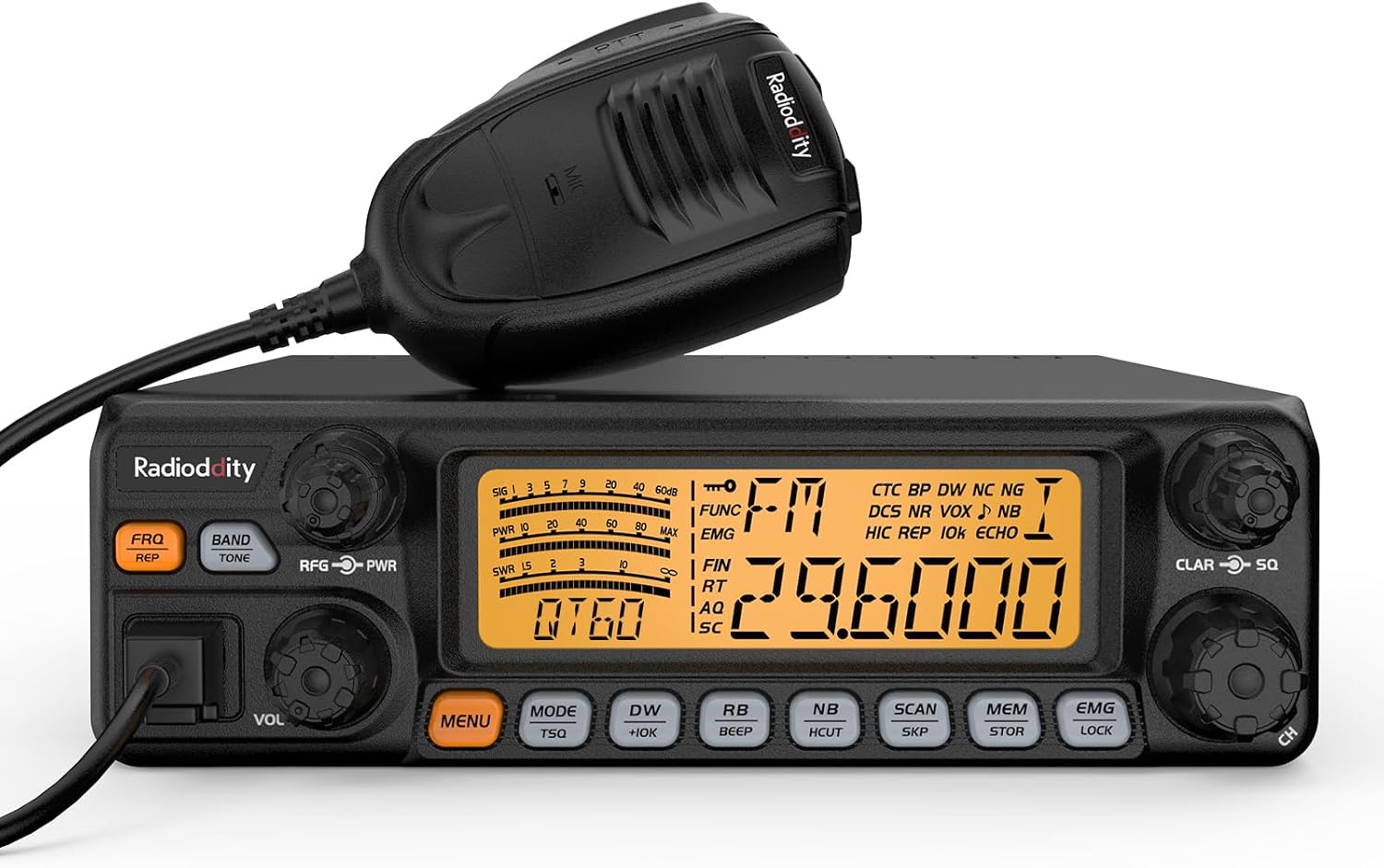
The Radioddity QT60 Pro is a modern 10-meter mobile transceiver designed for amateur operators who want a high-power, feature-rich radio in a compact vehicle-friendly package. It supports SSB, AM, FM, and PA modes, offers up to 60 watts of output power, includes a large backlit LCD display, and provides both RX and TX noise reduction. Additional conveniences such as NOAA weather reception with alert capability, CTCSS/DCS tones, and adjustable squelch/ASQ make it a versatile radio for mobile or portable use.
What’s in the box and first impressions
Inside the box you find the radio, a mobile mounting bracket, a fused power cable, a standard microphone, and the user manual. The radio feels solidly built with a dense chassis and a front panel layout that is intuitive. Buttons and the main tuning encoder have a good feel, and the microphone is perfectly serviceable for everyday use. The overall construction gives the impression of a radio built to handle the bumps and vibrations of mobile operation.
Design and build quality
The QT60 Pro follows Radioddity’s compact design philosophy. The matte finish, large display, and clean button layout are practical for vehicle installations. The front panel is dominated by a clear LCD that shows frequency, mode, signal strength, and menu functions. The chassis is rigid, the connectors feel secure, and the radio has enough weight to stay stable once mounted. Build quality is strong for a mobile 10-meter transceiver in this class.
Display, ergonomics and controls
The LCD display is one of the standout features. It is bright, clear, and readable in bright sunlight or low-light conditions. Controls are straightforward: the primary tuning dial is smooth, the push buttons are responsive, and the menu system is organized logically. While some deeper features require menu navigation, basic functions such as changing modes, adjusting power, or selecting memory channels are quick and simple.
Receive and transmit audio performance
Receive audio from the built-in speaker is loud and clean enough for use in a noisy vehicle. Voice audio on SSB and AM is clear, with noise reduction helping improve intelligibility. Transmit audio using the stock microphone is good for most contacts, but those who operate SSB extensively or participate in nets may prefer an upgraded microphone for more natural tone and improved clarity. The radio’s TX noise reduction aids in cutting background noise when speaking in a moving vehicle.
Transmit power and operating modes
Radioddity rates the QT60 Pro at up to 60 watts depending on the mode. This offers a noticeable advantage for mobile 10-meter operation where every watt matters when conditions are marginal. SSB usually delivers the highest practical power, with AM and FM often slightly lower. As with any mobile HF-band radio, actual performance depends heavily on antenna tuning, power cable quality, and overall system grounding. In practice, the radio delivers strong, reliable output when properly installed.
Receiver performance and filtering
The QT60 Pro has respectable sensitivity and provides enough filtering flexibility for typical 10-meter SSB, AM, and FM operation. Adjustable squelch and ASQ reduce operator fatigue from noise and weak interferences. The noise reduction features are especially useful in mobile environments. While extremely strong nearby signals can overload many compact radios, the QT60 Pro handles ordinary band conditions quite well for its class.
Noise reduction, ASQ and extra features
The radio includes both RX and TX noise reduction, adjustable squelch, automatic squelch (ASQ), and multiple filtering options depending on mode. These features combine to create a comfortable listening experience, especially on long drives. The QT60 Pro is also compatible with data-mode operation when connected to appropriate sound card interfaces. Programming software and firmware updates are available, making it easier to manage memory channels and parameters.
NOAA weather, CTCSS/DCS and PA mode
Having built-in NOAA weather channels with alert capability makes the QT60 Pro well suited for long trips, seasonal weather, or emergency driving situations. CTCSS and DCS tone functions provide selective access for FM channels and reduce unwanted chatter. The PA mode allows you to route audio to an external PA speaker, useful in certain field or emergency scenarios.
Programming and software
Radioddity provides programming software that lets you manage memory channels, frequencies, tone settings, and other options from a PC. This is much faster than relying solely on front-panel programming. Firmware updates add future functionality and fix issues, giving the QT60 Pro better longevity.
Installation and power considerations
To get the best performance, use a high-quality, properly gauged power cable directly connected to the vehicle’s battery. Good grounding is essential for reducing noise and ensuring stable high-power output. Because the radio is capable of significant transmit wattage, heat buildup can occur, so mount it in a space with adequate ventilation. A properly tuned 10-meter antenna with low SWR is mandatory not only for performance but also for protecting the finals from damage.
Antenna and real-world range
10 meters can provide both short-range ground communication and impressive long-distance DX when the band opens. With a well-installed mobile antenna and favorable propagation, the QT60 Pro’s high power can help you reach distant stations more reliably. In poor conditions, antenna quality matters far more than power, so investing in a good 10-meter whip is strongly recommended.
Who should buy this radio
The Radioddity QT60 Pro is ideal for operators who want a dedicated 10-meter mobile transceiver with multiple voice modes and strong performance. It is well suited for:
Mobile hams who enjoy SSB and AM operation
Operators who want NOAA weather monitoring built into their radio
Users who need high power in a compact form factor
Beginners who want a modern, easy-to-navigate 10-meter radio
Anyone who values PC programmability and good filtering options
Areas for improvement
The stock microphone works but serious voice operators might prefer an upgrade. The radio’s high power requires careful installation to prevent overheating in tight spaces. Finally, those operating in extremely busy or high-interference areas may want external filtering, though this is common among radios in this price bracket.
Pros
High transmit power up to 60W
Large, easy-to-read LCD
SSB, AM, FM, and PA capability
Effective noise reduction features
NOAA weather channels with alerts
CTCSS/DCS support
Good PC programming options
Cons
Stock microphone is average
Needs careful power and heat management
Some menu functions require a learning curve
Optional external filtering may be needed in harsh RF environments
Final verdict
The Radioddity QT60 Pro offers tremendous value for hams who want a capable, modern 10-meter mobile transceiver with real SSB performance, strong output power, and a robust feature set. It balances functionality, clarity, and convenience in a compact form that fits well into most vehicles. With a properly matched antenna and a thoughtful installation, the QT60 Pro performs well for everyday mobile QSOs, DX attempts during band openings, and general 10-meter enjoyment.


