Showing posts with label 60 watts. Show all posts

Friday, November 28, 2025

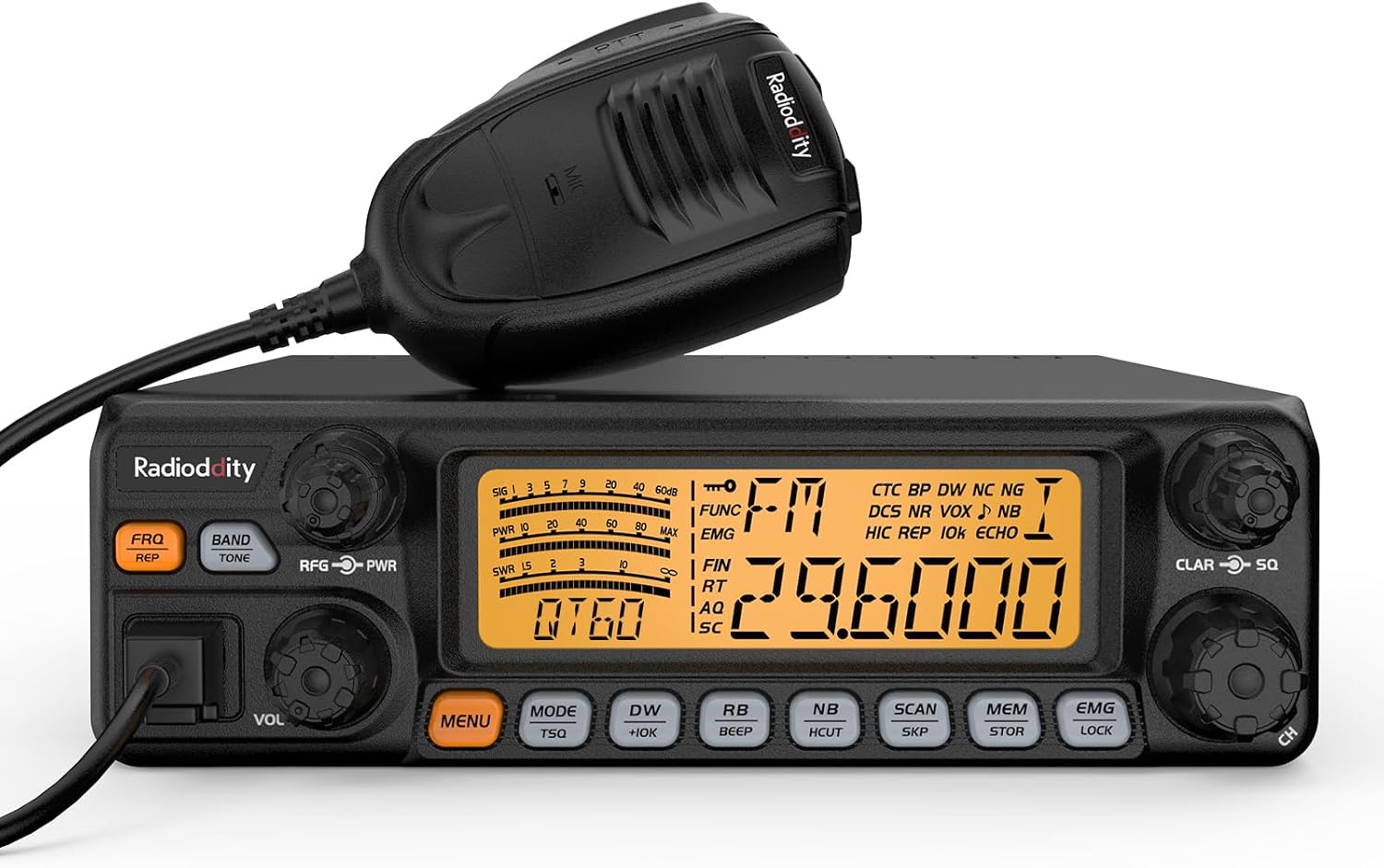
Radioddity QT60 Pro — In-depth Review


Overview
The Radioddity QT60 Pro is a modern 10-meter mobile transceiver designed for amateur operators who want a high-power, feature-rich radio in a compact vehicle-friendly package. It supports SSB, AM, FM, and PA modes, offers up to 60 watts of output power, includes a large backlit LCD display, and provides both RX and TX noise reduction. Additional conveniences such as NOAA weather reception with alert capability, CTCSS/DCS tones, and adjustable squelch/ASQ make it a versatile radio for mobile or portable use.

What’s in the box and first impressions
Inside the box you find the radio, a mobile mounting bracket, a fused power cable, a standard microphone, and the user manual. The radio feels solidly built with a dense chassis and a front panel layout that is intuitive. Buttons and the main tuning encoder have a good feel, and the microphone is perfectly serviceable for everyday use. The overall construction gives the impression of a radio built to handle the bumps and vibrations of mobile operation.

Design and build quality
The QT60 Pro follows Radioddity’s compact design philosophy. The matte finish, large display, and clean button layout are practical for vehicle installations. The front panel is dominated by a clear LCD that shows frequency, mode, signal strength, and menu functions. The chassis is rigid, the connectors feel secure, and the radio has enough weight to stay stable once mounted. Build quality is strong for a mobile 10-meter transceiver in this class.

Display, ergonomics and controls
The LCD display is one of the standout features. It is bright, clear, and readable in bright sunlight or low-light conditions. Controls are straightforward: the primary tuning dial is smooth, the push buttons are responsive, and the menu system is organized logically. While some deeper features require menu navigation, basic functions such as changing modes, adjusting power, or selecting memory channels are quick and simple.

Receive and transmit audio performance
Receive audio from the built-in speaker is loud and clean enough for use in a noisy vehicle. Voice audio on SSB and AM is clear, with noise reduction helping improve intelligibility. Transmit audio using the stock microphone is good for most contacts, but those who operate SSB extensively or participate in nets may prefer an upgraded microphone for more natural tone and improved clarity. The radio’s TX noise reduction aids in cutting background noise when speaking in a moving vehicle.

Transmit power and operating modes
Radioddity rates the QT60 Pro at up to 60 watts depending on the mode. This offers a noticeable advantage for mobile 10-meter operation where every watt matters when conditions are marginal. SSB usually delivers the highest practical power, with AM and FM often slightly lower. As with any mobile HF-band radio, actual performance depends heavily on antenna tuning, power cable quality, and overall system grounding. In practice, the radio delivers strong, reliable output when properly installed.

Receiver performance and filtering
The QT60 Pro has respectable sensitivity and provides enough filtering flexibility for typical 10-meter SSB, AM, and FM operation. Adjustable squelch and ASQ reduce operator fatigue from noise and weak interferences. The noise reduction features are especially useful in mobile environments. While extremely strong nearby signals can overload many compact radios, the QT60 Pro handles ordinary band conditions quite well for its class.

Noise reduction, ASQ and extra features
The radio includes both RX and TX noise reduction, adjustable squelch, automatic squelch (ASQ), and multiple filtering options depending on mode. These features combine to create a comfortable listening experience, especially on long drives. The QT60 Pro is also compatible with data-mode operation when connected to appropriate sound card interfaces. Programming software and firmware updates are available, making it easier to manage memory channels and parameters.

NOAA weather, CTCSS/DCS and PA mode
Having built-in NOAA weather channels with alert capability makes the QT60 Pro well suited for long trips, seasonal weather, or emergency driving situations. CTCSS and DCS tone functions provide selective access for FM channels and reduce unwanted chatter. The PA mode allows you to route audio to an external PA speaker, useful in certain field or emergency scenarios.

Programming and software
Radioddity provides programming software that lets you manage memory channels, frequencies, tone settings, and other options from a PC. This is much faster than relying solely on front-panel programming. Firmware updates add future functionality and fix issues, giving the QT60 Pro better longevity.

Installation and power considerations
To get the best performance, use a high-quality, properly gauged power cable directly connected to the vehicle’s battery. Good grounding is essential for reducing noise and ensuring stable high-power output. Because the radio is capable of significant transmit wattage, heat buildup can occur, so mount it in a space with adequate ventilation. A properly tuned 10-meter antenna with low SWR is mandatory not only for performance but also for protecting the finals from damage.

Antenna and real-world range
10 meters can provide both short-range ground communication and impressive long-distance DX when the band opens. With a well-installed mobile antenna and favorable propagation, the QT60 Pro’s high power can help you reach distant stations more reliably. In poor conditions, antenna quality matters far more than power, so investing in a good 10-meter whip is strongly recommended.

Who should buy this radio
The Radioddity QT60 Pro is ideal for operators who want a dedicated 10-meter mobile transceiver with multiple voice modes and strong performance. It is well suited for:
Mobile hams who enjoy SSB and AM operation
Operators who want NOAA weather monitoring built into their radio
Users who need high power in a compact form factor
Beginners who want a modern, easy-to-navigate 10-meter radio
Anyone who values PC programmability and good filtering options

Areas for improvement
The stock microphone works but serious voice operators might prefer an upgrade. The radio’s high power requires careful installation to prevent overheating in tight spaces. Finally, those operating in extremely busy or high-interference areas may want external filtering, though this is common among radios in this price bracket.

Pros
High transmit power up to 60W
Large, easy-to-read LCD
SSB, AM, FM, and PA capability
Effective noise reduction features
NOAA weather channels with alerts
CTCSS/DCS support
Good PC programming options

Cons
Stock microphone is average
Needs careful power and heat management
Some menu functions require a learning curve
Optional external filtering may be needed in harsh RF environments

Final verdict
The Radioddity QT60 Pro offers tremendous value for hams who want a capable, modern 10-meter mobile transceiver with real SSB performance, strong output power, and a robust feature set. It balances functionality, clarity, and convenience in a compact form that fits well into most vehicles. With a properly matched antenna and a thoughtful installation, the QT60 Pro performs well for everyday mobile QSOs, DX attempts during band openings, and general 10-meter enjoyment.

Get The Radioddity QT60 Pro On Amazon!

Friday, September 26, 2025

TYT TH-9000D — Full in-depth review


INTRODUCTION
The TYT TH-9000D is a mobile VHF transceiver aimed at amateur radio operators who want a high-power 2-meter mobile rig with flexible programming options. It promises strong transmit capability, a familiar user interface, and the convenience of USB programming. In this review I cover design and build, installation and wiring, user interface and ergonomics, receive and transmit performance, programming and software experience with the included USB cable, features and usability, audio quality, reliability and heat management, practical use cases, pros and cons, recommended accessories, and final verdict.

OVERVIEW AND WHO THIS IS FOR
The TH-9000D targets hams who use 2 meters as their primary mobile band and who value higher transmit power for extended range from a vehicle installation. It is particularly useful for operators who travel over varied terrain, need to reach distant repeaters, or run simplex between mobile and fixed stations. It also appeals to hobbyists who want straightforward USB-programming rather than manual channel entry.

DESIGN AND BUILD
Physically the unit follows a traditional mobile radio layout: a compact main head unit with a clear display and a detachable microphone. The chassis is metal and feels solid for a kitted mobile installation; mounting ears are supplied and the radio is sized to fit in a standard mobile space. The buttons and knobs are serviceable — not premium, but tactile enough for in-vehicle adjustments. The microphone is standard push-to-talk with keypad entry, which makes manual programming possible when you are away from a computer.

INSTALLATION AND WIRING
Installing the TH-9000D is a straightforward mobile-radio job. Power wiring to the vehicle battery should use an adequately sized fused feed to handle higher transmit currents at full power. Grounding the chassis to the vehicle body is important for RF performance and safety. Antenna choice and placement are critical; high power only matters if your coax and antenna can handle it and if a proper VSWR is maintained. A short run of low-loss coax and a well-mounted 2-meter mobile antenna will make the most of the radio’s output. If you are unfamiliar with soldering or RF grounding, consider professional installation to ensure good RF bonding and to avoid interference with vehicle electronics.

USER INTERFACE AND ERGONOMICS
The front panel layout is pragmatic. A rotary knob for volume and menu navigation, a separate squelch control or menu-accessible squelch, and a clear alphanumeric display are typical. Menus allow changing transmit power, setting channel names, and enabling features like tone squelch. For mobile use, the ability to lock keys and adjust backlight brightness is useful. The radio is also designed for two-way handheld-style operation from the vehicle microphone, which keeps things simple for routine comms.

RECEIVE PERFORMANCE
On receive the TH-9000D performs adequately for typical VHF mobile duties. Sensitivity is comparable to other mobile rigs in its class, pulling in local repeaters, distant beacons, and simplex signals with expected clarity when antenna and feedline are in good condition. The receiver’s selectivity and squelch characteristics are acceptable for normal mixed-traffic environments, although extremely congested repeater sites with many strong adjacent signals will always challenge any mobile receiver. Overall, expect reliable, everyday performance for contesting, nets, local nets, and casual ragchewing.

TRANSMIT PERFORMANCE
The 60-watt transmit capability is the headline feature. In practice this offers a meaningful increase in coverage compared with lower-power mobile radios, especially in hilly or fringe areas. Higher power increases current draw and heat output, so thermal considerations matter for prolonged high-power operation. The radio typically allows selecting lower power levels for everyday use, letting you balance battery load, heat, and range. Properly tuned antenna systems are essential; without a low SWR antenna and good coax, additional transmit power can be wasted or damage equipment.

PROGRAMMING AND USB EXPERIENCE
One of the TH-9000D’s conveniences is USB programming. The radio ships with a USB programming cable that plugs into the rear or front programming jack, allowing channel memories, tone settings, and other options to be edited on a computer. Programming saves time compared with manual entry and is ideal for bulk edits and organizing channel banks. The actual user experience depends on the PC software used for programming; the cable typically appears as a serial device to the computer, and programming workflows follow the usual pattern: read the radio’s memory, edit on the PC, then write back. For first-time users, it is advisable to keep a backup of the radio’s memory file before making large changes. If you plan to reprogram frequently, keep the cable and software handy.

FEATURES AND USABILITY
The TH-9000D supports conventional mobile features such as multiple memory channels, channel naming, adjustable transmit power, and tone encoding/decoding for CTCSS/DCS. If you rely on tone squelch for repeater access, the memory system makes it easy to store repeaters with their tones. Many operators will appreciate features like priority channels, scan functions, and lockable front panel keys for safe driving. If the radio includes additional conveniences like a detachable face or remote head capabilities, those are valuable for flexible mounting.

AUDIO QUALITY
Audio quality on both transmit and receive is an important area. A mobile radio’s microphone and audio processing determine how intelligible you sound over the air and how clearly incoming signals come through. The TH-9000D generally provides clear receive audio in normal conditions and a crisp transmit voice when you set proper microphone gain and use good microphone technique. If you need louder cabin audio, consider mounting the radio in a location where its speaker is not blocked, or use an external speaker if the unit supports one.

HEAT MANAGEMENT AND RELIABILITY
High-power VHF operation produces heat. The radio’s chassis and internal heatsinking should handle intermittent high-power bursts, but continuous maximum-power operation will raise internal temperatures. Ensure the radio has airflow and avoid burying it under other electronics. For reliability, keep firmware up to date if the manufacturer provides updates, and avoid operating with high SWR. Routine checks of connectors and coax integrity will prolong the unit’s life.

PRACTICAL USE CASES
The TH-9000D works well for:

  • Mobile repeater access when traveling through hilly terrain.

  • Emergency communications where extra range is beneficial.

  • Vehicle-to-vehicle simplex in rural or suburban settings.

  • Amateur radio nets where mobile participation is common.

  • Users who maintain an organized memory bank and enjoy reprogramming their radio from a laptop.

PROS

CONS

TIPS AND BEST PRACTICES

  • Use quality coax and a properly tuned 2-meter mobile antenna to make the most of the 60-watt output.

  • Fuse the power feed at the battery and use an adequately sized wire to prevent voltage drop under high transmit current.

  • If you plan on frequent high-power transmissions, ensure the radio has ventilation and avoid enclosed mounting spaces.

  • Keep a programming backup file on your computer and save copies after major edits.

  • Adjust microphone gain so transmitted audio is loud and clear without distortion; test with a friendly local operator to fine-tune settings.

  • Periodically check connectors and the antenna mount for corrosion or looseness, especially if you drive through wet or salty environments.

RECOMMENDED ACCESSORIES

FINAL VERDICT
The TYT TH-9000D is a pragmatic, capable VHF mobile transceiver for amateur operators who need extra transmit power and appreciate the convenience of USB programming. It delivers on the core promises: solid transmit punch for the 2-meter band, dependable receive performance, and practical features for mobile operation. It is not a premium boutique radio focused on cosmetic polish or a feature set overflowing with every modern convenience, but for its intended role as a workhorse mobile 2-meter transceiver, it performs well and gives mobile operators useful range and flexibility. If your priority is reliable mobile coverage on 2 meters and you are prepared to install a proper antenna system and manage heat and power considerations, the TH-9000D is a strong choice.

Get The TYT TH-9000D On Amazon!

Friday, April 18, 2025

In-Depth Review: AnyTone AT-5555N II Upgraded 10 Meter Radio High Power Mobile Transceiver


The AnyTone AT-5555N II is a high-powered, feature-rich mobile transceiver designed specifically for amateur radio operators who want strong performance, versatility, and ease of use in the 10-meter band. This upgraded version builds on the foundation of its predecessor, the AT-5555, and brings a range of improvements that appeal to both seasoned ham operators and newcomers who are stepping into the world of high-frequency mobile communication. In this review, we’ll delve into the capabilities, performance, build quality, and overall user experience of the AnyTone AT-5555N II to help you decide if it’s the right radio for your setup.

Power and Performance

One of the key selling points of the AnyTone AT-5555N II is its impressive power output. It offers 60 watts on AM and SSB modes, and 45 watts on FM. This power level is significant for a mobile 10-meter transceiver, allowing users to reach out further and communicate more reliably even under less-than-ideal propagation conditions. Whether you’re operating in AM, FM, or single sideband (SSB) modes, the radio delivers clear and consistent audio, with minimal distortion even at high output.

The radio covers 28.000 to 29.700 MHz in standard configuration, but it can be expanded for additional frequencies, making it more flexible for different operating preferences. Once expanded, it can serve a wider range of users looking to experiment with CB frequencies or use it as an export radio.

Signal Clarity and Audio Quality

Transmit and receive clarity is another strong suit of the AT-5555N II. Users will appreciate the crisp and natural-sounding audio both from the built-in speaker and when using an external speaker or mic. The microphone itself is robust and ergonomic, with up/down buttons and a channel switch, giving users convenient access to frequent adjustments.

Reception sensitivity is excellent, picking up weak signals with clarity. The squelch and RF gain controls allow for fine-tuning reception, helping to cut through noise and focus on the signals that matter. For those who use SSB frequently, the radio includes clarifier functionality that allows for precise tuning of voice signals, a critical feature for maintaining intelligible communication over long distances.

Build Quality and Display

Physically, the AT-5555N II is solidly built with a rugged chassis designed to endure the demands of mobile operation. The controls have a satisfying feel, and the front panel is logically laid out for intuitive operation. The volume, squelch, RF gain, and clarifier knobs are smooth and responsive, and the push buttons have a quality feel that suggests durability.

One of the standout improvements in the upgraded version is the multi-color LCD display. The screen is bright, readable in various lighting conditions, and can be customized to suit individual preferences. This includes the ability to change backlight colors, which is both a cosmetic and practical feature, especially for night-time operation. The display shows key operating information such as frequency, mode, power level, and signal strength, all in a clean, easily digestible layout.

Features and Functionality

The AT-5555N II comes with a suite of features that enhance its flexibility and usability. These include:

  • Multi-band support (post-expansion) for users who want more than just 10-meter capability

  • Automatic and manual squelch control, helping reduce unwanted noise

  • VOX (voice-operated transmit) for hands-free operation

  • NB/ANL (noise blanker and automatic noise limiter) for improved noise reduction

  • Dual Watch, which allows monitoring of two frequencies at once

  • Scan functions, which are useful for finding active frequencies quickly

  • Adjustable mic gain and RF power output, giving users control over performance

Programming the radio can be done manually via the front panel or with software for those who prefer PC-based control and memory management. This makes it easier to configure and store multiple channels and settings for specific communication needs.

Ease of Use

Despite its professional-grade features, the AnyTone AT-5555N II is surprisingly approachable for new users. The manual operation is straightforward, and those familiar with ham radios will find the menu system intuitive. For newcomers, there might be a slight learning curve, especially with understanding SSB operation and menu navigation, but nothing that a bit of hands-on time can’t overcome.

The user-friendly interface, combined with flexible controls and powerful performance, makes this radio suitable for both mobile and base station use. It’s compact enough to fit in most vehicles, and the front-facing speaker design helps ensure audio is heard clearly even in noisy environments.

Final Thoughts

The AnyTone AT-5555N II stands out as a powerful, dependable, and versatile mobile transceiver for the 10-meter amateur radio band. Its high output power, superior audio clarity, and extensive feature set make it an appealing choice for both hobbyists and serious operators. The ability to expand its frequency range and the inclusion of adjustable parameters offer a high degree of customization to suit different user preferences and conditions.

While it may be more advanced than basic CB radios, the AT-5555N II bridges the gap between entry-level and high-end ham gear by offering excellent value and performance. For those looking for a rugged, high-performance mobile transceiver with modern features and strong output capabilities, the AnyTone AT-5555N II is a solid investment.

Find The Anytone AT-5555N II On Amazon!

Baofeng UV-5R Mini Ham Radio — In-Depth Review

Overview The Baofeng UV-5R Mini is a compact, budget-minded dual-band handheld transceiver that takes the familiar UV-5R platform and shr...

Search This Blog