Showing posts with label General. Show all posts

Friday, May 29, 2026

Ranger RCI-69VHP High Power 10 Meter Amateur Radio Review


The Ranger RCI-69VHP is one of those radios that immediately grabs the attention of operators who enjoy traditional high-power 10 meter rigs with big audio, classic styling, and straightforward controls. In a market filled with compact menu-driven radios and multi-function buttons, the RCI-69VHP stays true to the old-school style that many experienced operators still prefer. Large knobs, dedicated controls, a heavy-duty chassis, bright display lighting, and strong transmit power make this radio feel more like a serious mobile communications platform than a modern compact export-style radio.

Built around Ranger’s long-standing reputation in the high-power 10 meter world, the RCI-69VHP combines AM, FM, SSB, and CW capability into a radio that was clearly designed for operators who enjoy long-distance talking, sideband work, mobile operation, and strong audio performance. The radio includes a large heatsink, variable power output, a true frequency counter, fine and coarse clarifier controls, SWR meter functionality, and the popular SRA-198NC dynamic noise-canceling microphone.

For operators who appreciate traditional radio design and strong on-air presence, the RCI-69VHP delivers a very appealing package.

First Impressions

The first thing most operators notice about the RCI-69VHP is its physical size and appearance. This is not a tiny modern mobile radio designed to disappear into a dashboard. The RCI-69VHP is a full-sized radio with a large front panel, chrome accents, oversized heatsink, and prominent controls.

The dark chrome finish combined with blue LED lighting gives the radio a sharp appearance without looking overly flashy. Ranger managed to create a radio that feels modern enough visually while still retaining the classic high-performance 10 meter aesthetic many operators enjoy.

The front panel layout is excellent. Nearly every major function has its own dedicated control. Instead of burying important adjustments inside complicated menus, Ranger gives the operator immediate access to RF power, clarifier functions, talkback, mic gain, RF gain, mode selection, and SWR monitoring.

That simplicity becomes especially important during mobile operation. Operators can make adjustments quickly without digging through layers of settings while driving.

The radio also feels solid. Between the chassis weight and the massive heatsink on the rear, the RCI-69VHP gives the impression that it was built to handle extended operation without thermal stress becoming a major issue.

Power Output and Performance

One of the biggest selling points of the RCI-69VHP is its power capability. Ranger markets the radio in the 60 to 80+ watt PEP range depending on mode and tuning configuration. The radio uses Ranger RT1 MOSFET transistors and a newer final amplifier design intended to provide strong output while maintaining reliability.

On sideband, the radio performs very well for a dedicated 10 meter mobile unit. SSB audio is clean and strong when properly adjusted, and the clarifier controls make it easy to fine tune stations during crowded conditions.

The variable RF power control is a valuable feature. Operators can reduce carrier levels for local work or increase power when conditions demand additional punch. This flexibility is useful both for barefoot operation and for operators who may occasionally run an external amplifier.

AM performance is strong and loud, which is exactly what many operators expect from a Ranger radio. Audio has the characteristic “big radio” sound that Ranger and Galaxy radios have long been known for. Operators who enjoy AM rag chewing or long-distance skip conversations will likely be very pleased with the audio characteristics.

FM mode is also included, which has become increasingly useful on 10 meters in recent years. FM activity on 10 meters continues to grow in popularity, especially during band openings.

CW capability is another welcome inclusion, although most operators buying this radio will likely spend the majority of their time on SSB and AM.

Receiver Performance

Receiver sensitivity is quite respectable for this style of radio. Weak stations are easy to copy on sideband, and the radio has enough selectivity to remain usable even during crowded band conditions. Ranger lists receiver sensitivity figures that are competitive with many radios in this category.

The RF gain and squelch controls are smooth and responsive. Operators can quickly tailor receive characteristics depending on local noise conditions and propagation.

The NB/ANL circuitry does a decent job handling mobile ignition noise and electrical interference. It is not perfect, but it performs well enough for typical mobile operation.

One area where the RCI-69VHP performs particularly well is overall receive audio character. The radio has a fuller and more pleasant receive sound than many smaller compact radios. Audio through the internal speaker is strong, and an external speaker can improve clarity even further.

SRA-198NC Noise Canceling Microphone

The included SRA-198NC dynamic noise-canceling microphone is actually a major selling point. Many stock microphones included with radios are mediocre at best, but the Ranger microphone included here is genuinely useful.

Operators running mobile installations especially benefit from the noise-canceling design. Road noise, engine noise, cooling fans, and other background sounds are reduced significantly when the microphone is adjusted properly.

Several operators online have commented positively about Ranger’s SRA-series microphones, particularly in mobile environments where clean transmitted audio is important.

The mic also has a solid feel in the hand and matches the overall styling of the radio nicely.

Frequency Counter and Clarifier Controls

One of the standout features of the RCI-69VHP is the true 6-digit frequency counter. Ranger specifically emphasized that this is a real frequency counter rather than a simple frequency display approximation.

This makes tuning on sideband much easier and provides a more precise operating experience.

The fine and coarse clarifier controls are another excellent feature. Operators who spend a lot of time on SSB know how important smooth clarifier adjustment can be during crowded or drifting conditions.

The clarifier on this radio is smooth, responsive, and useful for both transmit and receive adjustments. That level of control is something experienced operators appreciate immediately.

SWR Meter and Front Panel Functions

The built-in SWR meter is convenient and easy to use. Ranger designed the SWR circuit to auto-calibrate, which simplifies antenna checking considerably.

The front panel meter also handles signal strength and RF output monitoring, giving the operator constant feedback during operation.

Other front panel functions include:

  • Variable talkback
  • Roger beep
  • Echo controls
  • RF power adjustment
  • Mic gain
  • RF gain
  • Mode selection
  • External speaker support
  • PA capability

Some operators love features like echo and talkback while others never touch them. Regardless, Ranger gives users the option.

Mobile Installation Considerations

The RCI-69VHP is clearly designed with mobile operation in mind, but operators need to remember that this is a large radio with significant power output.

A proper power connection directly to the battery is highly recommended. Running this radio through a cigarette lighter plug is not a good idea.

Ventilation also matters. The large rear heatsink helps tremendously, but high-power radios generate heat, especially during long AM or FM transmissions.

The radio draws enough current that proper wiring becomes important for both performance and reliability.

A quality antenna system is also critical. High-power operation into poor SWR conditions can damage finals over time. Several experienced operators online have emphasized the importance of maintaining a properly tuned antenna system when running radios in this power class.

On-Air Audio

This is where the RCI-69VHP really shines.

The radio has strong, loud transmit audio with excellent presence on both AM and SSB. Ranger radios have long had a reputation for producing strong modulation characteristics, and the 69VHP continues that tradition.

Operators who enjoy DX chasing on 10 meters will appreciate the radio’s ability to cut through crowded conditions during band openings.

Sideband audio is especially good when paired with the included microphone. The radio has enough talk power to maintain a commanding signal without sounding overly distorted or harsh when adjusted correctly.

Reliability and Build Quality

The RCI-69VHP appears to be built with durability in mind. The heavy chassis, oversized heatsink, and large internal layout all contribute to a radio that feels more robust than many compact alternatives.

That said, high-power export-style radios always benefit from responsible operation. Running maximum power continuously, especially on FM or with poor SWR conditions, can create stress on finals over time.

Many experienced operators recommend running reduced power whenever possible and increasing output only when needed.

Like many radios in this category, the RCI-69VHP also exists in a world where modifications are common. Buyers should be cautious when purchasing used units, as “golden screwdriver” modifications can sometimes create reliability issues.

A properly aligned stock unit is generally the safest route.

Pros

  • Excellent transmit audio
  • Strong AM and SSB performance
  • Real 6-digit frequency counter
  • Fine and coarse clarifier controls
  • Large heavy-duty heatsink
  • Included quality noise-canceling microphone
  • Easy-to-use front panel layout
  • Strong receiver audio
  • All-mode capability including FM and CW
  • Variable RF power control

Cons

  • Large size may not fit all vehicles
  • Current draw requires proper wiring
  • Heat management still matters during long transmissions
  • Not as compact as newer menu-driven radios
  • Higher price than some competing 10 meter rigs
  • Echo features may not appeal to all operators

Final Thoughts

The Ranger RCI-69VHP is a radio built for operators who enjoy classic high-power 10 meter operation. It is loud, strong, easy to operate, and loaded with the features serious sideband and AM operators want.

This radio is not trying to compete with tiny compact SDR-based mobile rigs. Instead, it embraces the traditional big-radio philosophy with dedicated controls, powerful output, large audio, and old-school operating feel.

For operators who spend significant time on 10 meters, especially those who enjoy SSB DX work, AM conversations, and strong mobile performance, the RCI-69VHP remains an extremely appealing option.

The combination of all-mode operation, heavy-duty construction, powerful audio, real frequency counter functionality, and classic Ranger styling makes it one of the more enjoyable traditional 10 meter radios available today.

If you want a radio that feels substantial, sounds impressive on the air, and delivers the classic high-power Ranger experience, the RCI-69VHP absolutely deserves serious consideration.

See The Ranger RCI-69VHP On Amazon!

Monday, August 11, 2025

Understanding Ham Radio Bands


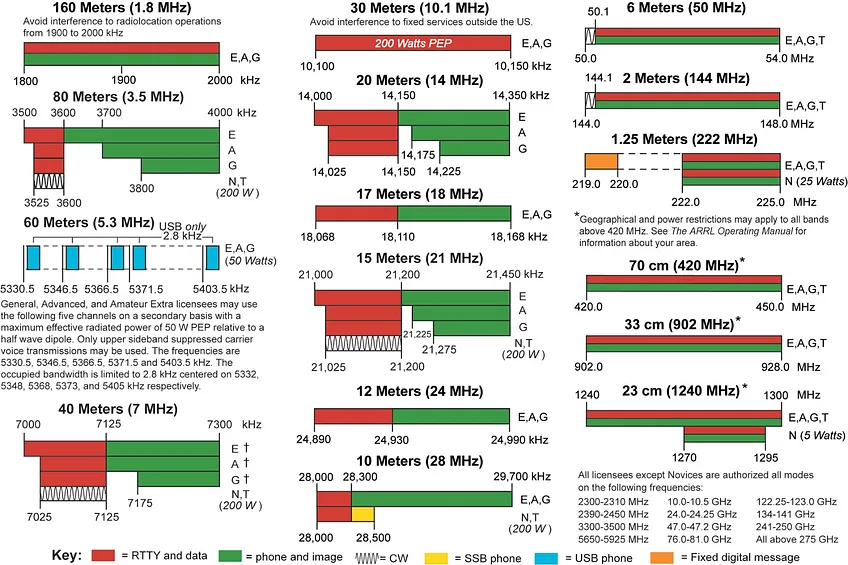
Ham radio bands are portions of the radio spectrum allocated for amateur radio use. Each band corresponds to a specific range of frequencies, typically identified by wavelength in meters or by frequency in megahertz. Lower frequency bands have longer wavelengths and tend to travel farther, especially at night, while higher frequency bands often allow for local or line-of-sight communication with less interference.

The characteristics of a band are shaped by several factors:

  • Wavelength: Longer wavelengths travel farther and bend around obstacles better.

  • Propagation: How signals reflect, refract, or are absorbed in the atmosphere.

  • Time of Day: Some bands work best during daylight, others at night.

  • Solar Activity: Higher solar activity can enhance high-frequency propagation.


160 Meters (1.8 – 2.0 MHz)

How it works:
Known as the "Top Band," 160 meters behaves like the AM broadcast band. Signals can travel hundreds of miles at night through groundwave and skywave propagation, but daytime range is usually much shorter due to absorption by the ionosphere.

Best for:

  • Long-distance nighttime communication.

  • Experimental antennas and low-frequency propagation studies.

When to use:
At night for regional to continental contacts, especially in winter when static is lower.


80 Meters (3.5 – 4.0 MHz)

How it works:
A strong nighttime band with excellent regional coverage. During the day, it is mostly limited to short-range contacts due to ionospheric absorption.

Best for:

  • Nighttime nets and ragchewing.

  • Emergency communications covering a few hundred miles.

When to use:
Evenings and nighttime for stable, reliable communication.


60 Meters (5.3 MHz)

How it works:
This is a shared band with specific channels and power limits. It often bridges the gap between 80 and 40 meters, working well for medium-range contacts both day and night.

Best for:

  • Emergency communications.

  • Consistent regional coverage.

When to use:
When 80 meters is too noisy or dead during the day, and 40 meters is too long-range for your needs.


40 Meters (7.0 – 7.3 MHz)

How it works:
A versatile band with excellent regional coverage during the day and long-distance capability at night. Often considered the "workhorse" of HF.

Best for:

  • Daytime communications over a few hundred miles.

  • Nighttime DX (long-distance contacts).

When to use:
Day for regional nets, night for chasing distant stations.


30 Meters (10.1 – 10.15 MHz)

How it works:
Primarily used for digital modes and CW (Morse code). It offers stable propagation nearly all day and night with low noise levels.

Best for:

  • Long-distance digital and CW contacts.

  • Quiet band for low-power operations.

When to use:
When other bands are noisy or crowded, especially for digital modes.


20 Meters (14.0 – 14.35 MHz)

How it works:
The most popular DX band. Signals travel worldwide during daylight and into the evening. Propagation is influenced by solar activity.

Best for:

  • Worldwide communication.

  • DX contests and expeditions.

When to use:
Daytime for global contacts; remains open later during high solar activity.


17 Meters (18.068 – 18.168 MHz)

How it works:
A quieter band with less congestion. Offers good long-distance propagation during daylight hours and is less affected by contest activity.

Best for:

  • Relaxed long-distance contacts.

  • Avoiding heavy competition for contacts.

When to use:
Daylight hours, especially during solar peak conditions.


15 Meters (21.0 – 21.45 MHz)

How it works:
Excellent DX potential when the solar cycle is favorable. It can open early and stay active through the afternoon.

Best for:

  • Worldwide contacts with small antennas.

  • High-energy contests and pileups.

When to use:
Late morning to late afternoon during active solar conditions.


12 Meters (24.89 – 24.99 MHz)

How it works:
Similar to 10 meters but slightly more stable. Offers great DX when propagation is favorable, often with less noise.

Best for:

  • Daytime DX.

  • Experimenting with small portable antennas.

When to use:
Daylight hours during solar peaks.


10 Meters (28.0 – 29.7 MHz)

How it works:
When the solar cycle is strong, 10 meters can provide worldwide communication using very little power. At solar minimum, it works mostly for local and regional contacts.

Best for:

  • DX during solar peaks.

  • Short-range communications at other times.

When to use:
Daytime during high solar activity for DX; local use otherwise.


6 Meters (50 – 54 MHz)

How it works:
The “Magic Band” that can act like HF or VHF depending on conditions. Sporadic-E propagation can allow long-distance contacts unexpectedly.

Best for:

  • Surprise DX openings.

  • Local communication when HF is poor.

When to use:
Late spring and summer for sporadic-E; local year-round.


2 Meters (144 – 148 MHz)

How it works:
Primarily line-of-sight VHF communication, but can reach farther via tropospheric ducting. Common for FM repeaters, simplex, and satellites.

Best for:

  • Local and regional voice communications.

  • Emergency response and public service.

When to use:
Any time for local contacts; watch for rare tropospheric openings.


1.25 Meters (222 – 225 MHz)

How it works:
Less common in some regions but offers clear, quiet FM and repeater use. Propagation is similar to 2 meters with slightly less range.

Best for:

  • Local contacts without congestion.

  • Niche repeater systems.

When to use:
For quiet, interference-free local operations.


70 Centimeters (420 – 450 MHz)

How it works:
UHF with excellent penetration in urban areas. Mostly line-of-sight, with range influenced by terrain and building density.

Best for:

  • Repeater and portable operations.

  • ATV (Amateur Television) and digital voice.

When to use:
Any time, especially for city communications.


33 Centimeters (902 – 928 MHz) and Higher

How it works:
Primarily for local, experimental, and digital applications. Limited range but high data potential.

Best for:

  • Short-range links.

  • High-speed data and control systems.

When to use:
Specialized applications and technical experiments.


Final Thoughts

Each ham radio band is like a unique road through the radio spectrum, each with its own speed limits, scenery, and best seasons for travel. Understanding their characteristics allows operators to choose the right “road” for the journey — whether that’s chatting with a neighbor across town, checking in on an emergency net, or making a rare contact halfway around the world.

Friday, July 11, 2025

Understanding Ham Radio Licenses: A Journey Through History and Accessibility


Ham radio, or amateur radio, has long been a hobby and service that connects people across towns, countries, and continents. From emergency communication to space station chats, ham radio operators explore the science and art of radio communication. At the heart of the hobby lies a structured licensing system designed to ensure safe and knowledgeable operation. Understanding the different ham radio licenses, their historical evolution, and how accessible the entry-level license is today can help demystify a hobby that welcomes people from every background.

A Brief History of Ham Radio Licensing

Amateur radio licensing began in the early 20th century as wireless communication emerged as a powerful new technology. The Radio Act of 1912 in the United States was one of the first regulations requiring radio operators to be licensed. At that time, the main concern was interference with military and commercial signals, and licensing was a way to regulate and manage radio spectrum use.

In the decades that followed, especially after World War I and II, ham radio grew rapidly in popularity. Technological advances allowed amateur operators to experiment with everything from Morse code and voice communication to early forms of digital messaging. Licensing evolved with the technology. Over time, more structured exams were introduced, and multiple classes of licenses were developed, each offering greater privileges as technical knowledge and experience increased.

The licensing structure went through several changes in the 20th century. Originally, there were many license classes including Novice, Technician, General, Advanced, and Extra. Each class represented a step up in technical proficiency and operating privileges. In 2000, the system was simplified, and the Morse code requirement was later dropped, making entry more accessible than ever before.

The Current License Classes

Today in the United States, there are three main license classes:

Technician License:
This is the entry-level license and the most popular among new hams. It grants access to all amateur frequencies above 30 MHz and limited privileges on certain HF bands. With a Technician license, you can use VHF and UHF bands ideal for local and regional communication. This includes handheld radios, repeaters, and even satellite communication.

General License:
This is the mid-tier license and opens the door to worldwide communication. General licensees have access to a wide array of HF bands where long-distance communication is possible. To earn this license, one must pass a more advanced exam covering additional rules, operating practices, and technical concepts.

Amateur Extra License:
This is the highest class available and provides full access to all amateur radio frequencies. The exam for this license is the most comprehensive, covering advanced electronics, radio theory, and FCC regulations.

The Process of Getting Your First License

Getting your Technician license is a straightforward process. There is no longer any Morse code requirement, which removes a major barrier that once discouraged many potential operators. Today’s exam is made up of 35 multiple-choice questions pulled from a published question pool. It covers basic regulations, safety, operating procedures, and simple electronics.

There are numerous ways to study for the exam, including free online resources, apps, books, and local classes. Many amateur radio clubs offer study groups and mentoring programs. When you feel ready, you can take the exam through a Volunteer Examiner Coordinator, often hosted by local radio clubs or online exam services.

The cost is minimal, and the reward is great. Once you pass, you'll receive a call sign and be able to operate on your own station. It’s a feeling of accomplishment and the beginning of an exciting journey.

A Hobby for Everyone

One of the most remarkable things about amateur radio is its diversity. People from all walks of life are involved—doctors, mechanics, students, retirees, engineers, truck drivers, teachers, and artists. The airwaves bring together people of all ages, nationalities, and backgrounds.

Some are drawn to the emergency communication aspect, volunteering with disaster response teams. Others enjoy experimenting with antennas, building their own radios, or making global contacts. There are people who talk to astronauts on the International Space Station, bounce signals off the moon, or build digital networks. There are even entire families that get licensed together.

Amateur radio clubs are welcoming communities where newcomers are supported and encouraged. Whether you're a tech-savvy teenager, a curious retiree, or someone looking for a new hobby that connects you with the world, ham radio has something to offer.

A Doorway to a Lifelong Passion

Amateur radio is not just a hobby; it’s a bridge between people, technology, and communication. With an easy entry path, a welcoming community, and nearly limitless areas to explore, ham radio continues to thrive in a digital age.

The license is more than just a certificate—it’s a ticket to discovery, service, and lifelong learning. Getting started is easier than ever. All it takes is curiosity, a little study, and a willingness to explore the world through the invisible magic of radio waves.

Tuesday, December 17, 2024

In-Depth Review of Fast Track Ham Radio Facts: A Collection of Useful Knowledge for Informed Amateur Radio Operators by Michael Burnette


Introduction Michael Burnette, a well-regarded figure in the amateur radio world, delivers yet another practical resource for ham radio enthusiasts with Fast Track Ham Radio Facts: A Collection of Useful Knowledge for Informed Amateur Radio Operators. Released in January 2020, this companion to his popular Fast Track Ham License series bridges the gap between obtaining a ham license and becoming a confident, well-rounded operator. Designed to provide both new and experienced hams with concise, applicable knowledge, this book serves as a must-have addition to any operator's library.

In this in-depth review, we will explore the content, structure, target audience, and overall usefulness of this guide to assess its value for readers.


Content and Organization At its core, Fast Track Ham Radio Facts is structured as a collection of bite-sized, well-curated facts about amateur radio. Burnette has organized the book to serve as an accessible reference, packed with practical insights. Rather than presenting an exhaustive academic treatment of radio topics, the author distills essential knowledge into easy-to-digest sections.

The book covers a broad range of topics, including:

  • Radio frequency bands and allocations

  • Operating modes and their best use cases (CW, SSB, digital modes, etc.)

  • Propagation principles and the behavior of signals

  • Antenna basics and practical advice on setup and optimization

  • Key regulatory information, including international considerations

  • Emergency communication tips

  • Handy formulas, calculators, and reference charts for operators

Each topic is delivered in a clear, no-nonsense style, keeping explanations simple but informative. Burnette focuses on delivering actionable insights without overwhelming the reader with excessive jargon or theoretical detail.

For example, the sections on propagation and antennas are particularly helpful, as they simplify traditionally complex topics into straightforward, practical advice that readers can immediately apply to their setups. This focus on relevance makes the book stand out as an approachable resource for radio operators who want to quickly find useful information without wading through technical manuals.


Style and Tone Burnette maintains the friendly, conversational tone that readers of his Fast Track series have come to appreciate. His writing strikes a balance between technical accuracy and readability, ensuring that concepts are accessible to operators of all skill levels.

The tone is also motivational, encouraging operators to experiment, learn, and continue their amateur radio journey beyond the exam process. Burnette's enthusiasm for ham radio is contagious, making the book an enjoyable read despite its reference-style format.


Who Is This Book For? One of the greatest strengths of Fast Track Ham Radio Facts is its broad appeal. Burnette successfully targets:

  1. New Operators: For those who have recently passed their Technician, General, or Extra exams, this book provides essential knowledge that bridges the gap between studying for the test and actually using the radio.

  2. Experienced Hams: Even seasoned operators will find this book useful as a quick reference guide. Its well-organized structure makes it easy to find information on specific topics, whether you’re troubleshooting an antenna or refreshing your memory on propagation concepts.

  3. Operators Preparing for Upgrades: Those looking to advance their licenses can use the book as supplementary material to strengthen their understanding of ham radio concepts.

This versatility ensures that Fast Track Ham Radio Facts has lasting value for operators at all stages of their journey.


Strengths The book has several standout features that make it a worthwhile addition to any ham radio library:

  1. Clear and Concise Format: Burnette’s ability to break down complex topics into manageable, actionable facts is a hallmark of this book.

  2. Practical Content: The focus on real-world advice, from antenna setups to emergency preparedness, makes the information immediately applicable.

  3. Highly Accessible Writing: Burnette’s conversational tone ensures that readers don’t feel overwhelmed, even when tackling more advanced topics.

  4. Compact and Portable: The paperback format is easy to carry, making it a great resource to keep in your shack or take on trips.

  5. Useful as a Reference: The book’s modular structure allows readers to quickly locate specific information without flipping through unrelated material.


Potential Limitations While Fast Track Ham Radio Facts excels in many areas, it is worth noting that:

  • Depth Is Limited: Readers looking for a highly technical or in-depth exploration of specific topics may find the content too basic. The book is intentionally designed as a practical reference rather than a technical manual.

  • Focused on Practical Use: Hams interested in exploring experimental or cutting-edge aspects of amateur radio might not find extensive coverage here.

These limitations, however, are intentional and do not detract from the book’s value for its target audience.


Overall Assessment Michael Burnette’s Fast Track Ham Radio Facts is a highly practical, user-friendly guide that delivers exactly what it promises: a collection of useful knowledge for informed amateur radio operators. Whether you’re a newcomer to ham radio, an experienced operator, or somewhere in between, this book provides actionable insights in a format that is both accessible and engaging.

The book succeeds because it focuses on what matters most—helping operators gain the confidence and practical knowledge they need to fully enjoy the amateur radio hobby. Burnette’s straightforward writing style, well-organized topics, and emphasis on real-world applications ensure that this resource remains relevant long after the initial read.

For anyone looking to expand their understanding of amateur radio in a practical, no-fuss way, Fast Track Ham Radio Facts is a worthwhile investment. It’s a book you’ll find yourself reaching for time and time again.

Get Fast Track Ham Radio Facts On Amazon!

Ranger RCI-69VHP High Power 10 Meter Amateur Radio Review

  The Ranger RCI-69VHP is one of those radios that immediately grabs the attention of operators who enjoy traditional high-power 10 meter ...

Search This Blog