Showing posts with label preps. Show all posts

Friday, January 30, 2026

Icom IC-V3500 VHF Radio Review — Deep Dive into a Workhorse Communicator


The Icom IC-V3500 is a mobile VHF two-way radio designed for users who need reliable, rugged, and straightforward communications in vehicles, on worksites, or at events. It sits in Icom’s line-up as a mid-range option that balances power, durability, and ease of use. In this review, we’ll explore what makes the IC-V3500 stand out, where it fits best, and what potential buyers should know before investing.

Build and Design
The IC-V3500 has a classic, no-nonsense radio look. It’s built around a sturdy metal chassis with a heat-dissipating exterior that feels like it can take years of daily use. The buttons and knobs are solid with good tactile feedback. Everything is large enough to operate with gloved hands, which matters if you use it outdoors, in cold weather, or on a job site.
The microphone is rugged and has an integrated DTMF keypad, making dialing and code entry convenient without reaching for additional hardware. The display on the main unit is clear and easy to read, but it isn’t backlit to the level of premium consumer gear. Still, for its class, visibility in various lighting conditions is good.

Installation and Setup
Setting up the IC-V3500 in a vehicle or fixed location is straightforward for anyone comfortable with mobile radios. Power and antenna connections are intuitive, and the radio comes with mounting hardware that makes it simple to secure under a dash or on a flat surface.
Programming the radio can be done manually via the keypad and menu, though for many people it’s more efficient to use optional programming software and a computer cable. This software approach speeds up entering multiple channels with specific frequencies, tones, and offsets, and it saves time versus pushing buttons for every setting. Once programmed, the unit stores all your configurations reliably.

Performance and Range
The VHF band that the IC-V3500 operates on is ideal for line-of-sight communication, which is common in marine, public safety, construction, and general mobile use. With up to 55 watts of transmit power, this radio can reach farther than many handheld units. In open areas with a good antenna, you can expect clear communication over long distances. In urban or obstructed environments, range will vary, but overall performance is solid for this power class.
Receive sensitivity is strong, and the audio clarity is crisp through the speaker. The radio handles weak signals reasonably well, which is important when you’re trying to maintain contact in fringe coverage areas.

Features
The IC-V3500 doesn’t overwhelm you with gimmicks, but it covers all the essentials and a few nice extras:

The front display keeps you informed of channel, frequency, and operational status. Scanning features let you monitor multiple channels, which is incredibly useful in dynamic environments where activity shifts across frequencies. Built-in CTCSS and DCS tones give you flexibility to access repeaters and manage interference, and they’re easy to assign during programming.
The microphone keypad is a useful addition, especially if you frequently change channels or need to send DTMF tones for access codes or paging systems. The radio also supports emergency alert features, adding a layer of safety for users in demanding roles such as search and rescue or fleet operations.

Audio Quality
Audio from the IC-V3500 is loud and intelligible. The internal speaker delivers clear voice communications without distortion at higher volumes. In noisy environments like construction sites or emergency scenes, the clarity makes a real difference in ensuring your messages come through without repeated transmissions.

Durability and Reliability
Icom has a reputation for building radios that last, and the IC-V3500 continues that tradition. The construction feels robust, and the unit doesn’t heat up excessively even during extended high-power transmissions. The controls don’t feel loose, and despite frequent use, they should hold up well over time. Weather and vibration resistance are strong enough for mobile and outdoor use, though it’s not fully waterproof, so it’s best protected from direct water exposure.

Who Is It For?
The IC-V3500 is ideal for professionals and enthusiasts who need a dependable mobile VHF radio. That includes emergency responders, public works crews, fleet vehicles, rural property managers, and radio hobbyists who want more power and range than a handheld can provide. It’s not a consumer toy; it’s a tool meant for serious communication tasks.

Pros and Cons
It’s worth summarizing the strongest and weakest points. On the positive side, the IC-V3500 delivers solid power and range, a rugged build, straightforward operation, and useful features like scanning and tone control. The audio quality and reliability in daily use are also commendable.
On the downside, the interface feels a bit dated compared to modern digital radios with full graphic screens. Programming via the front panel can be slow, so a computer connection is almost a necessity if you have many channels. It also stays in the analog world; there’s no digital mode for those who want advanced digital voice features.

Final Thoughts
The Icom IC-V3500 is a dependable, no-frills mobile VHF radio that excels in durability, ease of use, and reliable communication. It strikes a good balance for users who need serious performance without paying for bells and whistles they won’t use. If your priorities are rugged construction, clear audio, and long-range VHF coverage in a mobile unit, the IC-V3500 should be high on your list.

In short, this radio feels like it was built to work hard, day in and day out — and to still be going strong when you need it most.

See The Icom IC-V3500 On Amazon!

Monday, August 11, 2025

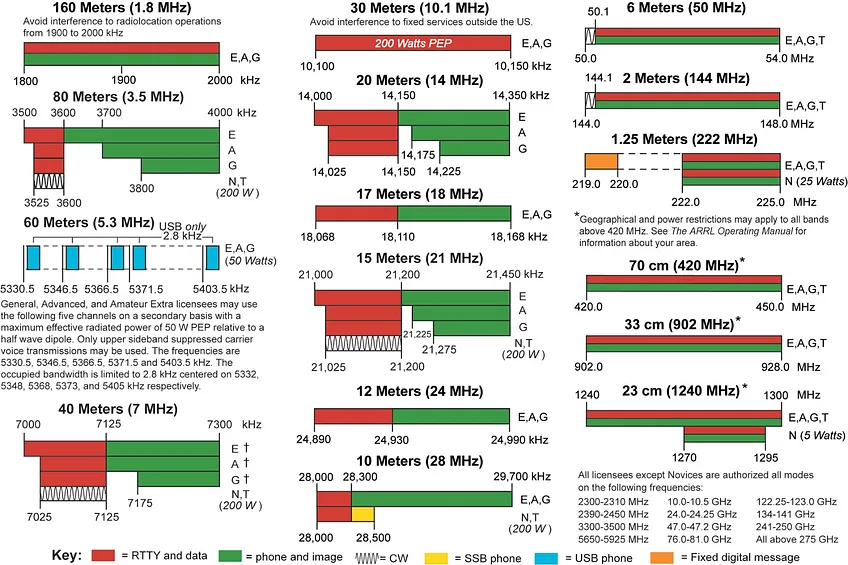
Understanding Ham Radio Bands


Ham radio bands are portions of the radio spectrum allocated for amateur radio use. Each band corresponds to a specific range of frequencies, typically identified by wavelength in meters or by frequency in megahertz. Lower frequency bands have longer wavelengths and tend to travel farther, especially at night, while higher frequency bands often allow for local or line-of-sight communication with less interference.

The characteristics of a band are shaped by several factors:

  • Wavelength: Longer wavelengths travel farther and bend around obstacles better.

  • Propagation: How signals reflect, refract, or are absorbed in the atmosphere.

  • Time of Day: Some bands work best during daylight, others at night.

  • Solar Activity: Higher solar activity can enhance high-frequency propagation.


160 Meters (1.8 – 2.0 MHz)

How it works:
Known as the "Top Band," 160 meters behaves like the AM broadcast band. Signals can travel hundreds of miles at night through groundwave and skywave propagation, but daytime range is usually much shorter due to absorption by the ionosphere.

Best for:

  • Long-distance nighttime communication.

  • Experimental antennas and low-frequency propagation studies.

When to use:
At night for regional to continental contacts, especially in winter when static is lower.


80 Meters (3.5 – 4.0 MHz)

How it works:
A strong nighttime band with excellent regional coverage. During the day, it is mostly limited to short-range contacts due to ionospheric absorption.

Best for:

  • Nighttime nets and ragchewing.

  • Emergency communications covering a few hundred miles.

When to use:
Evenings and nighttime for stable, reliable communication.


60 Meters (5.3 MHz)

How it works:
This is a shared band with specific channels and power limits. It often bridges the gap between 80 and 40 meters, working well for medium-range contacts both day and night.

Best for:

  • Emergency communications.

  • Consistent regional coverage.

When to use:
When 80 meters is too noisy or dead during the day, and 40 meters is too long-range for your needs.


40 Meters (7.0 – 7.3 MHz)

How it works:
A versatile band with excellent regional coverage during the day and long-distance capability at night. Often considered the "workhorse" of HF.

Best for:

  • Daytime communications over a few hundred miles.

  • Nighttime DX (long-distance contacts).

When to use:
Day for regional nets, night for chasing distant stations.


30 Meters (10.1 – 10.15 MHz)

How it works:
Primarily used for digital modes and CW (Morse code). It offers stable propagation nearly all day and night with low noise levels.

Best for:

  • Long-distance digital and CW contacts.

  • Quiet band for low-power operations.

When to use:
When other bands are noisy or crowded, especially for digital modes.


20 Meters (14.0 – 14.35 MHz)

How it works:
The most popular DX band. Signals travel worldwide during daylight and into the evening. Propagation is influenced by solar activity.

Best for:

  • Worldwide communication.

  • DX contests and expeditions.

When to use:
Daytime for global contacts; remains open later during high solar activity.


17 Meters (18.068 – 18.168 MHz)

How it works:
A quieter band with less congestion. Offers good long-distance propagation during daylight hours and is less affected by contest activity.

Best for:

  • Relaxed long-distance contacts.

  • Avoiding heavy competition for contacts.

When to use:
Daylight hours, especially during solar peak conditions.


15 Meters (21.0 – 21.45 MHz)

How it works:
Excellent DX potential when the solar cycle is favorable. It can open early and stay active through the afternoon.

Best for:

  • Worldwide contacts with small antennas.

  • High-energy contests and pileups.

When to use:
Late morning to late afternoon during active solar conditions.


12 Meters (24.89 – 24.99 MHz)

How it works:
Similar to 10 meters but slightly more stable. Offers great DX when propagation is favorable, often with less noise.

Best for:

  • Daytime DX.

  • Experimenting with small portable antennas.

When to use:
Daylight hours during solar peaks.


10 Meters (28.0 – 29.7 MHz)

How it works:
When the solar cycle is strong, 10 meters can provide worldwide communication using very little power. At solar minimum, it works mostly for local and regional contacts.

Best for:

  • DX during solar peaks.

  • Short-range communications at other times.

When to use:
Daytime during high solar activity for DX; local use otherwise.


6 Meters (50 – 54 MHz)

How it works:
The “Magic Band” that can act like HF or VHF depending on conditions. Sporadic-E propagation can allow long-distance contacts unexpectedly.

Best for:

  • Surprise DX openings.

  • Local communication when HF is poor.

When to use:
Late spring and summer for sporadic-E; local year-round.


2 Meters (144 – 148 MHz)

How it works:
Primarily line-of-sight VHF communication, but can reach farther via tropospheric ducting. Common for FM repeaters, simplex, and satellites.

Best for:

  • Local and regional voice communications.

  • Emergency response and public service.

When to use:
Any time for local contacts; watch for rare tropospheric openings.


1.25 Meters (222 – 225 MHz)

How it works:
Less common in some regions but offers clear, quiet FM and repeater use. Propagation is similar to 2 meters with slightly less range.

Best for:

  • Local contacts without congestion.

  • Niche repeater systems.

When to use:
For quiet, interference-free local operations.


70 Centimeters (420 – 450 MHz)

How it works:
UHF with excellent penetration in urban areas. Mostly line-of-sight, with range influenced by terrain and building density.

Best for:

  • Repeater and portable operations.

  • ATV (Amateur Television) and digital voice.

When to use:
Any time, especially for city communications.


33 Centimeters (902 – 928 MHz) and Higher

How it works:
Primarily for local, experimental, and digital applications. Limited range but high data potential.

Best for:

  • Short-range links.

  • High-speed data and control systems.

When to use:
Specialized applications and technical experiments.


Final Thoughts

Each ham radio band is like a unique road through the radio spectrum, each with its own speed limits, scenery, and best seasons for travel. Understanding their characteristics allows operators to choose the right “road” for the journey — whether that’s chatting with a neighbor across town, checking in on an emergency net, or making a rare contact halfway around the world.

KSUN UV5200D Dual Band Mobile Amateur Radio Transceiver Review

The KSUN UV5200D is a dual band mobile amateur radio transceiver designed for operators who want an affordable entry into mobile VHF and ...

Search This Blog