Showing posts with label amateur. Show all posts

Saturday, December 13, 2025

Baofeng UV-5R Mini Ham Radio — In-Depth Review


Overview
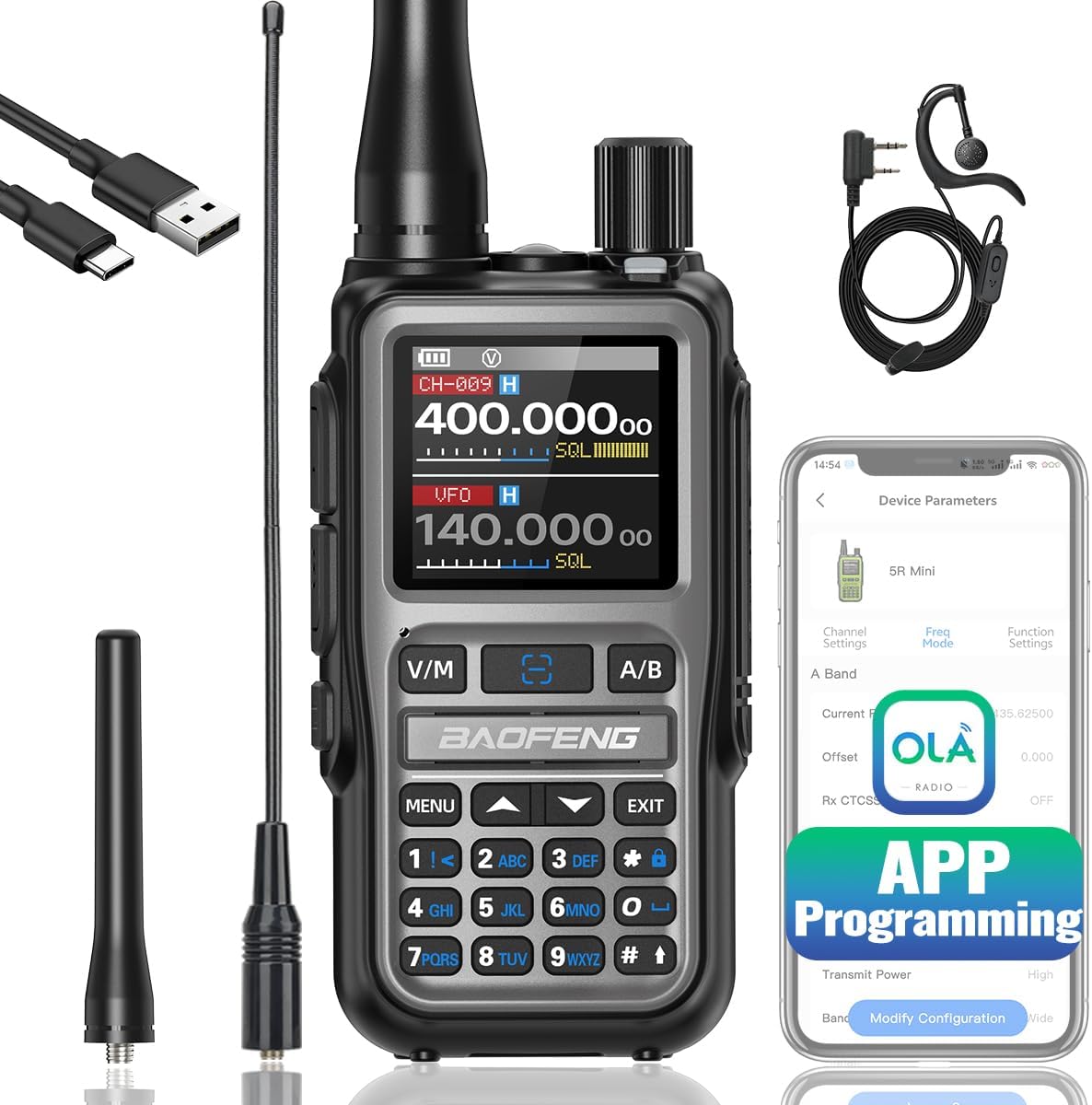
The Baofeng UV-5R Mini is a compact, budget-minded dual-band handheld transceiver that takes the familiar UV-5R platform and shrinks it into an even more pocketable form while adding a handful of modern conveniences such as USB-C charging and simplified app-based programming options. It aims at new hams and casual users who want a low-cost entry to VHF/UHF operations, local repeaters, NOAA weather monitoring, and short-range emergency communications without a heavy or bulky unit.

Design and Build
Physically, the Mini keeps a straightforward, no-frills layout: a small but readable display, a numeric keypad for direct frequency entry, PTT and function buttons, and a removable antenna. The body is light and compact — easy to carry on a belt or slip into a jacket pocket — and the simpler control layout makes it approachable for beginners. The casing is typically plastic with a matte finish; it’s adequate for everyday handling but not as rugged-feeling as higher-end handhelds.

The USB-C charging port is a welcome, modern update that removes the need for proprietary chargers or older micro-USB cables. Many packages include a rechargeable battery and a basic charger cable; battery capacity varies by seller and bundle but generally supports a full day of casual use. Some bundles include an earpiece/headset; connector type for external audio (3.5mm vs two-pin Kenwood-style) varies by variant, so buyers should check what their specific kit contains.

Radio Performance and RF Features
At its core the UV-5R Mini remains a dual-band VHF/UHF transceiver capable of transmit and receive on the popular 2-meter and 70-centimeter amateur bands. It receives public-service broadcasts and NOAA weather channels, which is useful for monitoring weather alerts and local broadcasts.

Transmit power on most Baofeng handhelds is selectable (high/low) and typically sufficient for simplex work and for hitting nearby repeaters when used with a decent antenna and proper location. Range in real-world terms depends heavily on antenna, terrain, height, local noise, and repeater placement — expect neighborhood to several miles in typical suburban conditions, and substantially farther if you can place the antenna high or use repeaters.

Receiver sensitivity and selectivity are surprisingly capable for the price: the Mini will pull in local repeaters,-weather and aircraft/airband (receive-only, if equipped to) reasonably well. That said, it does not match the front-end filtering or audio fidelity of more expensive commercial or hobbyist radios, so in very crowded RF environments you may notice handling of strong out-of-band signals is not as robust.

Channels, Memory and Features
One of the marketing hooks is large channel memory counts (advertised 999 channels on some models). Practically, the memory system lets you store frequencies, offsets and tones for repeaters, weather channels, and simplex buddies. The front panel allows manual frequency entry and navigation through stored memories.

Other common features include dual-watch/dual-standby (monitor two channels/frequencies), FM broadcast reception, CTCSS/DCS tone support for repeater access, VOX (hands-free transmit), and an emergency alarm function in some firmware versions. The Mini also often includes a “frequency copy” or wireless frequency copy feature allowing two radios of the same model to copy programmed channels to each other without a computer — handy for field operations and quick setup.

Programming: App, Cable, and Software
Programming options are flexible. For users who prefer GUI programming, many sellers bundle a USB programming cable and the radio can be programmed using PC software such as CHIRP — though support and cable compatibility may vary with clones and firmware revisions. The increasingly common alternative is smartphone app programming: a Bluetooth or proprietary app can write frequencies and memories to the radio, which appeals to users who dislike dealing with desktop software. App functionality and reliability vary by vendor and third-party app developer; some apps are straightforward and work well for the basics while others are limited.

If you rely on USB-C for charging only and still need the traditional programming cable, double-check the bundle contents. The radio’s keypad and small screen permit manual programming, but that is slower and error-prone for many channels compared to software upload.

Audio and Accessories
On receive and transmit, audio clarity is acceptable for casual use. Speaker volume is adequate in quiet conditions; in noisy environments or when clear audio is vital, a headset or external speaker improves intelligibility. Many kits include a basic earpiece/mic; higher-quality aftermarket accessories with secure connectors improve comfort and durability.

Common accessory purchases include upgraded antennas (better whip or telescoping designs), high-capacity batteries for longer operating time, belt clips, and carry cases. Antenna upgrades often yield better range and performance than changing radio settings.

Battery Life and Charging
Battery life varies with transmit duty cycle, power level, and battery capacity. For intermittent use (monitoring and occasional transmissions), a standard rechargeable pack typically lasts many hours; for heavy transmit use (net control, long data bursts), life shortens. The USB-C charging option is convenient for field use with power banks and modern chargers — a practical advantage over older micro-USB or proprietary charge ports.

Safety, Regulations, and Practical Use
Important: transmitting on amateur bands requires an appropriate license in most countries (for example, an FCC amateur radio license in the United States). Users should obtain the correct license and operate within permitted frequencies and power limits. Additionally, do not transmit on public safety, aviation, or other restricted frequencies — many handhelds can receive such bands but transmitting there is illegal and dangerous. Learn local regulations and program only authorized frequencies.

Real-World Experience and Usability
For new hams, the Mini is an accessible, low-cost way to learn the basics: making simplex contacts, checking into local repeaters, monitoring NOAA weather, and understanding radio etiquette. Its light weight and small size encourage taking it along on hikes, RV trips, or local events.

Ease-of-use depends on the user’s patience with small menus and a compact keypad. Those comfortable with programming via PC or app will set up the radio quickly. For group deployments or emergency prep, the wireless frequency copy function (if present) and app-based sharing are practical features that speed distributing channel plans among multiple units.

Limitations and Trade-Offs
The UV-5R Mini is a budget device and shows it in several ways: build materials are economical, front-end filtering is limited compared to mid- or high-end handhelds, and audio fidelity and ergonomics are basic. Some users report variability across different batches or vendor clones, so quality control can be inconsistent. The small form factor also means smaller buttons and a smaller display, which can be a nuisance for large-gloved hands or for users who value large, tactile controls.

Many advanced features common in pricier radios — superior receiver front-end, better shielding against strong-signal overload, more robust firmware, superior ergonomics, and more reliable accessory connectors — are absent here. If you plan frequent contesting, serious weak-signal work, or professional-grade reliability, stepping up to a higher-tier radio is worth considering.

Pros and Cons (concise)
Pros: Extremely affordable; pocketable; dual-band VHF/UHF; NOAA/weather receive; USB-C charging; multiple programming options including app and cable; good entry-level feature set.

Cons: Build and audio quality are basic; front-end performance limited in crowded RF environments; possible variation between suppliers/clones; small keypad/display; some bundle inconsistencies (battery size, headset type).

Who Is This Radio For?
The UV-5R Mini is best for beginners who want an inexpensive, portable way to get on the air and learn. It’s useful for hikers, campers, event volunteers, and anyone who wants a low-cost handheld for local communications, weather monitoring, and basic repeater use. It is less suited to users requiring professional durability, heavy-duty contest performance, or the best possible receiver performance in noisy RF environments.

Verdict
The Baofeng UV-5R Mini delivers a compelling value proposition for its price: a compact, modernized take on a popular low-cost handheld platform that includes practical updates like USB-C charging and app-friendly programming. It won’t match the refinement or performance of mid-range handhelds, but for newcomers, hobbyists on a budget, and those needing a light, inexpensive backup radio, it’s an attractive choice. As with any inexpensive radio, buyers should be mindful of bundle differences, confirm exact features before purchase, and plan on learning basic programming and radio etiquette to get the most out of it.

Final Notes and Tips
Learn the local band plan and licensing requirements where you live. Program NOAA weather channels and a few local repeater memories before heading out. Invest in a better antenna and a spare battery if you expect regular use. Use the radio’s lower power setting for short-range contacts to conserve battery life, and reserve high power for reaching distant repeaters when needed.

🎅See The Baofeng Mini On Amazon!🎅

Friday, November 14, 2025

Radtel RT-910B 5W Multi-Band Ham Radio Handheld Walkie Talkie — In-Depth Review


Overview
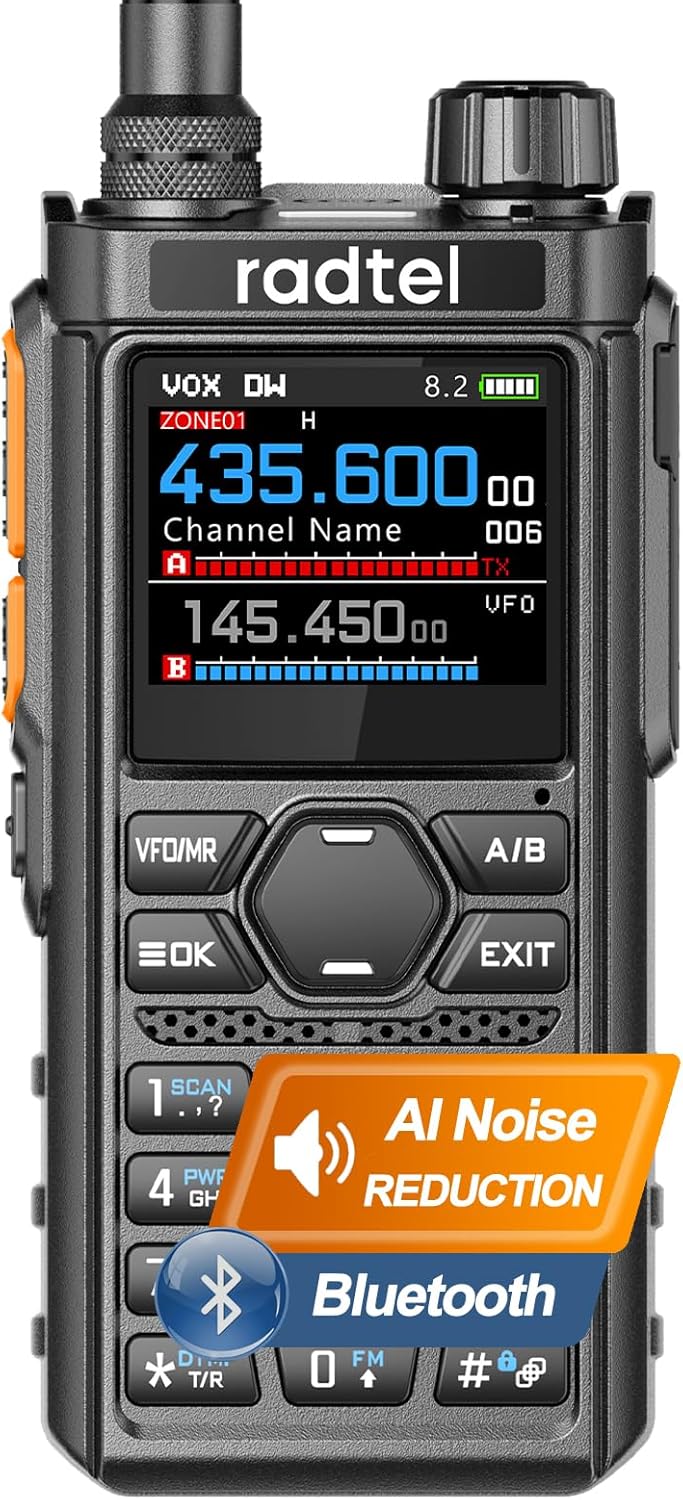
The Radtel RT-910B is a compact, feature-heavy handheld aimed at amateur radio operators who want a versatile, budget-friendly rig. It packs multi-band coverage including the 6 meter amateur band, up to 5 watts transmit power, a large channel capacity (960 channels), AM/FM broadcast receive, Type-C charging, spectrum scan, and Bluetooth support. On paper it looks like a Swiss Army knife for hams who want one radio that does a bit of everything: local simplex, repeater work, shortwave-ish monitoring, and casual scanning. This review walks through the hardware, ergonomics, audio, RF performance, usability, programming options, battery life and charging, Bluetooth and accessories, plus who will get the most from this radio.

What it is good for

What it is not

  • A substitute for a full-power base station or contest-grade transceiver.

  • The best choice for serious weak-signal work, long-distance DXing, or high-performance contesting.

  • A replacement for radios with extensive aftermarket support, custom firmware, or world-class receiver performance.

Build quality and design
The RT-910B follows the now-common handheld stylistic template: a rugged-looking ABS/polycarbonate housing, a rubberized grip area, a detachable antenna, and a top-mounted rotary or button control for volume and channel selection. The chassis feels reasonably solid for the price point; seams are tight and buttons have a positive feel, though they’re not as crisp as midrange handhelds from legacy brands. The radio usually ships with a removable belt clip and a basic antenna; higher performance or longer antennas will improve transmit and receive noticeably.

Ergonomics and controls
Controls are laid out to be usable by one hand: a push-to-talk (PTT) on the side, programmable function keys, and a front-facing keypad for direct channel entry and quick menu access. The menu system is typically layered but logical — expect a learning curve if you’re used to simpler consumer radios. The display is clear enough for channel info, frequency readout, and menu navigation; backlighting helps in low light but is not overwhelmingly bright. The keypad and soft keys work fine with gloved hands if the gloves are not too bulky.

Display and user interface
The radio’s display presents frequency, mode (FM/AM), channel number, and status icons for battery, Bluetooth, lock, and scan. Spectrum scan functions usually show a waterfall or bar display to let you visually locate active signals — useful for newcomers and for chasing activity on less-commonly used bands like 6 meters. The channel memory system (up to 960 channels) is powerful: you can store repeaters, offsets, tones, and custom names — a strong point for portable operation and for users who hop between many repeaters.

Receiver and audio performance
For typical on-the-air use the receiver is serviceable. Sensitivity and selectivity are adequate for local repeater work and casual monitoring, though it won’t match the front-end filtering or DSP of higher-end transceivers. The inclusion of AM and FM broadcast receive expands utility for monitoring local news or propagation beacons. The speaker gets loud enough for noisy outdoor environments; audio is clear at reasonable volume levels but shows compression and distortion at extremes. Bluetooth audio output is handy for headset use, but expect slightly higher latency and compressed audio quality compared with wired headsets.

Transmit performance and power
The RT-910B is rated up to 5 watts on transmit, which is typical for handheld ham radios that allow QRP/low-power operation and still provide usable range into repeaters. Users should verify actual transmit power for each band/mode and expect that HTs with stock antennas and 5W will perform like other handhelds — excellent for local contacts and repeater access, limited for long-distance simplex unless propagation is favorable. The dual-PTT feature (if present) is useful for quick switching between channels or for linking talk groups in certain setups.

Antenna and RF considerations
Performance out of the box depends heavily on the supplied antenna. Stock antennas favor compactness over efficiency; swapping to a higher-gain, longer whip or using a mag-mount on a vehicle will substantially improve both transmit and receive. Because the radio covers multiple bands (including 6 meters), using band-appropriate aftermarket antennas for 6m, 2m, and 70cm will yield the best results.

Programming, memory, and features
The RT-910B’s 960-channel memory system is one of its headline features. It supports channel naming, offsets, CTCSS/DCS tones, and priority scanning. Many users will want to program channels via software (PC programming using a compatible cable and CHIRP-like formats where supported); if the radio supports CHIRP or vendor software, that makes bulk programming much easier. The spectrum scan function helps identify active frequencies quickly; it’s a great learning tool and simplifies finding local repeaters and beacons on the 6 meter band. Other useful features often include dual-watch, priority channel, VOX (if present), and adjustable power settings (high/low).

Bluetooth version and capabilities
The Bluetooth version adds convenience: wireless headsets, earpieces, and possibly wireless programming or phone link depending on implementation. Expect standard Bluetooth audio profiles that allow voice routing to a headset; Bluetooth will be handy for hands-free operation but is not a replacement for wired, low-latency connections in high-demand environments. If the radio supports Bluetooth PTT through an accessory, that can be a useful field addition.

Battery life and charging
Type-C charging is a modern convenience and means you can top up the battery almost anywhere without hunting for a proprietary charger. The stated battery capacity (if listed by the manufacturer) will determine real-world runtime; with moderate use a mid-sized battery often yields a full day of casual operation, while heavy scanning, Bluetooth streaming, or continuous transmit will shorten runtime quickly. Fast top-ups via USB-C are convenient in the field. If the radio supports external power via USB-C while transmitting, verify voltage/current specs to avoid charger overheating or insufficient power during transmit.

Accessories and expandability

  • Upgraded antenna: highly recommended for real improvement.

  • Desktop/charging cradle: handy if offered.

  • Programming cable and PC software: essential for bulk memory management.

  • Bluetooth headset or boom mic: for hands-free operation.

  • External mag-mount or mobile adapter: if you plan to use the radio in a car.

  • Spare batteries for extended outings.

Usability in real-world scenarios

Pros

  • Multi-band coverage including the 6 meter band.

  • Large channel memory (960 channels) for repeaters, simplex frequencies, and scanning playlists.

  • AM/FM broadcast receive adds general utility.

  • Spectrum scan helps visually locate activity.

  • Modern conveniences: Type-C charging and Bluetooth support.

  • Compact, lightweight, and feature-rich for the price point.

Cons

  • Build and button feel are not the premium level of legacy high-end brands.

  • Receiver and audio quality are good but not class-leading—limited selectivity on crowded bands.

  • Out-of-the-box antenna usually limits real-world range; upgrade recommended.

  • Bluetooth audio is convenient but usually compressed and slightly latent compared to wired.

  • Programming can be tedious without PC software and a cable.

Tips and recommended settings

  • Replace the stock antenna early — you’ll notice an immediate improvement.

  • Program repeaters, offsets, and tones into memory before field use. Bulk programming via PC is faster and reduces mistakes.

  • Use the spectrum scan to find active spots on 6 meters before relying on memory channels.

  • Keep Bluetooth off if you need the lowest latency or best audio clarity for monitoring weak signals.

  • Carry a spare battery or powerbank for long outings; USB-C top-up from a powerbank is very convenient.

  • Learn how to lock keys and set backlight timeout to prevent accidental channel changes.

Who should buy it

  • New hams wanting many features at a modest price.

  • Portable operators who value light weight and battery convenience.

  • Casual users who want AM/FM listening plus a capable ham handheld.

  • Hams who want an inexpensive multi-band backup radio with modern features like Type-C charging and Bluetooth.

Who might skip it

  • Contesters, DX chasers, and weak-signal enthusiasts who require top-tier receiver performance and advanced filtering.

  • Operators who demand best-in-class ergonomics, proven long-term firmware support, and extensive aftermarket accessories.

Final verdict
The Radtel RT-910B brings together an appealing set of modern features into a single, compact handheld: multi-band coverage with 6 meters, 960 programmable channels, AM/FM receive, spectrum scanning, Bluetooth, and USB-C charging. For the price-conscious operator or the newcomer who wants to experiment across bands and modes, it’s a strong value proposition. Expect solid—but not exceptional—RF performance and build quality; the radio shines when paired with a better antenna and a bit of programming work. If you want a versatile daily carry or a capable backup HT with modern conveniences, the RT-910B deserves serious consideration. If, however, you need the absolute best receiver performance, premium buttons and knobs, or professional-grade durability, look to higher-tier models from long-established manufacturers.

🎅See The Radtel RT-910B On Amazon!🎅

Full In-Depth Review: BTECH UV-50PRO 50W Dual Band Mobile Ham Radio

The BTECH UV-50PRO 50W Dual Band Mobile Ham Radio is designed for amateur radio operators who want a modern, feature-packed mobile transc...

Search This Blog