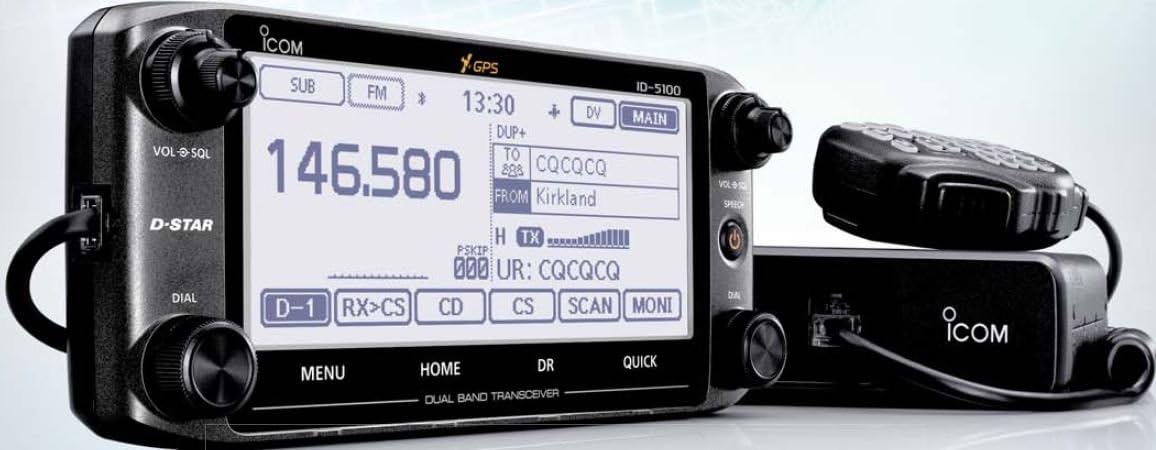
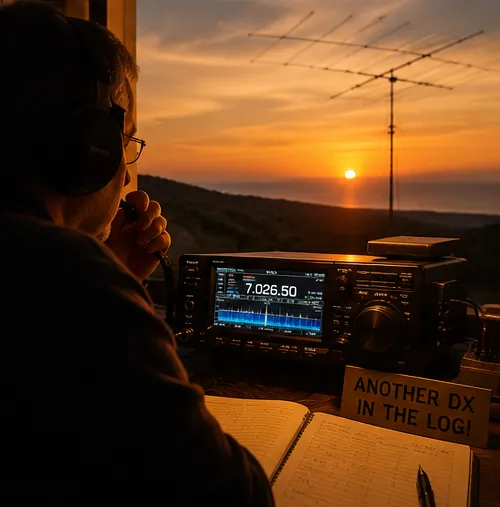
The Icom IC-9700 has earned a reputation as one of the most capable dedicated VHF and UHF amateur radio transceivers available to serious operators. Rather than being simply another FM base station, the IC-9700 is an all-mode, tri-band SDR transceiver designed to cover a remarkable range of amateur radio activities.
It covers the 2-meter, 70-centimeter, and 23-centimeter bands and supports SSB, CW, AM, FM, RTTY, D-STAR DV, and D-STAR DD. It also includes sophisticated satellite operating capabilities, a real-time spectrum scope, waterfall display, dual-watch operation, full-duplex satellite operation, LAN connectivity, USB connectivity, and an impressive touchscreen interface.
For an operator interested in weak-signal VHF and UHF, amateur satellites, meteor scatter, moonbounce, contesting, D-STAR, digital communications, or simply having an extremely capable VHF/UHF station, the IC-9700 deserves serious consideration.
Overview
The IC-9700 occupies an interesting position in the amateur radio market. Most modern HF transceivers include VHF and UHF capabilities, but those radios generally do not provide the same depth of functionality on the higher-frequency bands.
The IC-9700 was designed specifically around VHF, UHF, and 23 cm operation.
The U.S. version covers 144-148 MHz, 430-450 MHz, and 1240-1300 MHz. It supports 100 watts on 2 meters, 75 watts on 70 centimeters, and 10 watts on 23 centimeters for SSB, CW, FM, RTTY, DV, and DD operation.
That power arrangement makes considerable sense for the intended applications. Two meters and 70 centimeters are commonly used for terrestrial weak-signal work, contesting, repeater operation, satellite communication, and other activities where additional transmitter power can be useful.
The 23 cm band is a different story. Ten watts is a respectable amount of power from a compact transceiver at 1.2 GHz, and the IC-9700 provides a convenient way to get into 23 cm without requiring a separate transceiver.
Design and Build Quality
The IC-9700 has the familiar appearance of a modern Icom desktop transceiver.
The front panel is dominated by a 4.3-inch color touchscreen. Around the display are physical controls and buttons that provide direct access to many frequently used functions. A large tuning knob occupies the right side of the radio.
The overall design will be immediately familiar to anyone who has operated an Icom IC-7300 or other recent Icom SDR.
The radio measures approximately 9.4 inches wide, 3.7 inches high, and 9.4 inches deep, with a weight of approximately 10.4 pounds. It requires a 13.8-volt DC power source and can draw substantial current when transmitting at full power.
This is definitely a desktop base-station radio rather than a handheld or lightweight portable rig.
The construction feels appropriate for a serious station. The controls are substantial, the display is easy to see, and the combination of touchscreen and physical controls works particularly well during normal operation.
The SDR Architecture
One of the most important features of the IC-9700 is its SDR architecture.
The radio uses RF direct sampling on 144 and 430/440 MHz. On 1200 MHz, Icom uses a down-conversion IF sampling architecture.
That distinction is important because the IC-9700 isn't simply an old-style VHF/UHF superheterodyne transceiver with a modern display attached.
Digital signal processing plays a major role throughout the receiver and transmitter.
The result is a radio capable of providing excellent filtering, spectrum visualization, noise reduction, signal management, and other digital functions.
For operators who have become accustomed to the flexibility of modern SDR HF transceivers, the IC-9700 brings much of that experience to VHF and UHF.
The Spectrum Scope and Waterfall
One of the first features many operators notice is the spectrum scope.
The scope provides a visual representation of activity around the operating frequency. Instead of tuning blindly across the band looking for signals, the operator can see signals appearing on the display.
The waterfall adds another dimension by showing activity over time.
This can be extremely useful during contests or weak-signal operating.
For example, an operator monitoring a portion of the 2-meter SSB band can watch the waterfall for signals that might otherwise be difficult to locate by tuning alone.
The scope can also be useful when searching for satellite signals, monitoring repeater activity, or looking for weak stations.
For weak-signal enthusiasts, this feature alone can make the IC-9700 feel dramatically more modern than older VHF/UHF multimode radios.
The Receiver
The receiver is arguably one of the strongest reasons to purchase an IC-9700.
VHF and UHF operators often deal with very different conditions from HF operators. A weak signal may be only a few kilohertz away from a very strong signal. Contest locations can contain large numbers of transmitters operating simultaneously. Satellites can present rapidly changing signal levels.
A receiver needs more than simply good sensitivity.
It also needs selectivity and dynamic range.
The IC-9700 has demonstrated strong performance in these areas. The ARRL product review specifically highlighted its ability to receive weak signals while maintaining good dynamic-range performance.
That makes the radio particularly interesting for serious VHF and UHF operators.
Weak-Signal VHF Operation
The IC-9700 is an excellent match for operators interested in 2-meter SSB.
While FM dominates casual 2-meter operation, SSB opens an entirely different side of amateur radio.
With a suitable directional antenna and favorable conditions, operators can work stations much farther away than they might expect from ordinary FM operation.
The IC-9700 provides the power, filtering, receiver performance, and spectrum display needed for this type of operating.
It is particularly well suited to:
2-meter SSB
2-meter contesting
Meteor scatter
Tropospheric propagation
EME
Portable hilltop operation
VHF DX
Contest station operation
The 100-watt output on 2 meters is another major advantage.
For operators coming from a typical 50-watt VHF transceiver, the additional output can provide a useful increase in signal strength, although antenna height, antenna gain, feed-line quality, and propagation remain extremely important.
70-Centimeter Operation
The 70-centimeter band receives the same attention from the IC-9700.
The radio provides up to 75 watts on 70 centimeters for most major operating modes.
That makes it useful for both local and long-distance UHF work.
70 centimeters is particularly interesting for operators who enjoy weak-signal work because the band can support serious DX under favorable propagation conditions.
The IC-9700 also makes an excellent satellite radio because many amateur satellites use combinations of 2 meters and 70 centimeters.
23-Centimeter Operation
The inclusion of 23 cm is one of the features that really separates the IC-9700 from many competing amateur radios.
The 23-centimeter amateur band is 1240-1300 MHz in the U.S. version, and the IC-9700 provides up to 10 watts of output on the band.
23 cm is a fascinating part of amateur radio.
It offers opportunities for:
Point-to-point communication
Satellite work
Moonbounce
Digital experimentation
High-gain antenna experiments
Microwave-oriented amateur radio projects
The biggest challenge is that 23 cm requires considerably more attention to feed-line loss, antenna construction, connectors, and system design.
At 1.2 GHz, poor-quality coaxial cable can introduce significant losses.
Fortunately, the IC-9700 gives an operator a relatively simple entry point into the band.
Instead of purchasing separate equipment for 23 cm, the operator gets all three bands in one radio.
D-STAR
D-STAR is one of the defining features of the IC-9700.
The radio supports D-STAR Digital Voice as well as Digital Data operation. Icom also includes D-STAR gateway-related functionality that can allow the radio to function in Terminal or Access Point modes under supported configurations.
For operators already involved with D-STAR, this makes the IC-9700 considerably more attractive.
D-STAR can provide clear digital voice communication while also allowing connectivity through D-STAR repeater and gateway systems.
The radio's Digital Voice capabilities also integrate nicely with its other operating functions.
Dual D-STAR Receive
Another particularly interesting feature is dual D-STAR reception.
The IC-9700 can decode two D-STAR voice streams simultaneously under supported dual-receive configurations. Icom lists dual D-STAR receive among the radio's capabilities.
This can be extremely useful for an operator monitoring two digital channels.
For example, one receiver can monitor a local D-STAR repeater while another watches a different frequency.
Satellite Operation
Satellite operation is another area where the IC-9700 stands out.
The radio includes a dedicated satellite mode with extensive memory support. Icom specifies up to 99 satellite memory channels.
The satellite mode is designed to simplify the process of working amateur satellites.
Instead of manually adjusting the uplink and downlink frequencies independently, the radio can coordinate the frequencies as the satellite moves through the pass.
This makes satellite operation considerably easier.
The IC-9700 can also operate in full duplex, allowing the operator to listen to the satellite downlink while transmitting on the uplink.
That is a major advantage for satellite operators.
Being able to hear the downlink while transmitting is extremely useful because the operator can immediately determine whether the signal is making it through.
Satellite enthusiasts should also appreciate the large display and spectrum scope.
The combination makes it much easier to identify activity during a busy satellite pass.
Full-Duplex Operation
Full-duplex operation is one of the IC-9700's particularly important capabilities.
For satellite work, full duplex means the operator can transmit on one frequency while simultaneously receiving the other.
This is especially valuable when working satellites using separate uplink and downlink frequencies.
The IC-9700 can also perform dual-watch functions, although there are limitations regarding which band combinations can be monitored simultaneously. Icom's specifications identify full-duplex operation and dual-watch capabilities among the radio's features.
For serious satellite operators, this capability should be high on the list of features to consider.
Digital Data
The IC-9700 isn't limited to voice communication.
The radio supports D-STAR Digital Data, including DD operation on 23 cm. Icom specifies a 128 kbps data capability for DD mode.
This opens the door to experimentation beyond traditional voice communication.
Digital data operation is particularly interesting for amateur radio operators who enjoy combining radio with computers, networking, and experimentation.
Computer Connectivity
The IC-9700 includes USB and LAN connectivity.
This is increasingly important in modern amateur radio.
A computer can be integrated into the station for logging, digital modes, radio control, firmware management, and other applications.
The LAN connection is particularly useful because it allows the radio to become part of a network-connected station.
Operators interested in remote operation can also take advantage of Icom's broader network and remote-control ecosystem.
The radio's LAN interface and associated software support make it much more suitable for modern station integration than many older VHF/UHF transceivers.
Digital Modes
Although the IC-9700 is heavily associated with D-STAR, operators should not overlook its conventional digital-mode capabilities.
The radio supports RTTY and data operation, while its USB connectivity makes computer-based digital communication much easier to integrate.
Modern software can also be used for modes such as FT8 and other weak-signal digital applications.
This is particularly interesting on 2 meters and 70 centimeters, where digital weak-signal operation can provide an entirely different way of making contacts.
The ability to combine an SDR-based radio with computer software makes the IC-9700 a flexible experimental platform.
Controls and Touchscreen
The 4.3-inch color touchscreen is one of the radio's most noticeable features.
Icom uses an interface similar to the one found on the IC-7300.
For operators already familiar with the IC-7300, the transition to the IC-9700 is relatively straightforward because many controls and menus have a similar philosophy.
The touchscreen doesn't replace all physical controls.
Instead, the radio combines touchscreen menus with dedicated knobs and buttons.
That is an excellent approach for a base station.
Menus can handle advanced functions while frequently used controls remain immediately accessible.
Audio
The built-in audio system is perfectly adequate for normal amateur radio operation.
For serious weak-signal operators, however, headphones or a quality external speaker may be preferable.
Audio quality becomes especially important during long weak-signal sessions.
When listening to a station that is only barely above the noise floor, the ability to customize filtering and audio output can make a significant difference.
The IC-9700 offers extensive receiver filtering and DSP features that help operators tailor the receiver to different modes.
Memory System
The IC-9700 provides extensive memory capabilities.
The U.S. specifications list 297 simplex memory channels, 18 programmable scan-edge channels, six call channels, 99 satellite memories, and a large number of memories associated with the DR function.
That gives operators plenty of room for storing:
Local repeaters
Simplex frequencies
Contest frequencies
Satellite frequencies
Calling frequencies
Digital frequencies
Having a well-organized memory system can make a significant difference in everyday operation.
Antennas and Connections
One of the advantages of the IC-9700 is that it provides separate antenna connections for the three frequency ranges.
The radio uses an SO-239 connector for 144 MHz and Type-N connectors for the 430/440 and 1200 MHz connections.
The use of Type-N connectors for the higher-frequency connections is a sensible design choice.
At 70 centimeters and especially 23 centimeters, connector quality and feed-line construction become increasingly important.
A high-quality radio cannot compensate for a poor antenna system.
An operator buying an IC-9700 should budget for good coaxial cable, appropriate connectors, and a properly designed antenna system.
The Antenna Makes the Station
This point deserves emphasis.
Buying an expensive transceiver does not automatically create an effective VHF/UHF station.
The antenna system may be even more important.
For 2 meters, a good vertical antenna can provide excellent local coverage, while a horizontally polarized directional antenna can be much better for weak-signal SSB.
For 70 centimeters, antenna gain becomes particularly valuable.
For 23 centimeters, feed-line loss and antenna efficiency become even more important.
Operators purchasing the IC-9700 should think about the entire station rather than just the transceiver.
Power Supply Requirements
The IC-9700 operates from a nominal 13.8-volt DC supply.
The U.S. specifications indicate less than 18 amps of transmit consumption at high power.
A quality regulated power supply with sufficient current capacity is therefore essential.
It is not a good idea to pair a high-performance base station with an undersized or poor-quality power supply.
For a permanent shack installation, a reliable 25-amp-class or larger amateur-radio power supply provides reasonable headroom, depending on the rest of the station and operating requirements.
Portable Operation
Although the IC-9700 is clearly designed as a desktop radio, it can be taken into the field.
Its approximately 10.4-pound weight isn't unreasonable for portable contesting or hilltop operations, although it isn't a lightweight backpacking radio.
For VHF and UHF contesters, however, portability can be very useful.
A portable station placed on a hill or other elevated location can dramatically improve VHF/UHF performance.
Pair the IC-9700 with a directional antenna, mast, rotator, battery system, and appropriate feed line, and it can become an extremely capable portable weak-signal station.
Contesting
The IC-9700 is an excellent contest radio.
VHF and UHF contests can be very different from HF contests.
Operators frequently work stations based on distance, grid square, propagation, antenna height, and directional antennas.
The spectrum scope provides an important advantage because the operator can quickly identify activity.
The receiver's ability to handle strong signals is also valuable during contests when multiple stations may be operating nearby.
For a serious VHF/UHF contest station, the IC-9700 is an extremely attractive choice.
EME and Weak-Signal Work
Earth-Moon-Earth, commonly called moonbounce or EME, represents one of the most technically challenging areas of amateur radio.
The goal is to bounce radio signals off the Moon and receive the incredibly weak returning signals.
The IC-9700's combination of receiver performance, SDR technology, spectrum display, filtering, and high-frequency coverage makes it well suited to experimental EME work.
Of course, the radio is only one part of an EME station.
A serious EME installation generally requires high-gain antennas, excellent feed systems, precise frequency control, significant transmit power, and careful station design.
The IC-9700 provides a very capable foundation.
Remote Operation
Another strength of the IC-9700 is its suitability for station automation and remote operation.
The LAN connection allows the radio to communicate with a network, while Icom provides software and documentation supporting computer control and remote operation.
This can be useful for operators who want their radio located in a dedicated shack while controlling it from another computer.
Remote operation can also be attractive for contest stations and home stations where the antenna and radio equipment are located away from the operator's primary workspace.
Firmware
Modern SDR radios are increasingly dependent on firmware.
The IC-9700 is no exception.
Icom has continued to provide firmware updates for the radio, including updates affecting digital-mode operation. Icom's current product information specifically notes improvements for FT8 operation and additional functionality.
This is an important advantage over older radios.
The capability of a modern SDR can improve over time through firmware updates.
Potential Weaknesses
No radio is perfect, and the IC-9700 has some limitations.
First, it is expensive compared with a conventional VHF/UHF FM radio.
If your primary goal is simply talking through local repeaters, buying an IC-9700 may be excessive.
A much less expensive dual-band radio can handle ordinary repeater communication.
The IC-9700 makes sense when you actually intend to use its advanced capabilities.
The second issue is complexity.
There are many functions packed into the radio.
A new operator may initially find the menus overwhelming.
The solution is simply to learn the radio gradually.
Start with FM and basic VFO operation.
Then learn the memory system.
Next learn the spectrum scope.
After that, explore SSB, digital modes, D-STAR, and satellite operation.
The third limitation is 23 cm output power.
Ten watts is respectable, but operators interested in serious 23 cm DX, EME, or other specialized applications may eventually want an external amplifier.
That isn't necessarily a criticism of the radio.
At 1.2 GHz, external amplification and specialized antennas are common parts of advanced stations.
Who Should Buy the IC-9700?
The IC-9700 is particularly well suited to several types of amateur radio operators.
VHF/UHF DXers
If you enjoy chasing distant stations, unusual propagation, and weak-signal contacts, the IC-9700 is an excellent choice.
Satellite Operators
The dedicated satellite features and full-duplex capability make it one of the most appealing choices for serious satellite enthusiasts.
D-STAR Operators
If D-STAR is an important part of your amateur radio activities, the IC-9700 provides an unusually complete base-station platform.
VHF/UHF Contesters
The receiver, spectrum scope, output power, and multi-band capabilities make it extremely attractive for contesting.
Experimenters
The SDR architecture, computer connectivity, digital modes, D-STAR data capabilities, and 23 cm coverage provide a tremendous playground for experimentation.
Established Base Stations
Operators who already have HF equipment and want a dedicated VHF/UHF station will find the IC-9700 particularly appealing.
Who Should Skip It?
If all you want is a basic repeater radio, the IC-9700 is probably more radio than you need.
If you primarily operate FM from your vehicle, a mobile radio is a more appropriate solution.
If you only occasionally use VHF and UHF, spending money on a high-end tri-band SDR may not provide much benefit.
The IC-9700 is best appreciated by operators who actually intend to explore the capabilities it provides.
Final Verdict
The Icom IC-9700 is much more than a high-end VHF/UHF base station.
It is a complete amateur radio platform built around three important bands: 2 meters, 70 centimeters, and 23 centimeters.
Its combination of SDR technology, excellent receiver performance, spectrum scope, waterfall display, touchscreen controls, high power on 2 meters and 70 centimeters, 23 cm operation, D-STAR, digital data, satellite functions, full-duplex capability, USB, LAN connectivity, and computer integration makes it one of the most versatile dedicated VHF/UHF transceivers available.
The radio's greatest strength is its flexibility.
One day it can be used as a traditional 2-meter FM base station.
The next day it can be used for 2-meter SSB weak-signal work.
Another day it can become a satellite station.
It can also be used for D-STAR, digital modes, 70-centimeter DX, 23-centimeter experimentation, contesting, meteor scatter, or even advanced EME projects.
That versatility is what makes the IC-9700 special.
For the casual operator who only needs a repeater radio, the price and complexity are difficult to justify.
For the serious amateur radio operator who wants to explore everything VHF and UHF have to offer, however, the IC-9700 is an outstanding investment.
It is particularly difficult to find another single desktop radio that combines this many VHF, UHF, 23 cm, satellite, SDR, and D-STAR capabilities into one package.
Overall Rating
Build Quality: Excellent
Receiver Performance: Excellent
Transmitter Performance: Excellent
2-Meter Capability: Excellent
70-Centimeter Capability: Excellent
23-Centimeter Capability: Excellent
D-STAR: Excellent
Satellite Operation: Excellent
Weak-Signal Operation: Excellent
Spectrum Scope: Excellent
Computer Connectivity: Excellent
Ease of Use: Very Good
Value for Advanced Operators: Excellent
Value for Casual FM Operators: Fair
Overall: 9.5/10
The Icom IC-9700 is one of those radios that can grow with the operator. You can begin with basic FM operation and gradually discover more advanced features as your interests develop. For anyone serious about VHF, UHF, 23 cm, satellites, weak-signal work, D-STAR, and digital experimentation, the IC-9700 is a radio that can provide years of operating opportunities.