Showing posts with label tri band. Show all posts

Friday, August 28, 2026

Icom IC-9700 VHF/UHF/1.2 GHz D-STAR Base Station Transceiver Review


The Icom IC-9700 has earned a reputation as one of the most capable dedicated VHF and UHF amateur radio transceivers available to serious operators. Rather than being simply another FM base station, the IC-9700 is an all-mode, tri-band SDR transceiver designed to cover a remarkable range of amateur radio activities.

It covers the 2-meter, 70-centimeter, and 23-centimeter bands and supports SSB, CW, AM, FM, RTTY, D-STAR DV, and D-STAR DD. It also includes sophisticated satellite operating capabilities, a real-time spectrum scope, waterfall display, dual-watch operation, full-duplex satellite operation, LAN connectivity, USB connectivity, and an impressive touchscreen interface.

For an operator interested in weak-signal VHF and UHF, amateur satellites, meteor scatter, moonbounce, contesting, D-STAR, digital communications, or simply having an extremely capable VHF/UHF station, the IC-9700 deserves serious consideration.

Overview

The IC-9700 occupies an interesting position in the amateur radio market. Most modern HF transceivers include VHF and UHF capabilities, but those radios generally do not provide the same depth of functionality on the higher-frequency bands.

The IC-9700 was designed specifically around VHF, UHF, and 23 cm operation.

The U.S. version covers 144-148 MHz, 430-450 MHz, and 1240-1300 MHz. It supports 100 watts on 2 meters, 75 watts on 70 centimeters, and 10 watts on 23 centimeters for SSB, CW, FM, RTTY, DV, and DD operation.

That power arrangement makes considerable sense for the intended applications. Two meters and 70 centimeters are commonly used for terrestrial weak-signal work, contesting, repeater operation, satellite communication, and other activities where additional transmitter power can be useful.

The 23 cm band is a different story. Ten watts is a respectable amount of power from a compact transceiver at 1.2 GHz, and the IC-9700 provides a convenient way to get into 23 cm without requiring a separate transceiver.

Design and Build Quality

The IC-9700 has the familiar appearance of a modern Icom desktop transceiver.

The front panel is dominated by a 4.3-inch color touchscreen. Around the display are physical controls and buttons that provide direct access to many frequently used functions. A large tuning knob occupies the right side of the radio.

The overall design will be immediately familiar to anyone who has operated an Icom IC-7300 or other recent Icom SDR.

The radio measures approximately 9.4 inches wide, 3.7 inches high, and 9.4 inches deep, with a weight of approximately 10.4 pounds. It requires a 13.8-volt DC power source and can draw substantial current when transmitting at full power.

This is definitely a desktop base-station radio rather than a handheld or lightweight portable rig.

The construction feels appropriate for a serious station. The controls are substantial, the display is easy to see, and the combination of touchscreen and physical controls works particularly well during normal operation.

The SDR Architecture

One of the most important features of the IC-9700 is its SDR architecture.

The radio uses RF direct sampling on 144 and 430/440 MHz. On 1200 MHz, Icom uses a down-conversion IF sampling architecture.

That distinction is important because the IC-9700 isn't simply an old-style VHF/UHF superheterodyne transceiver with a modern display attached.

Digital signal processing plays a major role throughout the receiver and transmitter.

The result is a radio capable of providing excellent filtering, spectrum visualization, noise reduction, signal management, and other digital functions.

For operators who have become accustomed to the flexibility of modern SDR HF transceivers, the IC-9700 brings much of that experience to VHF and UHF.

The Spectrum Scope and Waterfall

One of the first features many operators notice is the spectrum scope.

The scope provides a visual representation of activity around the operating frequency. Instead of tuning blindly across the band looking for signals, the operator can see signals appearing on the display.

The waterfall adds another dimension by showing activity over time.

This can be extremely useful during contests or weak-signal operating.

For example, an operator monitoring a portion of the 2-meter SSB band can watch the waterfall for signals that might otherwise be difficult to locate by tuning alone.

The scope can also be useful when searching for satellite signals, monitoring repeater activity, or looking for weak stations.

For weak-signal enthusiasts, this feature alone can make the IC-9700 feel dramatically more modern than older VHF/UHF multimode radios.

The Receiver

The receiver is arguably one of the strongest reasons to purchase an IC-9700.

VHF and UHF operators often deal with very different conditions from HF operators. A weak signal may be only a few kilohertz away from a very strong signal. Contest locations can contain large numbers of transmitters operating simultaneously. Satellites can present rapidly changing signal levels.

A receiver needs more than simply good sensitivity.

It also needs selectivity and dynamic range.

The IC-9700 has demonstrated strong performance in these areas. The ARRL product review specifically highlighted its ability to receive weak signals while maintaining good dynamic-range performance.

That makes the radio particularly interesting for serious VHF and UHF operators.

Weak-Signal VHF Operation

The IC-9700 is an excellent match for operators interested in 2-meter SSB.

While FM dominates casual 2-meter operation, SSB opens an entirely different side of amateur radio.

With a suitable directional antenna and favorable conditions, operators can work stations much farther away than they might expect from ordinary FM operation.

The IC-9700 provides the power, filtering, receiver performance, and spectrum display needed for this type of operating.

It is particularly well suited to:

2-meter SSB

2-meter contesting

Weak-signal contacts

Meteor scatter

Tropospheric propagation

EME

Portable hilltop operation

VHF DX

Contest station operation

The 100-watt output on 2 meters is another major advantage.

For operators coming from a typical 50-watt VHF transceiver, the additional output can provide a useful increase in signal strength, although antenna height, antenna gain, feed-line quality, and propagation remain extremely important.

70-Centimeter Operation

The 70-centimeter band receives the same attention from the IC-9700.

The radio provides up to 75 watts on 70 centimeters for most major operating modes.

That makes it useful for both local and long-distance UHF work.

70 centimeters is particularly interesting for operators who enjoy weak-signal work because the band can support serious DX under favorable propagation conditions.

The IC-9700 also makes an excellent satellite radio because many amateur satellites use combinations of 2 meters and 70 centimeters.

23-Centimeter Operation

The inclusion of 23 cm is one of the features that really separates the IC-9700 from many competing amateur radios.

The 23-centimeter amateur band is 1240-1300 MHz in the U.S. version, and the IC-9700 provides up to 10 watts of output on the band.

23 cm is a fascinating part of amateur radio.

It offers opportunities for:

Weak-signal contacts

Point-to-point communication

Satellite work

Moonbounce

Digital experimentation

High-gain antenna experiments

Microwave-oriented amateur radio projects

The biggest challenge is that 23 cm requires considerably more attention to feed-line loss, antenna construction, connectors, and system design.

At 1.2 GHz, poor-quality coaxial cable can introduce significant losses.

Fortunately, the IC-9700 gives an operator a relatively simple entry point into the band.

Instead of purchasing separate equipment for 23 cm, the operator gets all three bands in one radio.

D-STAR

D-STAR is one of the defining features of the IC-9700.

The radio supports D-STAR Digital Voice as well as Digital Data operation. Icom also includes D-STAR gateway-related functionality that can allow the radio to function in Terminal or Access Point modes under supported configurations.

For operators already involved with D-STAR, this makes the IC-9700 considerably more attractive.

D-STAR can provide clear digital voice communication while also allowing connectivity through D-STAR repeater and gateway systems.

The radio's Digital Voice capabilities also integrate nicely with its other operating functions.

Dual D-STAR Receive

Another particularly interesting feature is dual D-STAR reception.

The IC-9700 can decode two D-STAR voice streams simultaneously under supported dual-receive configurations. Icom lists dual D-STAR receive among the radio's capabilities.

This can be extremely useful for an operator monitoring two digital channels.

For example, one receiver can monitor a local D-STAR repeater while another watches a different frequency.

Satellite Operation

Satellite operation is another area where the IC-9700 stands out.

The radio includes a dedicated satellite mode with extensive memory support. Icom specifies up to 99 satellite memory channels.

The satellite mode is designed to simplify the process of working amateur satellites.

Instead of manually adjusting the uplink and downlink frequencies independently, the radio can coordinate the frequencies as the satellite moves through the pass.

This makes satellite operation considerably easier.

The IC-9700 can also operate in full duplex, allowing the operator to listen to the satellite downlink while transmitting on the uplink.

That is a major advantage for satellite operators.

Being able to hear the downlink while transmitting is extremely useful because the operator can immediately determine whether the signal is making it through.

Satellite enthusiasts should also appreciate the large display and spectrum scope.

The combination makes it much easier to identify activity during a busy satellite pass.

Full-Duplex Operation

Full-duplex operation is one of the IC-9700's particularly important capabilities.

For satellite work, full duplex means the operator can transmit on one frequency while simultaneously receiving the other.

This is especially valuable when working satellites using separate uplink and downlink frequencies.

The IC-9700 can also perform dual-watch functions, although there are limitations regarding which band combinations can be monitored simultaneously. Icom's specifications identify full-duplex operation and dual-watch capabilities among the radio's features.

For serious satellite operators, this capability should be high on the list of features to consider.

Digital Data

The IC-9700 isn't limited to voice communication.

The radio supports D-STAR Digital Data, including DD operation on 23 cm. Icom specifies a 128 kbps data capability for DD mode.

This opens the door to experimentation beyond traditional voice communication.

Digital data operation is particularly interesting for amateur radio operators who enjoy combining radio with computers, networking, and experimentation.

Computer Connectivity

The IC-9700 includes USB and LAN connectivity.

This is increasingly important in modern amateur radio.

A computer can be integrated into the station for logging, digital modes, radio control, firmware management, and other applications.

The LAN connection is particularly useful because it allows the radio to become part of a network-connected station.

Operators interested in remote operation can also take advantage of Icom's broader network and remote-control ecosystem.

The radio's LAN interface and associated software support make it much more suitable for modern station integration than many older VHF/UHF transceivers.

Digital Modes

Although the IC-9700 is heavily associated with D-STAR, operators should not overlook its conventional digital-mode capabilities.

The radio supports RTTY and data operation, while its USB connectivity makes computer-based digital communication much easier to integrate.

Modern software can also be used for modes such as FT8 and other weak-signal digital applications.

This is particularly interesting on 2 meters and 70 centimeters, where digital weak-signal operation can provide an entirely different way of making contacts.

The ability to combine an SDR-based radio with computer software makes the IC-9700 a flexible experimental platform.

Controls and Touchscreen

The 4.3-inch color touchscreen is one of the radio's most noticeable features.

Icom uses an interface similar to the one found on the IC-7300.

For operators already familiar with the IC-7300, the transition to the IC-9700 is relatively straightforward because many controls and menus have a similar philosophy.

The touchscreen doesn't replace all physical controls.

Instead, the radio combines touchscreen menus with dedicated knobs and buttons.

That is an excellent approach for a base station.

Menus can handle advanced functions while frequently used controls remain immediately accessible.

Audio

The built-in audio system is perfectly adequate for normal amateur radio operation.

For serious weak-signal operators, however, headphones or a quality external speaker may be preferable.

Audio quality becomes especially important during long weak-signal sessions.

When listening to a station that is only barely above the noise floor, the ability to customize filtering and audio output can make a significant difference.

The IC-9700 offers extensive receiver filtering and DSP features that help operators tailor the receiver to different modes.

Memory System

The IC-9700 provides extensive memory capabilities.

The U.S. specifications list 297 simplex memory channels, 18 programmable scan-edge channels, six call channels, 99 satellite memories, and a large number of memories associated with the DR function.

That gives operators plenty of room for storing:

Local repeaters

D-STAR repeaters

Simplex frequencies

Contest frequencies

Satellite frequencies

Calling frequencies

Favorite monitoring channels

Digital frequencies

Having a well-organized memory system can make a significant difference in everyday operation.

Antennas and Connections

One of the advantages of the IC-9700 is that it provides separate antenna connections for the three frequency ranges.

The radio uses an SO-239 connector for 144 MHz and Type-N connectors for the 430/440 and 1200 MHz connections.

The use of Type-N connectors for the higher-frequency connections is a sensible design choice.

At 70 centimeters and especially 23 centimeters, connector quality and feed-line construction become increasingly important.

A high-quality radio cannot compensate for a poor antenna system.

An operator buying an IC-9700 should budget for good coaxial cable, appropriate connectors, and a properly designed antenna system.

The Antenna Makes the Station

This point deserves emphasis.

Buying an expensive transceiver does not automatically create an effective VHF/UHF station.

The antenna system may be even more important.

For 2 meters, a good vertical antenna can provide excellent local coverage, while a horizontally polarized directional antenna can be much better for weak-signal SSB.

For 70 centimeters, antenna gain becomes particularly valuable.

For 23 centimeters, feed-line loss and antenna efficiency become even more important.

Operators purchasing the IC-9700 should think about the entire station rather than just the transceiver.

Power Supply Requirements

The IC-9700 operates from a nominal 13.8-volt DC supply.

The U.S. specifications indicate less than 18 amps of transmit consumption at high power.

A quality regulated power supply with sufficient current capacity is therefore essential.

It is not a good idea to pair a high-performance base station with an undersized or poor-quality power supply.

For a permanent shack installation, a reliable 25-amp-class or larger amateur-radio power supply provides reasonable headroom, depending on the rest of the station and operating requirements.

Portable Operation

Although the IC-9700 is clearly designed as a desktop radio, it can be taken into the field.

Its approximately 10.4-pound weight isn't unreasonable for portable contesting or hilltop operations, although it isn't a lightweight backpacking radio.

For VHF and UHF contesters, however, portability can be very useful.

A portable station placed on a hill or other elevated location can dramatically improve VHF/UHF performance.

Pair the IC-9700 with a directional antenna, mast, rotator, battery system, and appropriate feed line, and it can become an extremely capable portable weak-signal station.

Contesting

The IC-9700 is an excellent contest radio.

VHF and UHF contests can be very different from HF contests.

Operators frequently work stations based on distance, grid square, propagation, antenna height, and directional antennas.

The spectrum scope provides an important advantage because the operator can quickly identify activity.

The receiver's ability to handle strong signals is also valuable during contests when multiple stations may be operating nearby.

For a serious VHF/UHF contest station, the IC-9700 is an extremely attractive choice.

EME and Weak-Signal Work

Earth-Moon-Earth, commonly called moonbounce or EME, represents one of the most technically challenging areas of amateur radio.

The goal is to bounce radio signals off the Moon and receive the incredibly weak returning signals.

The IC-9700's combination of receiver performance, SDR technology, spectrum display, filtering, and high-frequency coverage makes it well suited to experimental EME work.

Of course, the radio is only one part of an EME station.

A serious EME installation generally requires high-gain antennas, excellent feed systems, precise frequency control, significant transmit power, and careful station design.

The IC-9700 provides a very capable foundation.

Remote Operation

Another strength of the IC-9700 is its suitability for station automation and remote operation.

The LAN connection allows the radio to communicate with a network, while Icom provides software and documentation supporting computer control and remote operation.

This can be useful for operators who want their radio located in a dedicated shack while controlling it from another computer.

Remote operation can also be attractive for contest stations and home stations where the antenna and radio equipment are located away from the operator's primary workspace.

Firmware

Modern SDR radios are increasingly dependent on firmware.

The IC-9700 is no exception.

Icom has continued to provide firmware updates for the radio, including updates affecting digital-mode operation. Icom's current product information specifically notes improvements for FT8 operation and additional functionality.

This is an important advantage over older radios.

The capability of a modern SDR can improve over time through firmware updates.

Potential Weaknesses

No radio is perfect, and the IC-9700 has some limitations.

First, it is expensive compared with a conventional VHF/UHF FM radio.

If your primary goal is simply talking through local repeaters, buying an IC-9700 may be excessive.

A much less expensive dual-band radio can handle ordinary repeater communication.

The IC-9700 makes sense when you actually intend to use its advanced capabilities.

The second issue is complexity.

There are many functions packed into the radio.

A new operator may initially find the menus overwhelming.

The solution is simply to learn the radio gradually.

Start with FM and basic VFO operation.

Then learn the memory system.

Next learn the spectrum scope.

After that, explore SSB, digital modes, D-STAR, and satellite operation.

The third limitation is 23 cm output power.

Ten watts is respectable, but operators interested in serious 23 cm DX, EME, or other specialized applications may eventually want an external amplifier.

That isn't necessarily a criticism of the radio.

At 1.2 GHz, external amplification and specialized antennas are common parts of advanced stations.

Who Should Buy the IC-9700?

The IC-9700 is particularly well suited to several types of amateur radio operators.

VHF/UHF DXers

If you enjoy chasing distant stations, unusual propagation, and weak-signal contacts, the IC-9700 is an excellent choice.

Satellite Operators

The dedicated satellite features and full-duplex capability make it one of the most appealing choices for serious satellite enthusiasts.

D-STAR Operators

If D-STAR is an important part of your amateur radio activities, the IC-9700 provides an unusually complete base-station platform.

VHF/UHF Contesters

The receiver, spectrum scope, output power, and multi-band capabilities make it extremely attractive for contesting.

Experimenters

The SDR architecture, computer connectivity, digital modes, D-STAR data capabilities, and 23 cm coverage provide a tremendous playground for experimentation.

Established Base Stations

Operators who already have HF equipment and want a dedicated VHF/UHF station will find the IC-9700 particularly appealing.

Who Should Skip It?

If all you want is a basic repeater radio, the IC-9700 is probably more radio than you need.

If you primarily operate FM from your vehicle, a mobile radio is a more appropriate solution.

If you only occasionally use VHF and UHF, spending money on a high-end tri-band SDR may not provide much benefit.

The IC-9700 is best appreciated by operators who actually intend to explore the capabilities it provides.

Final Verdict

The Icom IC-9700 is much more than a high-end VHF/UHF base station.

It is a complete amateur radio platform built around three important bands: 2 meters, 70 centimeters, and 23 centimeters.

Its combination of SDR technology, excellent receiver performance, spectrum scope, waterfall display, touchscreen controls, high power on 2 meters and 70 centimeters, 23 cm operation, D-STAR, digital data, satellite functions, full-duplex capability, USB, LAN connectivity, and computer integration makes it one of the most versatile dedicated VHF/UHF transceivers available.

The radio's greatest strength is its flexibility.

One day it can be used as a traditional 2-meter FM base station.

The next day it can be used for 2-meter SSB weak-signal work.

Another day it can become a satellite station.

It can also be used for D-STAR, digital modes, 70-centimeter DX, 23-centimeter experimentation, contesting, meteor scatter, or even advanced EME projects.

That versatility is what makes the IC-9700 special.

For the casual operator who only needs a repeater radio, the price and complexity are difficult to justify.

For the serious amateur radio operator who wants to explore everything VHF and UHF have to offer, however, the IC-9700 is an outstanding investment.

It is particularly difficult to find another single desktop radio that combines this many VHF, UHF, 23 cm, satellite, SDR, and D-STAR capabilities into one package.

Overall Rating

Build Quality: Excellent

Receiver Performance: Excellent

Transmitter Performance: Excellent

2-Meter Capability: Excellent

70-Centimeter Capability: Excellent

23-Centimeter Capability: Excellent

D-STAR: Excellent

Satellite Operation: Excellent

Weak-Signal Operation: Excellent

Spectrum Scope: Excellent

Computer Connectivity: Excellent

Ease of Use: Very Good

Value for Advanced Operators: Excellent

Value for Casual FM Operators: Fair

Overall: 9.5/10

The Icom IC-9700 is one of those radios that can grow with the operator. You can begin with basic FM operation and gradually discover more advanced features as your interests develop. For anyone serious about VHF, UHF, 23 cm, satellites, weak-signal work, D-STAR, and digital experimentation, the IC-9700 is a radio that can provide years of operating opportunities.

See The Icom IC-9700 On Amazon! 

Friday, February 21, 2025

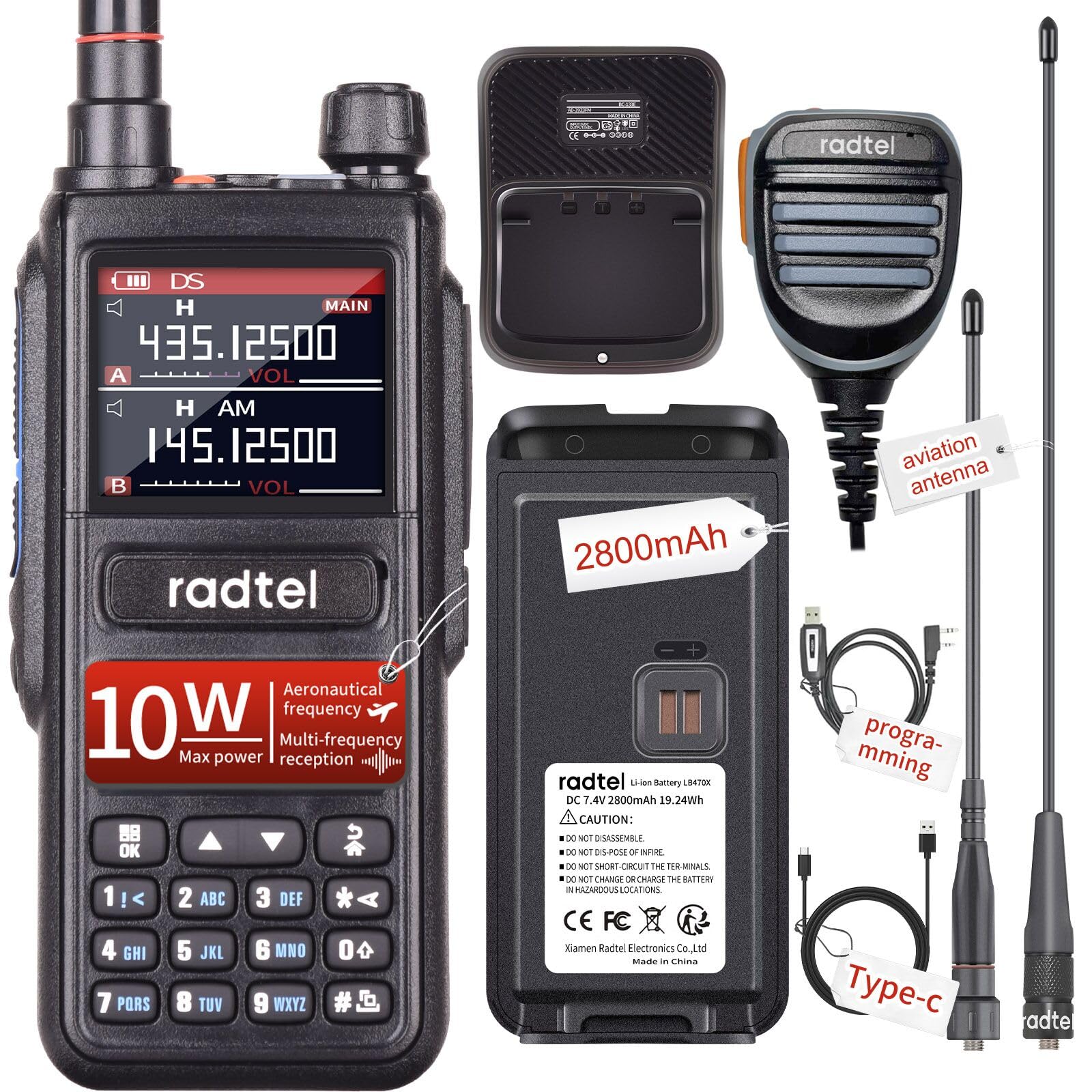
Radtel RT-470 10-Watt Tri-Band Radio Review: A Comprehensive Look


The Radtel RT-470 is a powerful and versatile tri-band radio designed for amateur radio enthusiasts, emergency communication, and outdoor adventurers. Featuring 10 watts of output power, a wide frequency range, and NOAA weather alerts, this radio provides an excellent balance of performance and portability. In this review, we will examine the key features, usability, build quality, and overall performance of the RT-470 to help you determine if it is the right choice for your communication needs.

Key Features

The Radtel RT-470 stands out in the market due to its impressive feature set. Some of the most notable aspects of this radio include:

  • Tri-Band Frequency Coverage: The RT-470 supports 136-174MHz (VHF), 400-620MHz (UHF), and 1.25-meter bands, making it highly versatile for different communication environments.

  • 10-Watt Power Output: With up to 10 watts of power, this radio provides solid transmission capabilities, improving range and reliability in both urban and remote locations.

  • 256 Programmable Channels: It supports 256 memory channels, allowing users to store frequently used frequencies for quick access.

  • NOAA Weather Alerts and FM Radio: The built-in NOAA weather receive function ensures users stay informed about severe weather conditions, while the FM radio feature adds entertainment value.

  • Air Band Reception: The ability to receive air band frequencies makes it useful for aviation enthusiasts and monitoring airport communications.

  • Long-Lasting Battery: Equipped with a high-capacity battery, the RT-470 provides extended operational time, making it reliable for long outings.

  • Dual Display and Dual Standby: The large LCD screen with a dual-frequency display allows users to monitor two channels at once, improving situational awareness.

Build Quality and Design

The RT-470 is constructed with durability in mind, featuring a rugged casing that can withstand moderate drops and rough handling. The ergonomic design makes it comfortable to hold for extended periods, and the buttons are well-spaced for easy operation even when wearing gloves. The large backlit LCD display is clear and readable, making it easy to use in low-light conditions.

Performance and Usability

In real-world testing, the Radtel RT-470 performs exceptionally well in various environments. The 10-watt transmission power enhances signal reach, particularly in open areas, while the tri-band capability allows for greater flexibility across different communication bands. Users report clear audio quality, with minimal background noise and distortion, even in challenging conditions.

Programming the RT-470 can be done manually, but using software is recommended for efficiency. The menu system is intuitive, making it easy for both beginners and experienced radio users to navigate. Battery life is another strong point, as the device holds up well under continuous use.

Pros and Cons

Pros:

  • Strong 10-watt output improves range and clarity

  • Tri-band support increases flexibility for different communication needs

  • Air band reception is a bonus for aviation monitoring

  • NOAA weather alerts keep users informed of emergencies

  • Long battery life ensures reliability in the field

  • Durable build quality for outdoor and emergency use

  • Dual standby mode enhances multitasking capabilities

Cons:

  • Programming software is necessary for full customization, which may be challenging for beginners

  • Antenna performance can be improved with aftermarket options

  • Size is slightly bulkier compared to lower-powered models

Final Verdict

The Radtel RT-470 is an excellent choice for users who need a powerful, versatile, and reliable tri-band radio. Its 10-watt output, broad frequency coverage, and NOAA weather alerts make it suitable for ham radio operators, emergency responders, outdoor enthusiasts, and aviation monitors. While manual programming may take some learning, the overall functionality and performance make this radio a great investment for those looking for a feature-rich communication device.

If you are looking for a robust and flexible handheld radio, the Radtel RT-470 is definitely worth considering.

Visit Radtel To See The RT-470!

Monday, November 11, 2024

In-Depth Review: BTECH UV-5X3 Tri-Band Radio – A Powerful and Customizable Handheld


Amateur radio operators often seek radios that offer high performance, versatility, and value for money. The BTECH UV-5X3 Tri-Band Radio stands out as a powerful handheld transceiver that checks all these boxes and more. Building on the success of its predecessor, the UV-5R, BTECH’s UV-5X3 takes things a step further by offering tri-band capabilities, higher power output, and a range of customizable features. Coupled with a comprehensive accessory bundle and the convenience of USB-C charging, the UV-5X3 has become a popular choice for both new and seasoned ham radio operators. In this review, we’ll dive into the key features, performance, and overall value of the BTECH UV-5X3 to help you determine if it’s the right radio for your needs.

Key Features of the BTECH UV-5X3 Tri-Band Radio

  1. Tri-Band Operation (VHF, 1.25M, UHF)
    The UV-5X3 distinguishes itself with its tri-band capabilities, allowing users to access three key frequency bands:

    • VHF (136-174 MHz): Ideal for local communications and emergency services.
    • 1.25M (222-225 MHz): The 1.25-meter band offers less congestion and is favored by some amateur operators for regional communications.
    • UHF (400-520 MHz): Commonly used for urban communications and repeater access.

    This tri-band functionality is a significant advantage over standard dual-band radios, as it offers more flexibility in terms of available frequencies and operating environments.

  2. High Power Output
    The BTECH UV-5X3 offers a selectable power output of up to 8 watts (compared to the 5-watt output found in many entry-level handheld radios). This high power provides extended range and better penetration, especially in urban environments or when operating through repeaters. For more localized communications, you can switch to lower power modes (1W, 4W, or 8W) to preserve battery life and reduce interference.

  3. Improved Display and Interface
    The UV-5X3 features a clear and bright LCD display, making it easier to read the screen even in low-light conditions. The display offers important information such as frequency, power level, and signal strength. The user interface is intuitive, with dedicated buttons for frequently used features like volume, squelch, and memory channels. BTECH has also improved the ergonomics of the radio, making it comfortable to hold for extended periods, especially for operators who need to multitask during long communication sessions.

  4. Wide Frequency Coverage
    In addition to the standard amateur radio bands, the UV-5X3 also covers airband, marine bands, and general utility frequencies. This makes the UV-5X3 a versatile tool for a variety of uses beyond just amateur radio, including scanning for local emergency services or aircraft communications.

  5. Customizable Features and Programmability
    One of the standout features of the UV-5X3 is its programmability. The radio comes with a software package (CHIRP-compatible) that allows users to create custom frequency lists, adjust settings, and even program the radio from their PC. The UV-5X3 also includes 128 programmable memory channels, enabling users to store frequently used frequencies for easy access.

  6. Dual Watch and Dual Receive
    The UV-5X3 supports dual watch functionality, meaning it can listen to two different frequencies simultaneously. This is useful if you need to monitor two channels at once or listen to a primary frequency while keeping an ear on emergency communications or local repeaters.

  7. USB-C Charging Port
    In a notable upgrade from earlier models, the UV-5X3 features a USB-C charging port, which offers faster and more reliable charging compared to older micro-USB standards. This is particularly convenient for modern users who may already have USB-C cables for other devices. The radio can also be charged via an external charging dock (included in the bundle).

  8. Battery Life
    The UV-5X3 is equipped with a 1800mAh battery, which provides sufficient power for hours of use at lower power settings. Battery life will vary depending on the power output and usage, but most users can expect up to 10-12 hours of operation on a single charge with moderate use. For those engaging in longer communication sessions, spare batteries are available for purchase, and the USB-C charging option ensures that keeping the radio topped off is straightforward.

  9. Comprehensive Accessory Bundle
    The BTECH UV-5X3 comes with an extensive bundle of accessories, adding significant value to the purchase:

    • Antennas: The radio includes both a standard rubber duck antenna and a high-gain antenna, providing enhanced reception and transmission capabilities depending on the frequency you’re using.
    • Charger Dock: The included charging dock allows for convenient drop-in charging of the radio, though USB-C charging can be done via an external cable as well.
    • Belt Clip: A sturdy belt clip is included, making it easy to carry the radio hands-free.
    • Earpiece and Mic: For hands-free operation, an earpiece and microphone combo are included.
    • Li-ion Battery: The rechargeable Li-ion battery is pre-installed and ready to use.
    • User Manual: A detailed user manual is included, though some operators may need additional research to fully leverage the radio's capabilities, especially for more advanced settings.

Performance and Usability

The BTECH UV-5X3 offers solid performance across all three bands. The radio provides good range on both VHF and UHF frequencies, with noticeably stronger signal quality compared to other handheld radios in its price range. The increased power output allows for clearer, longer-range communications, particularly in rural areas or when using repeaters.

In terms of audio quality, the UV-5X3 delivers crisp and clear sound, even when operating at higher output levels. The built-in speaker is loud enough to be heard in noisy environments, and the radio includes a VOX (voice-activated) mode, allowing hands-free operation when using a compatible headset.

The dual watch and dual receive modes are useful for operators who need to monitor multiple frequencies, though there is a slight drawback in that the radio will prioritize one frequency over the other, which may cause delays in real-time communication.

For more advanced users, the UV-5X3’s compatibility with CHIRP software and the ability to customize channels and settings is a big draw. The ease of programming through a PC, combined with the intuitive manual programming interface, makes the radio highly adaptable to different operating styles.

Pros and Cons of the BTECH UV-5X3

Pros:

  • Tri-band operation (VHF, 1.25M, UHF) provides more frequency options than typical dual-band radios.
  • High power output up to 8W extends range and provides better penetration through obstructions.
  • USB-C charging is a modern convenience that makes charging faster and more reliable.
  • Comprehensive accessory bundle includes everything needed to get started right out of the box.
  • Customizable and programmable with 128 memory channels and CHIRP compatibility.
  • Dual-watch/dual-receive functionality allows for monitoring two frequencies at once.
  • High build quality and ergonomic design for comfortable extended use.

Cons:

  • Size and weight: At 5.5 x 2.4 x 1.3 inches and around 9 ounces, it’s slightly larger and heavier than some ultra-compact handheld radios, which might be a downside for operators seeking portability above all.
  • Advanced features may be intimidating for beginner users, though the manual provides a good starting point for learning.
  • Limited range on 1.25M band: While the 1.25M band is useful for regional communications, it’s not as widely used, and some users may find fewer repeaters or stations on this band.

Conclusion

The BTECH UV-5X3 Tri-Band Radio offers a compelling combination of power, versatility, and value for amateur radio operators. With its tri-band capabilities, high power output, customizable features, and modern conveniences like USB-C charging, it’s a solid choice for both newcomers and experienced hams. The comprehensive accessory bundle further enhances the value proposition, making the UV-5X3 an excellent all-in-one solution for those looking to upgrade their handheld radio experience.

If you’re in the market for a feature-rich, reliable, and powerful radio that can handle a variety of communication needs, the BTECH UV-5X3 is definitely worth considering. Whether you're monitoring local traffic, engaging in emergency preparedness, or just enjoying the hobby, this radio has the tools to get the job done with ease and reliability.

Check Out The UV-5X3 On Amazon!

Tuesday, October 8, 2024

In-Depth Review of the Radtel RT-470X Tri-Band Ham Radio


The Radtel RT-470X Tri-Band Ham Radio has garnered attention in the amateur radio community for its versatility and functionality. With capabilities that span aviation air bands, NOAA weather channels, police scanning, and marine communications, it positions itself as a comprehensive communication tool. This review will delve into its features, performance, usability, and overall value for both amateur radio enthusiasts and professionals.

Key Features

1. Tri-Band Capability

The RT-470X supports three frequency bands: VHF (136-174 MHz), UHF (400-480 MHz), and aviation air bands (108-137 MHz). This tri-band functionality makes it suitable for a variety of communication needs, including amateur radio operations, monitoring aviation communications, and emergency services.

2. 256 Channels

With a memory capacity of 256 channels, users can program their most-used frequencies, allowing for quick access to essential communication channels. This feature is particularly beneficial in emergency situations where rapid response is critical.

3. NOAA Weather Channels

The inclusion of NOAA weather channels ensures that users can stay informed about real-time weather updates, which is essential for outdoor activities and emergency preparedness. This is a significant advantage for those who frequently engage in hiking, boating, or other outdoor pursuits.

4. Police Scanner Functionality

The RT-470X allows users to monitor police and other emergency service frequencies, making it a useful tool for community awareness and safety. This feature can help users stay informed about local incidents and emergencies.

5. Marine Communication

For boating enthusiasts, the radio supports marine frequencies, providing an essential tool for communication on the water. This is critical for safety, especially when navigating remote areas.

6. Long Range Transmission

The RT-470X boasts a long-range transmission capability, which is vital for both amateur radio operators and professionals who require reliable communication over extended distances.

7. USB-C Charging

The radio features a USB-C charging port, making it convenient to charge with modern cables and providing faster charging times compared to older models.

8. Wireless Frequency Copying

One standout feature is the ability to wirelessly copy frequencies from another radio. This is particularly useful for users who want to quickly set up their radio without manually entering frequencies.

Design and Build Quality

The Radtel RT-470X is designed with portability in mind. Its compact size and lightweight construction make it easy to carry during outdoor activities or while on duty. The rugged design is also a plus, as it can withstand rough handling typical of outdoor use.

The interface is user-friendly, featuring a clear LCD display that shows channel information, signal strength, and battery status. The buttons are well-placed and responsive, allowing for easy navigation through the various functions and settings.

Performance

Audio Quality

The audio quality of the RT-470X is commendable, with clear sound transmission and reception. Whether communicating with fellow ham radio operators or monitoring emergency channels, users can expect minimal distortion and clear audio.

Reception and Transmission

In terms of reception, the RT-470X performs well across all supported bands. Users have reported effective communication over several miles, particularly in open areas. The radio’s ability to pick up signals in urban environments is also impressive, although some interference may occur due to obstructions.

Battery Life

Battery life is another crucial aspect for any handheld transceiver. The RT-470X comes with a robust battery that offers extended use on a single charge, especially when used at lower power settings. The USB-C charging feature ensures that users can quickly recharge the device, minimizing downtime.

Usability

For both novice and experienced users, the RT-470X is relatively easy to set up and operate. The manual provides clear instructions for programming channels and accessing features. However, beginners may take some time to familiarize themselves with the various settings and functionalities, especially with advanced features like frequency copying.

Pros and Cons

Pros

  • Versatile Functionality: Supports tri-band communication, NOAA, police scanning, and marine frequencies.
  • User-Friendly Interface: Easy to navigate with a clear display.
  • Compact and Durable: Lightweight design suited for outdoor use.
  • Excellent Audio Quality: Clear transmission and reception.
  • Long Battery Life: Extended usage with quick recharging via USB-C.

Cons

  • Learning Curve for Beginners: Some features may be complex for new users.
  • Limited Advanced Features: While it covers the basics well, it may lack advanced functionalities found in higher-end models.

Conclusion

The Radtel RT-470X Tri-Band Ham Radio stands out as a versatile and reliable communication tool for a wide range of users. Its tri-band capability, extensive channel memory, and additional features like NOAA and police scanning make it an excellent choice for both amateur radio enthusiasts and professionals.

While there may be a slight learning curve for those new to ham radio, the overall user-friendly design and robust performance make it a worthy investment. Whether you're exploring the outdoors, boating, or just wanting to stay informed about local emergencies, the RT-470X offers a comprehensive solution that is hard to beat.

Have A Look At The Radtel RT-470X On Amazon!

Monday, October 7, 2024

In-Depth Review of the TYT TH-350 Tri-Band Radio


Introduction

The TYT TH-350 Tri-Band Radio is a versatile and robust analog transceiver designed for amateur radio enthusiasts. Covering the 2-meter (144-148 MHz), 1.25-meter (220-225 MHz), and 70-centimeter (430-450 MHz) bands, this radio is tailored for users who require a reliable communication tool for various applications, whether it be for local communication or during outdoor adventures. This review will delve into its features, performance, build quality, usability, and overall value.

Key Features

1. Tri-Band Coverage

The TH-350's capability to operate across three bands makes it an excellent choice for those who need flexibility. Each band has its unique applications:

  • 2 Meters (144-148 MHz): Ideal for local communication and emergency services.
  • 1.25 Meters (220-225 MHz): Less crowded than 2 meters, offering unique repeaters and channels.
  • 70 Centimeters (430-450 MHz): Popular for both local communication and longer-distance operations.

2. Analog Operation

While digital modes are gaining popularity, the TH-350 stays true to analog, providing users with a straightforward interface. This simplicity allows for quick adjustments and is often preferred by traditionalists who enjoy the tactile experience of analog controls.

3. Power Output

The radio boasts a power output of up to 5 watts, adjustable to meet the needs of different communication scenarios. While this may not be as powerful as some of its competitors, it strikes a balance between portability and performance, making it suitable for most casual users.

4. Compact Design

Measuring approximately 5.5 x 2.5 x 6.5 inches and weighing around 1.5 pounds, the TH-350 is compact and lightweight. This portability makes it ideal for mobile use or for those who want a radio that won’t take up too much space.

5. User-Friendly Interface

The front panel features a straightforward layout with clear knobs and buttons for adjusting volume, squelch, and frequency. The LCD screen is easy to read, even in bright sunlight, making it user-friendly in various environments.

6. Memory Channels

The TH-350 includes 128 memory channels, allowing users to store frequently used frequencies for quick access. This feature is particularly beneficial for those who frequently switch between different repeaters or channels.

Performance

Reception

The reception quality of the TH-350 is commendable, providing clear audio on all three bands. The receiver handles interference well, thanks to its good selectivity and sensitivity. Users have reported successful communication even in areas with moderate noise.

Transmission

While the 5-watt power output may limit its range compared to higher-powered transceivers, the TH-350 is capable of clear transmissions over reasonable distances, particularly on the 2-meter band. Users have reported effective communication up to 10-15 miles under optimal conditions, which is satisfactory for local use.

Battery Life

Equipped with a standard battery, the TH-350 can run for several hours on a single charge, depending on usage. The efficiency of the device allows for extended use during outings, though users should consider carrying a backup battery for longer excursions.

Build Quality

The construction of the TH-350 is robust and durable, designed to withstand the rigors of outdoor use. The knobs and buttons have a solid feel, and the chassis is well-built. However, it’s worth noting that, like many portable radios, it may not be as rugged as higher-end models designed for extreme conditions.

Usability

The TH-350 shines in terms of usability. Its simple analog interface allows users of all experience levels to operate it without extensive training. The controls are intuitive, and the well-laid-out user manual provides clear instructions for setting up and using the radio.

The inclusion of the memory channel feature significantly enhances its usability, allowing quick access to preferred frequencies. Additionally, the compact design makes it easy to transport and operate in various settings.

Limitations

While the TYT TH-350 has many strengths, it does have some limitations:

  • Power Output: The 5-watt limit may be insufficient for users needing longer range communications.
  • Limited Memory Channels: With only 128 memory slots, more advanced users may find this lacking.
  • Analog Only: For users who prefer digital modes, this radio may not meet their needs.

Conclusion

The TYT TH-350 Tri-Band Radio offers a solid blend of performance, usability, and portability for amateur radio enthusiasts. Its tri-band coverage, coupled with a user-friendly interface, makes it suitable for both novice and experienced operators. While it may not compete with high-end models in terms of power output and features, it provides excellent value for those who prioritize simplicity and reliability.

For anyone seeking a reliable, compact, and straightforward analog radio for local communication, the TYT TH-350 is a commendable choice. Its affordable price point, combined with its effective performance across three bands, makes it a worthy addition to any amateur radio collection.

Have A Look At The TYT TH-350 On Amazon

Thursday, October 3, 2024

Review of the AnyTone AT-D578UVIII Plus Tri-Band DMR Mobile Radio


The AnyTone AT-D578UVIII Plus has made quite a name for itself in the world of amateur radio enthusiasts, combining advanced digital communication capabilities with a user-friendly interface. This tri-band DMR (Digital Mobile Radio) mobile radio stands out not only for its performance but also for its versatility. In this review, we’ll dive into the features, performance, and overall value of the AT-D578UVIII Plus.

Key Features

Tri-Band Operation

One of the standout features of the AT-D578UVIII Plus is its tri-band functionality, covering VHF (144-148 MHz), UHF (420-450 MHz), and the 1.2 GHz (902-928 MHz) bands. This wide coverage allows operators to access various repeaters and participate in different communication networks, making it a great choice for both local and distant communications.

DMR Capabilities

The DMR functionality is another significant advantage. The AT-D578UVIII Plus supports both Tier I and Tier II DMR operations, allowing for clear and reliable digital communications. The radio can handle both digital and analog signals, providing flexibility for users transitioning between modes. Its ability to store up to 100,000 contacts and 200,000 DMR IDs makes it suitable for large networks.

User-Friendly Interface

The radio features a large, full-color display that is easy to read in various lighting conditions. The intuitive menu navigation simplifies accessing the multitude of features, while customizable shortcuts enhance user experience. The integrated GPS functionality is also a plus, offering location services for both personal use and group communications.

Advanced Features

The AT-D578UVIII Plus comes packed with advanced features, including:

  • Dual Watch: Monitor two channels simultaneously, which is ideal for those who need to keep track of multiple conversations.
  • Programmable Keys: Customizable buttons allow users to set shortcuts for frequently used functions.
  • Wideband Receiver: The receiver can pick up a wide range of frequencies, including FM radio, which is a nice bonus for casual listening.
  • High Power Output: With up to 50 watts of output power, the radio ensures strong transmission capabilities, crucial for long-range communications.

Build Quality

The AT-D578UVIII Plus is designed for durability. Its robust construction and well-placed controls provide a solid feel, whether you’re mounting it in a vehicle or using it in a stationary setup. The built-in cooling fan helps manage heat during extended use, which is a thoughtful touch for maintaining performance.

Performance

In real-world usage, the AT-D578UVIII Plus delivers exceptional performance. The audio quality is clear, both in analog and digital modes, making conversations crisp and intelligible. During tests, the DMR functionality worked flawlessly, allowing seamless communication with other DMR users. The range was impressive, even in areas with heavy obstructions.

The GPS functionality was responsive, providing accurate location data, which is particularly useful for group communications in emergency situations or for those participating in public service events.

Value for Money

Priced competitively within the mobile radio market, the AT-D578UVIII Plus offers great value for its feature set and performance. While there are cheaper options available, the combination of tri-band capabilities, DMR support, and advanced features justifies its price point for serious radio enthusiasts.

Conclusion

The AnyTone AT-D578UVIII Plus Tri-Band DMR Mobile Radio is a powerful tool for amateur radio operators looking for versatility and reliability. With its tri-band operation, robust DMR capabilities, and user-friendly design, it caters to both newcomers and seasoned veterans alike. If you’re in the market for a mobile radio that doesn’t compromise on performance or features, the AT-D578UVIII Plus is a worthy investment that will serve you well in a variety of communication scenarios.

Have a Look at The Anytone AT-D578UVIII Plus On Amazon

Radioddity DB35-UV Dual Band Mobile Radio 35W Review

The Radioddity DB35-UV is a compact dual-band mobile radio designed for amateur radio operators who want more capability than a handheld...

Search This Blog