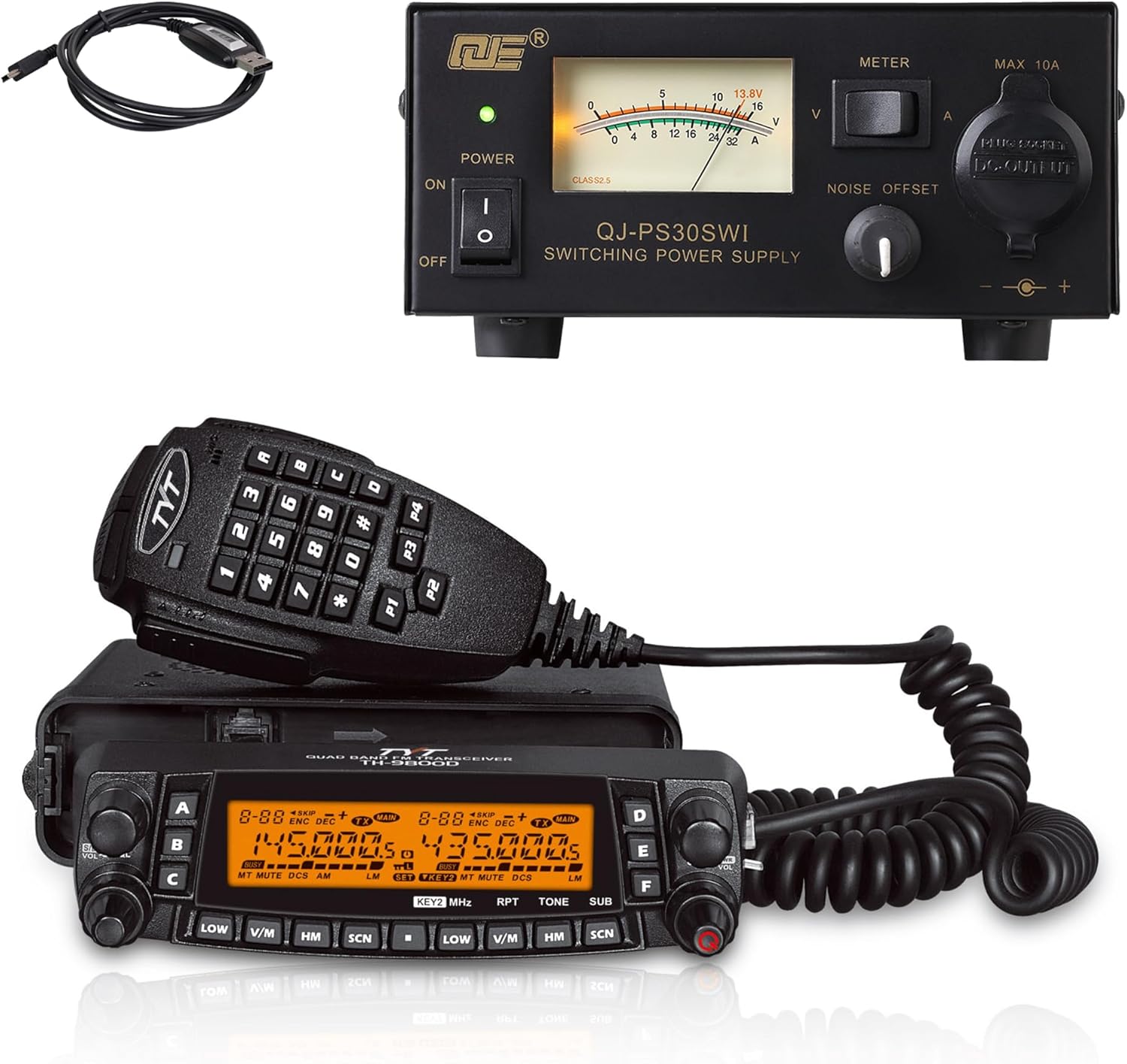
The TH-9800D Quad Band Mobile Ham Radio Transceiver paired with the Switching Mode DC Regulated Power Supply PS30SW is a feature-rich communications solution designed to meet the needs of amateur radio operators seeking flexibility, performance, and value in a mobile or base setup. This review takes an in-depth look at its design, functionality, usability, performance, and overall value for hobbyists ranging from beginners to experienced hams.
Design and Build Quality
The TH-9800D presents a robust and practical design typical of mobile transceivers intended for both fixed and mobile installations. The chassis feels solid and durable, with connectors and mounting points engineered to withstand the vibration and movement encountered in vehicle installations. The faceplate layout is logical, with clearly labeled buttons and knobs that facilitate intuitive operation even for newer operators.
The included switching mode DC regulated power supply, the PS30SW, complements the radio by providing a stable DC source for bench or base use. Its regulated output ensures that the transceiver receives consistent voltage, which can improve overall performance and longevity. The power supply itself is compact enough to fit into cramped workspaces yet sturdy enough for regular use.
Frequency Coverage and Features
A standout aspect of the TH-9800D is its quad band capability. It covers four amateur bands in one unit, which typically include the 6 meter, 10 meter, 2 meter, and 70 centimeter bands. This broad coverage allows operators to switch between frequencies without needing multiple radios, making the TH-9800D a versatile choice for VHF and UHF operation.
The radio incorporates a range of features that enhance functionality. These often include:
Transmit and receive functions across multiple modes, including FM and potentially other modes depending on implemented firmware
Memory channels for storing favorite frequencies
Scanning functions to monitor multiple channels
Automatic squelch and noise reduction to improve audio clarity
Roger beep, dual watch, and cross band repeat capabilities
These features contribute to a flexible and capable radio that can serve well in both local communications and more advanced scenarios such as repeater access or emergency communications.
User Interface and Controls
The control interface of the TH-9800D is designed for straightforward operation. The large main tuning knob allows quick frequency changes, while secondary knobs and buttons provide access to functions like volume, squelch, menu navigation, and band selection. The display, typically a backlit LCD, offers clear readouts of frequency, mode, and other relevant status information.
For many users, the menu system strikes a reasonable balance between simplicity and depth. Core functions are easily accessible, while more advanced settings are tucked into deeper menus. Users familiar with ham radio equipment will likely find the learning curve moderate and manageable.
Performance and Reception Quality
In terms of reception, the TH-9800D performs well for a mobile quad band transceiver. Sensitivity on VHF and UHF bands is generally solid, capturing weak signals with clarity. The noise reduction features help cut down on background hiss and static on busy bands. Audio output through the internal or external speaker is typically clear and intelligible.
Transmission power varies by band, but the unit usually provides sufficient output for effective local communication and repeater access. Reports from contacts indicate that the radio’s signal is clean and stable, with minimal distortion when properly tuned and configured.
The PS30SW power supply plays a critical role in performance during base use. By stabilizing the input voltage to the radio, it helps prevent fluctuations that can degrade transmission quality or lead to erratic behavior. The supply is reasonably efficient and operates quietly, so it does not introduce distracting hum or interference into the shack.
Installation and Setup
Installing the TH-9800D in a vehicle or base station is straightforward for those with basic technical skills. The radio includes standard mounting hardware for mobile installation and a microphone, antenna connectors, and power connections that follow industry norms. Antenna selection and placement are crucial for optimal performance, as with any radio, but the TH-9800D interfaces cleanly with typical VHF and UHF antennas.
The PS30SW power supply requires only a mains connection and appropriate DC leads to the transceiver. It is important to ensure that all power connections are secure and that proper fusing is used to protect equipment and wiring.
Pros and Cons
Among the strengths of the TH-9800D and PS30SW combination are its versatile quad band coverage, solid build quality, and feature set that appeals to both novice and intermediate operators. The inclusion of a regulated power supply adds considerable value for those intending to use the radio in a base configuration.
On the downside, operators seeking the most advanced digital modes or ultra-high-end audio processing might find the TH-9800D somewhat limited compared with premium standalone transceivers. Menu navigation can seem a bit dated compared to newer touch or graphic-intensive interfaces. Additionally, the user manual and documentation may require clarification for certain advanced functions, which could frustrate new users.
Overall Value and Recommendation
Overall, the TH-9800D Quad Band Mobile Ham Radio Transceiver with the PS30SW power supply offers excellent value for amateur radio enthusiasts looking for a robust, multi-band radio capable of both mobile and base operation. Its broad band coverage and versatile feature set make it suitable for everyday use as well as experimentation and local network participation.
This package is particularly recommended for those who want to consolidate multiple bands into one unit and appreciate the convenience of an included regulated power supply. While it may not match the sophistication of high-end transceivers, it delivers reliable performance, good audio quality, and a practical feature set that will satisfy many operators.
For anyone entering the hobby or upgrading from a single-band rig, the TH-9800D with the PS30SW stands out as a capable and cost-effective choice that balances performance with ease of use.